






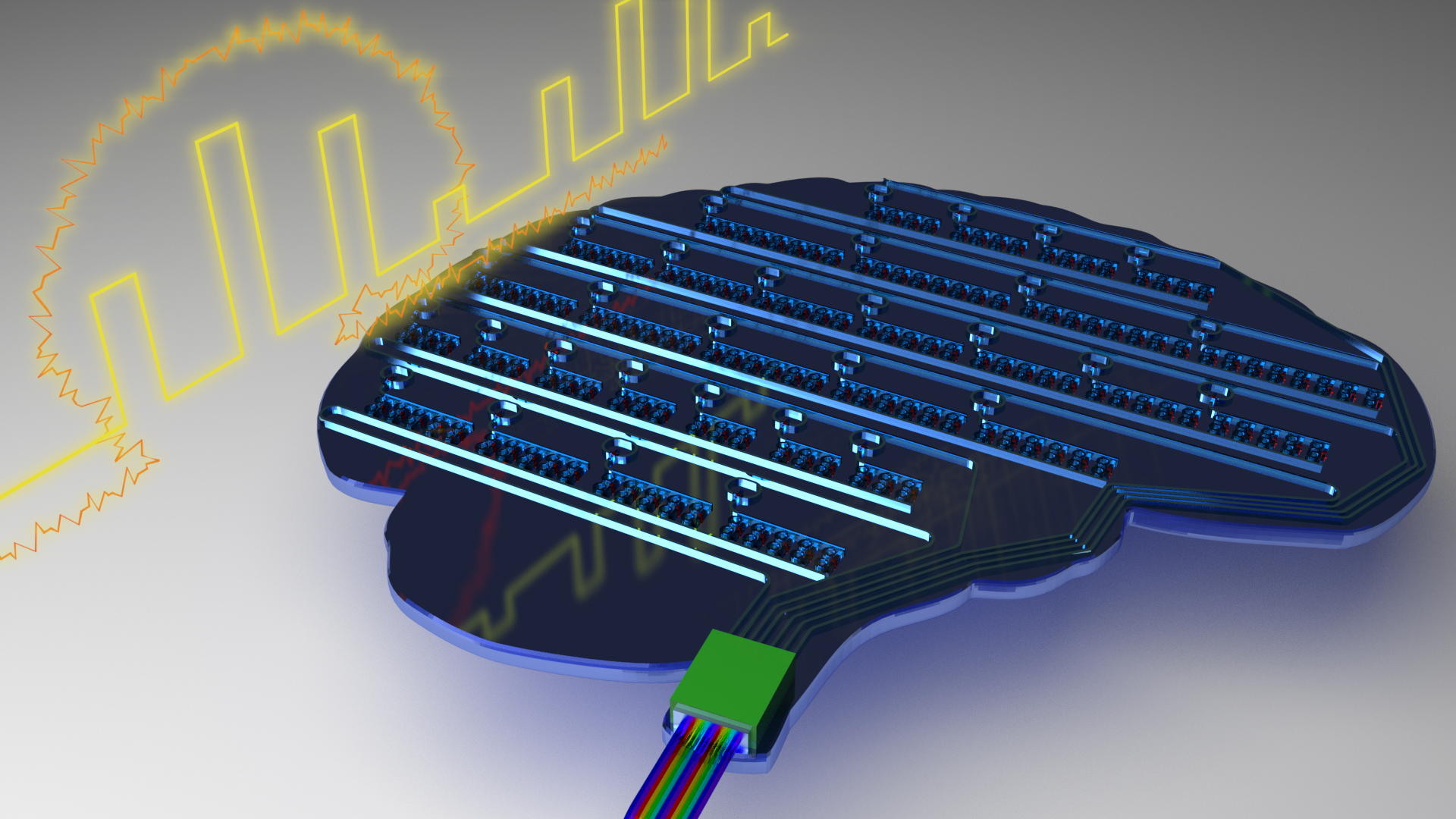
Step towards Light-based, Brain-like Computing Chip

Schematic illustration of a light-based, brain-inspired chip. By mimicking biological neuronal systems, photonic neuromorphic processors provide a promising platform to tackle challenges in machine learning and pattern recognition.© Johannes Feldman

Scientists have succeeded in developing a piece of hardware which could pave the way for creating computers resembling the human brain. They produced a chip containing a network of artificial neurons that works with light and can imitate neurons and their synapses. This network is able to ‘learn’ information and use this as a basis for computing. The approach could be used later in many different fields for evaluating patterns in large quantities of data.

The researchers were able to demonstrate, that such an optical neurosynaptic network...

Read More

Does Insulin Resistance cause Fibromyalgia?


Effect of metformin treatment on pain as measured by the NPRS (0–10 scale).

A newly confirmed link with insulin resistance may radically change the way fibromyalgia and related forms of chronic pain are identified and managed. Researchers led by a team from The University of Texas Medical Branch at Galveston were able to dramatically reduce the pain of fibromyalgia patients with medication that targeted insulin resistance.

This discovery could dramatically alter the way that chronic pain can be identified and managed. Dr. Miguel Pappolla, UTMB professor of neurology, said that although the discovery is very preliminary, it may lead to a revolutionary shift on how fibromyalgia and related forms of chronic pain are treated...

Read More

New Clues about how Ancient Galaxies Lit up the Universe

Spiral galaxy (stock illustration).
Credit: © Alexandr Mitiuc / Adobe Stock

NASA’s Spitzer Space Telescope has revealed that some of the Universe’s earliest galaxies were brighter than expected. The excess light is a by-product of the galaxies releasing incredibly high amounts of ionising radiation. The finding offers clues to the cause of the Epoch of Reionisation, a major cosmic event that transformed the universe from being mostly opaque to the brilliant starscape seen today.

Researchers report on observations of some of the first galaxies to form in the universe, less than 1 billion years after the big bang (or a little more than 13 billion years ago)...

Read More

Plastic gets a do-over: Breakthrough Discovery Recycles Plastic from the Inside

Unlike conventional plastics, the monomers of PDK plastic could be recovered and freed from any compounded additives simply by dunking the material in a highly acidic solution. (Credit: Peter Christensen et al./Berkeley Lab)

Scientists have made a next-generation plastic that can be recycled again and again into new materials of any color, shape, or form. Because plastics contain various additives, like dyes, fillers, or flame retardants, very few plastics can be recycled without loss in performance or aesthetics. Even the most recyclable plastic, PET – or poly(ethylene terephthalate) – is only recycled at a rate of 20-30%, with the rest typically going to incinerators or landfills, where the carbon-rich material takes centuries to decompose.

Now a team of researchers at the U.S...

Read More