






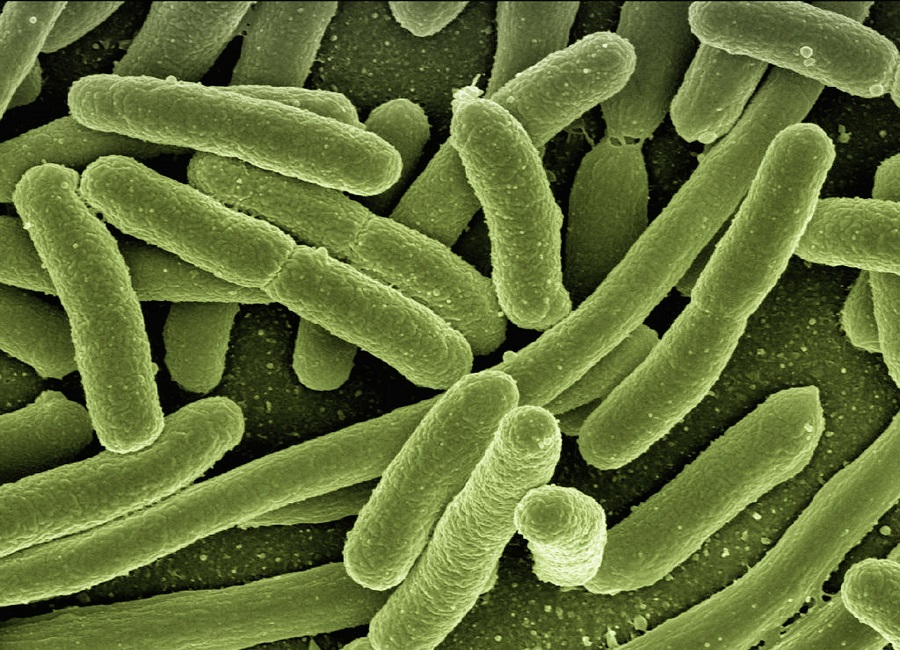
How ‘Superbug’ E. coli clones take over human Gut

The researchers investigated how and why a clone of E. coli called ST131 – dubbed a ‘superbug’ because it is resistant to multiple drugs – has become the major cause of drug resistant E. coli infections

A ‘superbug’ clone of E. coli has evolved to prevent itself from becoming so dominant that it could potentially wipe out the bacteria from existence, scientists led by the University of Birmingham have discovered.

The researchers investigated how and why a clone of E. coli called ST131 – dubbed a ‘superbug’ because it is resistant to multiple drugs – has become the major cause of drug resistant E. coli infections, but not so dominant that it has wiped out other clones that do not have multi-drug resistance.

Escherichia coli (E...

Read More

Proofreading the book of life: Gene Editing made Safer

The graphic illustrates the technique described in the new study. A version of the Cas9 protein used in CRISPR gene editing has been mutated. While this protein, seen in blue, retains its proper functioning, it remains “immunosilent”–hidden from predation as a foreign entity by the immune system’s T cells (seen in brown).
Credit: Graphic by Jason Drees

Scientists describe a method of rendering the gene editing tool CRISPR-Cas9 ‘immunosilent,’ potentially allowing the editing and repair of genes to be accomplished reliably and stealthily...

Read More

Rapid Destruction of Earth-like Atmospheres by Young Stars

© qimono/Pixabay/Pixabay license

Researchers show young stars rapidly destroy Earth-like Nitrogen dominated atmospheres. Fundamentally important for the habitability of a planet is whether or not it can hold onto an atmosphere, which requires that the atmosphere is not completely lost early in the lifetime of the planet. A new study by researchers based at the University of Vienna and at the Space Research Institute of the ÖAW in Graz has shown that young stars can rapidly destroy the atmospheres of potentially-habitable Earth-like planets, which is a significant additional difficulty for the formation of life outside our solar system. The results will appear soon in the journal Astronomy & Astrophysics Letters.

Much recent research has focused on planets orbiting stars called M-dwa...

Read More

Quantum Gas turns Supersolid

Several tens of thousands of particles spontaneously organize in a self-determined crystalline structure while sharing the same macroscopic wavefunction — hallmarks of supersolidity.
Credit: Uni Innsbruck

Researchers report on the observation of supersolid behavior in dipolar quantum gases of erbium and dysprosium. In the dysprosium gas these properties are unprecedentedly long-lived. This sets the stage for future investigations into the nature of this exotic phase of matter.

Supersolidity is a paradoxical state where the matter is both crystallized and superfluid. Predicted 50 years ago, such a counter-intuitive phase, featuring rather antithetic properties, has been long searched in superfluid helium...

Read More