






Spider Silk could be used as Robotic Muscle

The experimental setup used to study the behavior of spider dragline silk. The cylindrical chamber at center allowed for precise control of humidity while testing the contraction and twisting of the fiber.
Credit: Photo courtesy of the researchers

Unusual property of the ultrastrong material could be harnessed for twisting or pulling motions. Researchers have found that spider silk produces a strong twisting motion when exposed to humidity, and may be usable for future artificial muscles or actuators. Spider silk, already known as one of the strongest materials for its weight, turns out to have another unusual property that might lead to new kinds of artificial muscles or robotic actuators, researchers have found.

The resilient fibers, the team discovered, respond very strongly to ...

Read More

Exiled Planet Linked to Stellar Flyby 3 million years ago

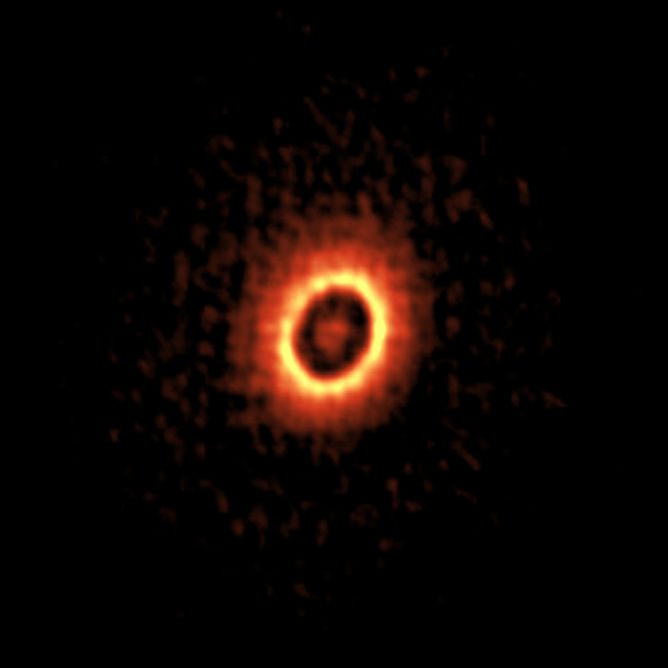
The HD 106906 binary star hosts a mysterious, asymmetric disk of cometary dust and a giant exoplanet HD 106906 b that is located very far from both the binary and the disk. Close flybys by other stars could have gravitationally perturbed the planet and researchers discovered that the two bright stars to the upper right passed near HD 106906 roughly 3 Myr years ago.
Credit: Paul Kalas, UC Berkeley

Two binary star systems narrowly missed one another, but left behind a smoking gun. Paul Kalas of UC Berkeley was puzzled by the tilted but stable orbit of a planet around a binary star – an orbit like that of our solar system’s proposed Planet Nine. He calculated backwards in time to see if any of the 461 nearby stars ever came close enough to perturb the system. One star fit the bill...

Read More

Exiled Planet Linked to Stellar Flyby 3 million years ago


Researchers explored a material that has an internal structure, shown in 3D in left panel, that consists of triangles and hexagons arranged in a pattern similar to that of a Japanese kagome basket.
Credit: Hasan, et. al, Princeton University

Two binary star systems narrowly missed one another, but left behind a smoking gun. Paul Kalas of UC Berkeley was puzzled by the tilted but stable orbit of a planet around a binary star – an orbit like that of our solar system’s proposed Planet Nine. He calculated backwards in time to see if any of the 461 nearby stars ever came close enough to perturb the system. One star fit the bill. The stellar flyby 2-3 million years ago likely stabilized the planet’s orbit, keeping it from flying away.

Some of the peculiar aspects of our solar system – an env...

Read More

Hiding Black Hole found

This is an artist’s impression of a gas cloud swirling around a black hole.
Credit: NAOJ

Astronomers have detected a stealthy black hole from its effects on an interstellar gas cloud. This intermediate mass black hole is one of over 100 million quiet black holes expected to be lurking in our Galaxy. These results provide a new method to search for other hidden black holes and help us understand the growth and evolution of black holes.

Black holes range in mass from about 5 times the mass of the Sun to supermassive black holes millions of times the mass of the Sun. Astronomers think that small black holes merge and gradually grow into large ones, but no one had ever found an intermediate mass black hole, hundreds or thousands of times the mass of the Sun.

A research team led by Shunya T...

Read More