
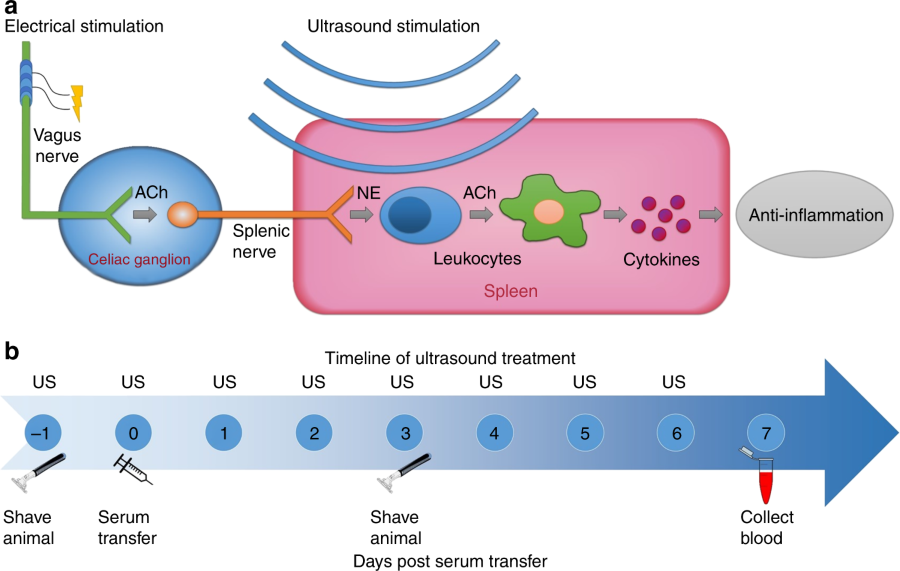
GE Research and Feinstein Institute for Medical Research bioelectronic medicine teams have demonstrated potentially breakthrough non-invasive methods to regulate dysfunction in the body’s metabolic or inflammatory control systems ...
Read More


Until we recognize the essential role of biology, our attempts to truly unify the universe will remain a train to nowhere. ~Robert Lanza Read More

Good health is not something we can buy. However, it can be an extremely valuable savings account. ~Anne Wilson Schaef Read More

The only way forward, if we are going to improve the quality of the environment, is to get everybody involved. ~Richard Rogers Read More

To raise new questions, new possibilities, to regard old problems from a new angle, requires creative imagination and marks real advance in science. ~Albert Einstein Read More

Old Newtonian physics claimed that things have an objective reality separate from our perception of them. Quantum physics, and particularly Heisenberg's Uncertainty Principle, reveal that, as our perception of an object changes, the object itself literally changes. ~Marianne Williamson Read More

Astronomy compels the soul to look upwards and leads us from this world to another. ~ Read More
March 12, 2019,
 Health/Medical, Biology/Biotechnology
GE Research and Feinstein Institute for Medical Research bioelectronic medicine teams have demonstrated potentially breakthrough non-invasive methods to regulate dysfunction in the body’s metabolic or inflammatory control systems ...
Read More
March 11, 2019,
Technology/Electronics, Physics

Rechargeable lithium metal batteries with increased energy density, performance, and safety may be possible with a newly-developed, solid-electrolyte interphase (SEI), according to Penn State researchers. As the demand for higher-energy-density lithium metal batteries increases – for electric vehicles, smartphones, and drones – stability of the SEI has been a critical issue halting their advancement because a salt layer on the surface of the battery’s lithium electrode insulates it and conducts lithium ions.
“This layer is very i...
Read More
Astronomers have discovered a binary star system with the closest high-mass young stellar objects ever measured, providing a valuable “laboratory” to test theories on high mass binary star formation.
An international team led by the University of Leeds has determined the distance between the massive young star PDS 27 and its orbiting stellar companion to be just 30 astronomical units away or 4.5 billion km...
Read More
March 10, 2019,
Biology/Biotechnology

Near-infrared technology pinpoints fluorescent probes deep within living tissue; may be used to detect cancer earlier. Many types of cancer could be more easily treated if they were detected at an earlier stage. MIT researchers have now developed an imaging system, named “DOLPHIN,” which could enable them to find tiny tumors, as small as a couple of hundred cells, deep within the body.
In a new study, the researchers used their imaging system, which relies on near-infrared light, to track a 0...
Read More
Recent Comments