To raise new questions, new possibilities, to regard old problems from a new angle, requires creative imagination and marks real advance in science.
~Albert Einstein
Read More
Old Newtonian physics claimed that things have an objective reality separate from our perception of them. Quantum physics, and particularly Heisenberg's Uncertainty Principle, reveal that, as our perception of an object changes, the object itself literally changes.
~Marianne Williamson
Read More
Saturn’s moon Mimas, imaged by the Cassini spacecraft. A new study shows how such small ice moons could sustain a liquid ocean beneath an icy shell, and how that could give rise to surface features. Credit: By NASA / JPL-Caltech / Space Science Institute – This image or video was catalogued by Jet Propulsion Laboratory of the United States National Aeronautics and Space Administration (NASA) under Photo ID: PIA12570., Public Domain, https://commons.wikimedia.org/w/index.php?curid=10371541
The outer planets of the solar system are swarmed by ice-wrapped moons. Some of these, such as Saturn’s moon Enceladus, are known to have oceans of liquid water between the ice shell and the rocky core and could be the best places in our solar system to look for extraterrestrial life...
Immunoregulatory mechanisms of kimchi. Credit: World Institute of Kimchi (WiKim)
Amid concerns about the simultaneous spread of multiple respiratory diseases, such as colds and influenza, with the change of seasons in current times, a clinical study has scientifically proven that kimchi, a traditional Korean fermented food, enhances the function of human immune cells and maintains the balance of the immune system.
The World Institute of Kimchi has reported the results of a single-cell genetic analysis that suggests that kimchi consumption has immunomodulatory effects, which include the suppression of excessive immune responses while simultaneously enhancing defense functions.
The results of the research are published in npj Science of Food.
3D printed polymer-based concrete structures. Credit: Advanced Composites and Hybrid Materials (2025). DOI: 10.1007/s42114-025-01456-1
Researchers at Oregon State University have developed a quick-setting, environmentally friendly alternative to concrete they hope can one day be used to rapidly 3D print homes and infrastructure.
Also known as additive manufacturing, 3D printing is already being used to help solve construction challenges such as the global housing crisis that’s emerged as Earth’s population approaches 8.5 billion.
But cement, the binding agent in concrete, accounts for about 8% of the planet’s carbon dioxide emissions, and concrete’s curing time—which can be multiple days—and required structural supports can inhibit progress on construction projects.
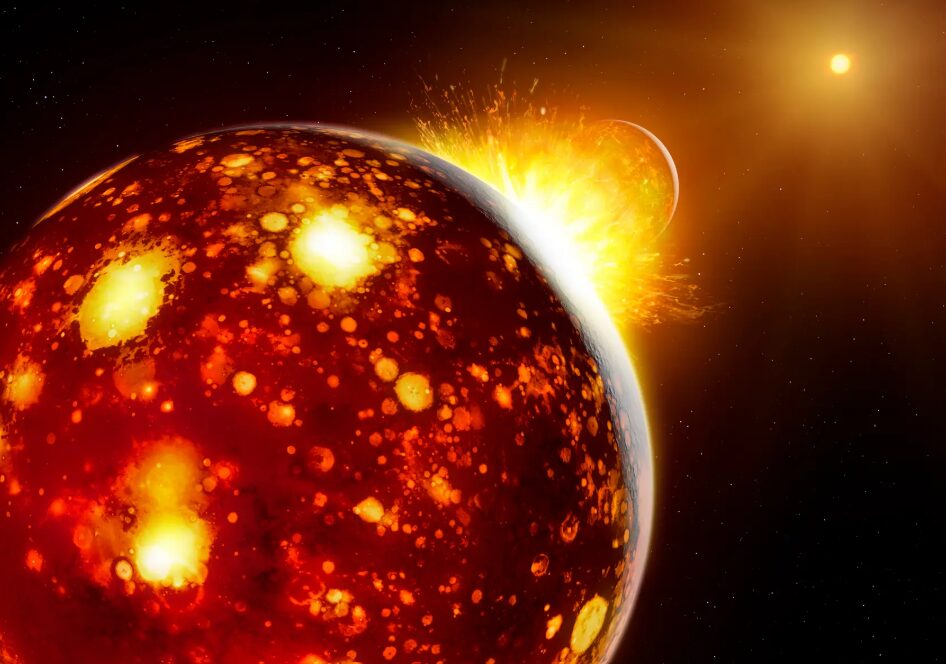
Artist’s impression of the collision between the early Earth and Theia. Since Theia originated in the inner Solar System, in this perspective the Sun can be seen in the background. Credit: MPS / Mark A. Garlick
Researchers have traced chemical clues in rocks from Earth and the Moon to uncover the origins of Theia, the body that struck Earth billions of years ago. About 4.5 billion years ago, a colossal impact between the young Earth and a mysterious planetary body called Theia changed everything—reshaping Earth, forming the Moon, and scattering clues across space rocks. By examining subtle isotopic fingerprints in Earth and Moon samples, scientists have reconstructed Theia’s possible composition and birthplace.
Reconstructing Theia’s makeup: A new study in Science identifies t...











Recent Comments