To raise new questions, new possibilities, to regard old problems from a new angle, requires creative imagination and marks real advance in science.
~Albert Einstein
Read More
Old Newtonian physics claimed that things have an objective reality separate from our perception of them. Quantum physics, and particularly Heisenberg's Uncertainty Principle, reveal that, as our perception of an object changes, the object itself literally changes.
~Marianne Williamson
Read More
This gigantic image of the Triangulum Galaxy – also known as Messier 33 – is a composite of about 54 different pointings with Hubble’s Advanced Camera for Surveys. With a staggering size of 34 372 times 19 345 pixels, it is the second-largest image ever released by Hubble. It is only dwarfed by the image of the Andromeda Galaxy, released in 2016. Credit: NASA, ESA, and M. Durbin, J. Dalcanton, and B. F. Williams (University of Washington)
The NASA/ESA Hubble Space Telescope has captured the most detailed image yet of a close neighbour of the Milky Way – the Triangulum Galaxy, a spiral galaxy located at a distance of only 3 million light-years...
Details in x are reconstructed in GF x, despite not appearing in the intermediate map F x. Credit: arXiv:1712.02950 [cs.CV]
Call it clever, brand it a cheater, but don’t feel ashamed to find it terribly interesting. The “it” is CycleGAN, and its link to steganography—where messages and information are hidden within nonsecret text or data. So, in 2019 it cannot be that shocking for people to learn that a machine, not a human, can cheat its way though a task. The AI in this instance, like good human spies and cons, learned when to hide some information that can be used later.
In Packt, Bhagyashree R wrote that “The researchers discovered the machine was encoding data of the aerial map into the noise patterns of the street map on the down low...
Wireless and battery-free implant with advanced control over targeted neuron groups. Credit: Philipp Gutruf
New research demonstrates a new optogenetics method that eliminates the need for bulky optical fibers, gives researchers more precise control of the light’s intensity, and allows for stimulating multiple areas of the brain simultaneously. Optogenetics is a biological technique that uses light to turn specific neuron groups in the brain on or off. For example, researchers might use optogenetic stimulation to restore movement in case of paralysis or, in the future, to turn off the areas of the brain or spine that cause pain.
“We’re making these tools to understand how different parts of the brain work,” Gutruf said...
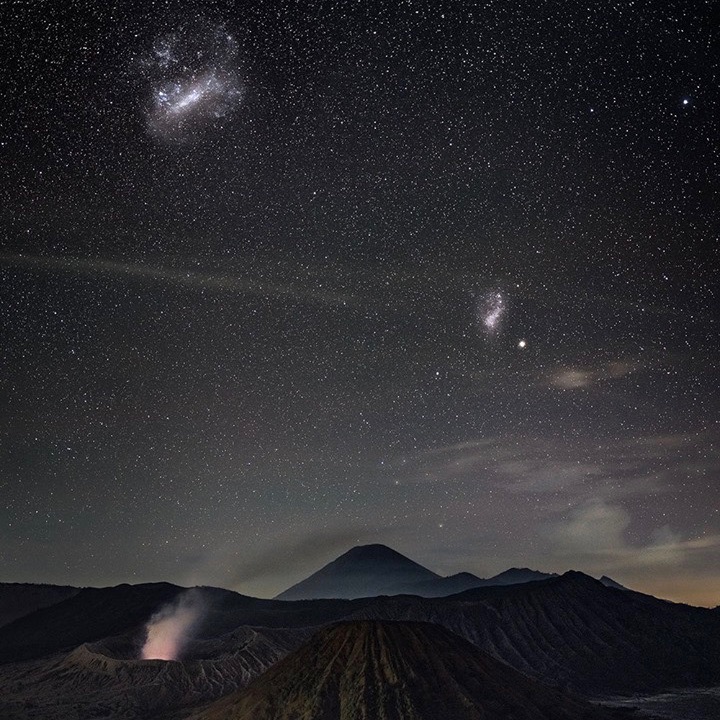
New research led by astrophysicists at Durham University, UK, predicts that the Large Magellanic Cloud (LMC) could hit the Milky Way in two billion years’ time. The collision could occur much earlier than the predicted impact between the Milky Way and another neighbouring galaxy, Andromeda, which scientists say will hit our galaxy in eight billion years.
The catastrophic coming together with the Large Magellanic Cloud could wake up our galaxy’s dormant black hole, which would begin devouring surrounding gas and increase in size by up to ten times.
As it feeds, the now-active black hole would throw out high-energy radiation and while these cosmic fireworks are unlikely to a...











Recent Comments