Compromised synapse-clearing ability linked to autism

Japanese researchers link compromised synapse-clearing ability to autism
Monocyte-derived macrophages modelled microglial function to explore impaired synaptic clearance in autism spectrum disorder (white: neurites of hiPS cell-derived neurons, green: macrophages from individuals with ASD, red: PSD95, a scaffolding protein in the postsynaptic region, blue: nuclei). Credit: Michihiro Toritsuka from Fujita Health University School of Medicine, Japan

Autism spectrum disorder (ASD) is a complex neurodevelopmental condition in which affected individuals experience difficulties in social communication and exhibit restricted, repetitive patterns of behavior or interests.

A growing body of research suggests that neurobiological changes, particularly abnormalities in dendritic spines, tiny protrusions on nerve cells where synapses form, may be a hallmark of ASD...

Read More

Quantum computer outperforms supercomputers in approximate optimization tasks

quantum computing
Credit: AI-generated image

A quantum computer can solve optimization problems faster than classical supercomputers, a process known as “quantum advantage” and demonstrated by a USC researcher in a paper recently published in Physical Review Letters.

The study shows how quantum annealing, a specialized form of quantum computing, outperforms the best current classical algorithms when searching for near-optimal solutions to complex problems.

“The way quantum annealing works is by finding low-energy states in quantum systems, which correspond to optimal or near-optimal solutions to the problems being solved,” said Daniel Lidar, corresponding author of the study and professor of electrical and computer engineering, chemistry, and physics and astronomy at the USC Viterbi School of Engi...

Read More

When a comet hits a tidally locked exo-Earth

When a comet hits a tidally locked exo-Earth
An ultraviolet image of the train of Shoemaker-Levy 9 comet fragments impacting Jupiter’s atmosphere in 1994. The black dot near the top is Jupiter’s moon Io. Credit: Hubble Space Telescope Comet Team, NASA

Comets that have hit Earth have been a mixed bag. Early in Earth’s history, during the solar system’s chaotic beginning, they were likely the source of our planet’s water, ultimately making up about 0.02% of the planet’s mass. (Mars and Venus received a similar fraction.)

Comets brought complex organic molecules and the biosphere, but later posed a threat to the same in cometary collisions...

Read More

Are ‘zombie’ skin cells harmful or helpful? The answer may be in their shapes

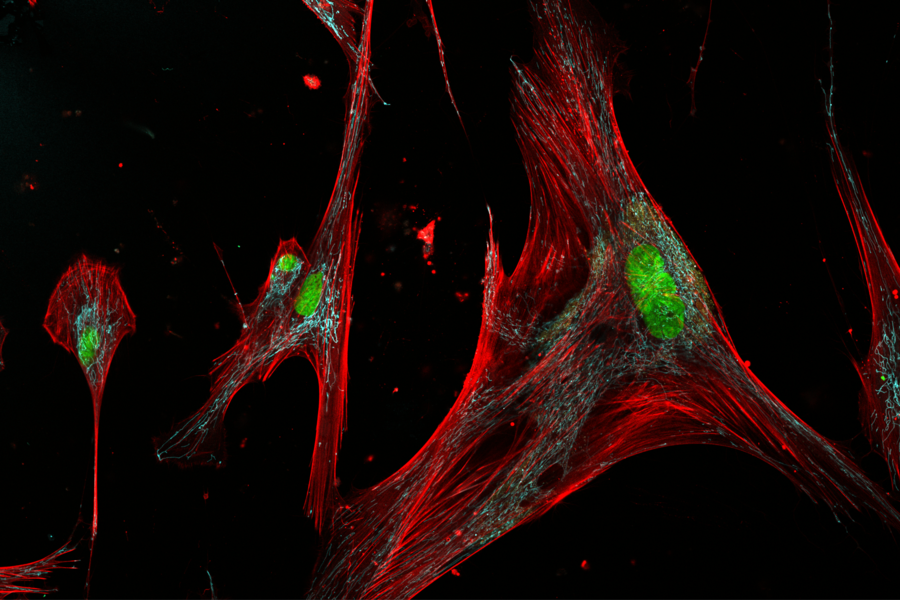
Skin-related fibroblasts with nuclei stained green and f-actin stained red.

Researchers identified three types of zombie skin cells; only one gets worse with age. Researchers have identified three subtypes of senescent skin cells with distinct shapes, biomarkers, and functions – an advance that could equip scientists with the ability to target and kill the harmful types while leaving the helpful ones intact.

Senescent skin cells, often referred to as zombie cells because they have outlived their usefulness without ever quite dying, have existed in the human body as a seeming paradox, causing inflammation and promoting diseases while also helping the immune system to heal wounds.

New findings may explain why: Not all senescent skin cells are the same. They were published today in the journal Science Advances.

“We’ve known that senescent skin cells are...

Read More