OLEDs become Brighter and more Durable

This is a graphic about improving OLEDS on the nanoscale. Credit Credit: Joan Rafols Ribé (UAB) and Paul Anton Will (TU Dresden)

This is a graphic about improving OLEDS on the nanoscale. Credit Credit: Joan Rafols Ribé (UAB) and Paul Anton Will (TU Dresden)

Researchers demonstrate the possibility of using ultrastable film formation to improve the performance of state-of-the-art OLEDs. The researchers show in a detailed study significant increases of efficiency and operational stability (>15% for both parameters and all cases, significantly higher for individual samples) are achieved for 4 differentultrastable glasses,.
Organic light-emitting diodes (OLEDs) truly have matured enough to allow for first commercial products in form of small and large displays. In order to compete in further markets and even open new possibilities (automotive lighting, head-mounted-displays, micro displays, etc...

Read More

We could Reverse Aging by Removing Wrinkles inside our Cells, study suggests

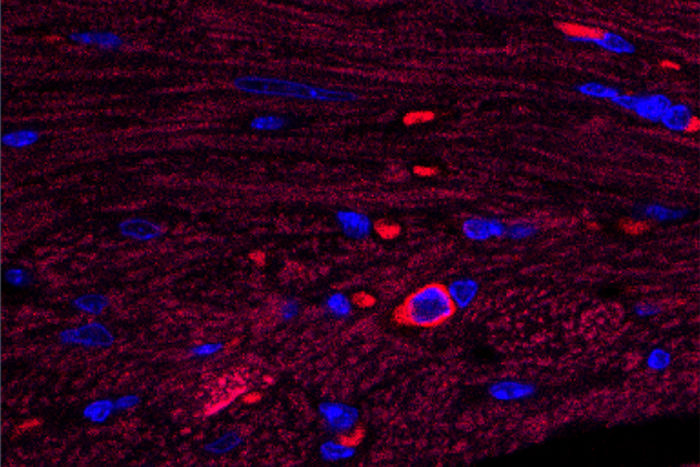
Irina M. Bochkis, Ph.D., of the University of Virginia School of Medicine, has made a new discovery that could let us prevent or cure diseases such as diabetes and fatty liver disease -- and possibly let us turn back the clock on aging itself. Credit: Dan Addison, University of Virginia Communications

Irina M. Bochkis, Ph.D., of the University of Virginia School of Medicine, has made a new discovery that could let us prevent or cure diseases such as diabetes and fatty liver disease — and possibly let us turn back the clock on aging itself. Credit: Dan Addison, University of Virginia Communications

How would we do it? By using viruses as tiny aestheticians. A new discovery about the effects of aging in our cells could allow doctors to cure or prevent diabetes, fatty liver disease and other metabolic diseases – and possibly even turn back the clock on aging itself. The new finding from the University of Virginia School of Medicine suggests that fatty liver disease and other unwanted effects of aging may be the result of our cells’ nuclei getting wrinkly...

Read More

EOVSA reveals new insights into Solar Flares’ Explosive Energy Releases

This is a EOVSA radio intensity spectrogram of the 2017 September 10 solar flare, with frequency (vertical scale) and time (horizontal scale). Credit: New Jersey Institute of Technology's expanded Owens Valley Solar Array

This is a EOVSA radio intensity spectrogram of the 2017 September 10 solar flare, with frequency (vertical scale) and time (horizontal scale). Credit: New Jersey Institute of Technology’s expanded Owens Valley Solar Array

Last September, a massive new region of magnetic field erupted on the Sun’s surface next to an existing sunspot. The powerful collision of magnetic fields produced a series of potent solar flares, causing turbulent space weather conditions at Earth. These were the first flares to be captured, in their moment-by-moment progression, by New Jersey Institute of Technology’s (NJIT) recently expanded Owens Valley Solar Array (EOVSA).

With 13 antennas now working together, EOVSA was able to make images of the flare in multiple radio frequencies simultaneously for the first time...

Read More

Lung-on-a-Chip Simulates Pulmonary Fibrosis

The image above shows collagen from a healthy engineered lung tissue. Credit: Ruogang Zhao

The image above shows collagen from a healthy engineered lung tissue. Credit: Ruogang Zhao

New biotech could reduce time and cost of developing medicine for deadly lung disease. The innovation, lung-on-a-chip technology, relies on the same technology used to print electronic chips, photolithography. Only instead of semiconducting materials, researchers placed upon the chip arrays of thin, pliable lab-grown lung tissues – in other words, its lung-on-a-chip technology.

“Obviously it’s not an entire lung, but the technology can mimic the damaging effects of lung fibrosis...

Read More