






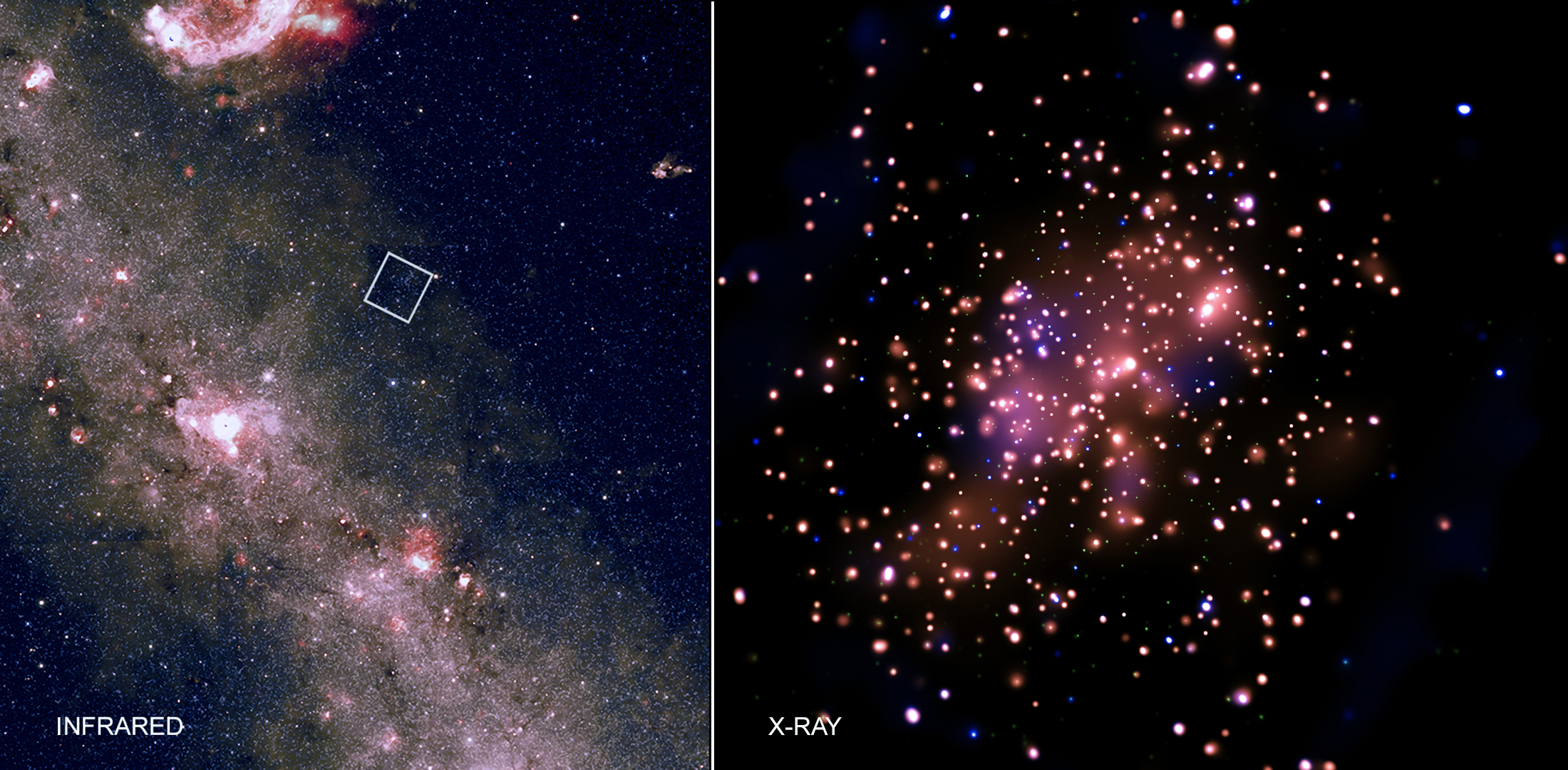
Stellar Family portrait in X-rays

Infrared image is ~5 degrees across (about 452 light years); Right: Xray image is ~16 arcmin across (about 24 light years). Credit: X-ray: NASA/CXC/Univ. of Valparaiso/M. Kuhn et al; IR: NASA/JPL/WISE

Infrared image is ~5 degrees across (about 452 light years); Right: Xray image is ~16 arcmin across (about 24 light years). Credit: X-ray: NASA/CXC/Univ. of Valparaiso/M. Kuhn et al; IR: NASA/JPL/WISE

In some ways, star clusters are like giant families with thousands of stellar siblings. These stars come from the same origins—a common cloud of gas and dust—and are bound to one another by gravity. Astronomers think that our Sun was born in a star cluster about 4.6 billion years ago that quickly dispersed. By studying young star clusters, astronomers hope to learn more about how stars—including our Sun—are born...

Read More

Liver Fix Thyself: How Some Liver Cells Switch Identities to Build Missing Plumbing

Mice that mimic Alagille syndrome are born without the branches of the biliary tree (A), but show a near-normal appearing biliary system at adult age (B). To build the missing branches, liver cells switch identity and form tubes, shown in green, that connect to the trunk of the biliary tree, shown in blue (C). The images are part of a study about liver regeneration published in Nature by scientists at Cincinnati Children's and the University of California San Francisco. Credit: Cincinnati Children's

Mice that mimic Alagille syndrome are born without the branches of the biliary tree (A), but show a near-normal appearing biliary system at adult age (B). To build the missing branches, liver cells switch identity and form tubes, shown in green, that connect to the trunk of the biliary tree, shown in blue (C). The images are part of a study about liver regeneration published in Nature by scientists at Cincinnati Children’s and the University of California San Francisco. Credit: Cincinnati Children’s

By studying a rare liver disease called Alagille syndrome, scientists from Cincinnati Children’s and the University of California San Francisco (UCSF) have discovered the mechanism behind an unusual form of tissue regeneration that may someday reduce the need for expensive and difficult-to-obta...

Read More

Physicists find Signs of a Time Crystal

Yale physicists looked for a signature of a discrete time crystal within a crystal of monoammonium phosphate. Credit: Michael Marsland/Yale University

Yale physicists looked for a signature of a discrete time crystal within a crystal of monoammonium phosphate. Credit: Michael Marsland/Yale University

Yale physicists have uncovered hints of a time crystal – a form of matter that “ticks” when exposed to an electromagnetic pulse – in the last place they expected: a crystal you might find in a child’s toy. The discovery means there are now new puzzles to solve, in terms of how time crystals form in the first place. Ordinary crystals such as salt or quartz are examples of 3D, ordered spatial crystals. Their atoms are arranged in a repeating system, something scientists have known for a century. Time crystals, first identified in 2016, are different...

Read More

Hubble detects Helium in the atmosphere of an Exoplanet for the first time

The exoplanet WASP-107b is a gas giant, orbiting a highly active K-type main sequence star. The star is about 200 light-years from Earth. Using spectroscopy, scientists were able to find helium in the escaping atmosphere of the planet -- the first detection of this element in the atmosphere of an exoplanet. Credit: ESA/Hubble, NASA, M. Kornmesser

The exoplanet WASP-107b is a gas giant, orbiting a highly active K-type main sequence star. The star is about 200 light-years from Earth. Using spectroscopy, scientists were able to find helium in the escaping atmosphere of the planet — the first detection of this element in the atmosphere of an exoplanet. Credit: ESA/Hubble, NASA, M. Kornmesser

Astronomers using Hubble have detected helium in the atmosphere of the exoplanet WASP-107b. This is the first time this element has been detected in the atmosphere of a planet outside the Solar System. The discovery demonstrates the ability to use infrared spectra to study exoplanet extended atmospheres...

Read More