






Meteorite Diamonds tell of a Lost Planet

Meteorite sample. Credit: © 2018 EPFL / Hillary Sanctuary

Meteorite sample. Credit: © 2018 EPFL / Hillary Sanctuary

Using transmission electron microscopy, EPFL scientists have examined a slice from a meteorite that contains large diamonds formed at high pressure. The study shows that the parent body from which the meteorite came was a planetary embryo of a size between Mercury and Mars. The discovery is published in Nature Communications.

On October 7, 2008, an asteroid entered Earth’s atmospahere and exploded 37 km above the Nubian Desert in Sudan. The asteroid, now known as “2008 TC3,” was just over four meters in diameter. When it exploded in the atmosphere, it scattered multiple fragments across the desert. Only fifty fragments, ranging in size from 1-10 cm, were collected, for a total mass of 4.5 kg...

Read More
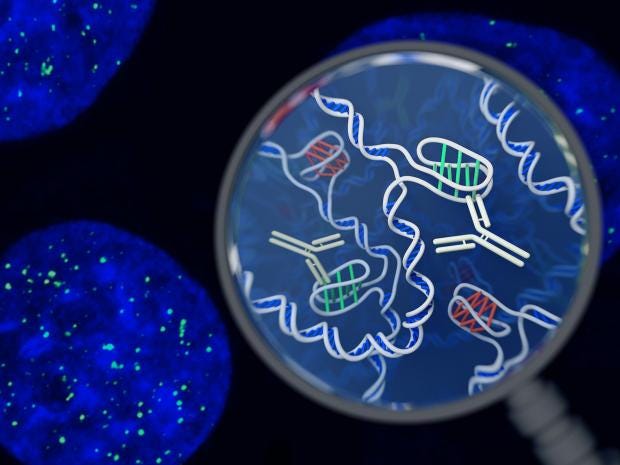
Found: A New form of DNA in our cells

Artist's impression of the i-motif DNA structure inside cells (strands with green bars), along with the antibody-based tool used to detect it (Y-shaped yellow structure) Chris Hammang

Artist’s impression of the i-motif DNA structure inside cells (strands with green bars), along with the antibody-based tool used to detect it (Y-shaped yellow structure) Chris Hammang

Scientists have tracked down an elusive ‘tangled knot’ of DNA. In a world first, Australian researchers have identified a new DNA structure – called the i-motif – inside cells. A twisted ‘knot’ of DNA, the i-motif has never before been directly seen inside living cells. The new findings, from the Garvan Institute of Medical Research, are published today in the leading journal Nature Chemistry.

Deep inside the cells in our body lies our DNA. The information in the DNA code – all 6 billion A, C, G and T letters – provides precise instructions for how our bodies are built, and how they work...

Read More

Face Recognition for Galaxies: Artificial Intelligence brings new tools to astronomy

A 'deep learning' algorithm trained on images from cosmological simulations is surprisingly successful at classifying real galaxies in Hubble images. Top row: High-resolution images from a computer simulation of a young galaxy going through three phases of evolution (before, during, and after the "blue nugget" phase). Middle row: The same images from the computer simulation of a young galaxy in three phases of evolution as it would appear if observed by the Hubble Space Telescope. Bottom row: Hubble Space Telescope images of distant young galaxies classified by a deep learning algorithm trained to recognize the three phases of galaxy evolution. The width of each image is approximately 100,000 light years. Credit: Image credits for top two rows: Greg Snyder, Space Telescope Science Institute, and Marc Huertas-Company, Paris Observatory. For bottom row: The HST images are from the Cosmic Assembly Near-infrared Deep Extragalactic Legacy Survey (CANDELS).

A ‘deep learning’ algorithm trained on images from cosmological simulations is surprisingly successful at classifying real galaxies in Hubble images. Top row: High-resolution images from a computer simulation of a young galaxy going through three phases of evolution (before, during, and after the “blue nugget” phase). Middle row: The same images from the computer simulation of a young galaxy in three phases of evolution as it would appear if observed by the Hubble Space Telescope. Bottom row: Hubble Space Telescope images of distant young galaxies classified by a deep learning algorithm trained to recognize the three phases of galaxy evolution. The width of each image is approximately 100,000 light years...

Read More

Galaxies grow Bigger and Puffier as they Age

This is a long-exposure image from NASA's Hubble Space Telescope of massive galaxy cluster Abell 2744. It shows some of the faintest and youngest galaxies detected in space. Credit: NASA/ESA/STScI

This is a long-exposure image from NASA’s Hubble Space Telescope of massive galaxy cluster Abell 2744. It shows some of the faintest and youngest galaxies detected in space. Credit: NASA/ESA/STScI

A new international study involving ANU and Sydney University has found that galaxies grow bigger and puffier as they age. Professor Matthew Colless from ANU said that stars in a young galaxy moved in an orderly way around the galaxy’s disk, much like cars around a racetrack...

Read More