






New Stem-cell based Stroke Rx Repairs Damaged Brain Tissue Human clinical trials could begin as early as next year

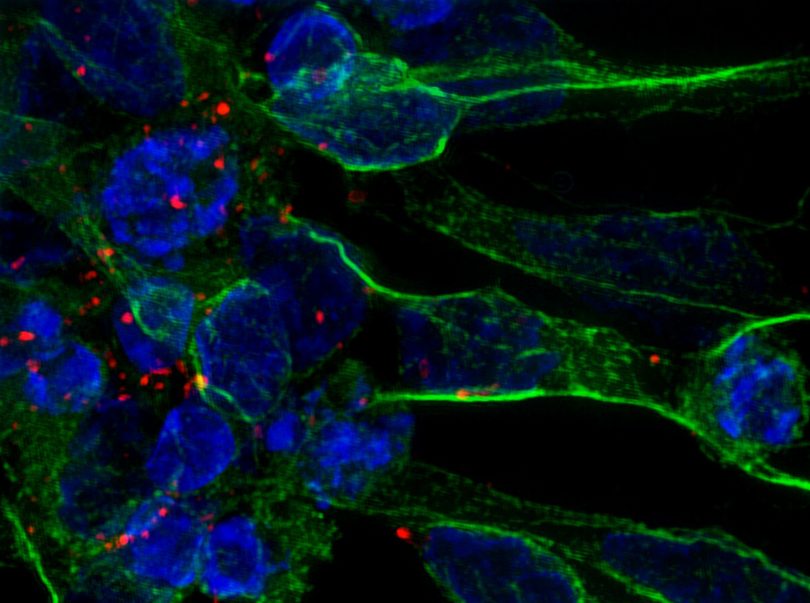
Exosomes under a microscope

Exosomes, shown as small red punctate clusters, are taken up by neurons, shown as green cell extensions surrounding a blue nucleus. Credit: UGA

A team of researchers at the University of Georgia’s Regenerative Bioscience Center and ArunA Biomedical, a UGA startup company, have developed a new treatment for stroke that reduces brain damage and accelerates the brain’s natural healing tendencies in animal models. The team created a treatment called AB126 using extracellular vesicles (EV), fluid-filled structures known as exosomes, generated from human neural stem cells.

Fully able to cloak itself within the bloodstream, this type of regenerative EV therapy appears to be the most promising in overcoming the limitations of many cell therapies-with the ability for exosomes to carry and deliver m...

Read More

Astronomers conduct a Multi-frequency study of the Milky Way-like spiral galaxy NGC 6744

WISE 3-color (W1+W2+W3) image of NGC 6744. Left panel shows the images before star subtraction, and the right panel after. Credit: Yew et al., 2018.

WISE 3-color (W1+W2+W3) image of NGC 6744. Left panel shows the images before star subtraction, and the right panel after. Credit: Yew et al., 2018.

The new research identifies radio and X-ray sources in NGC 6744 and estimates its star formation rate. Discovered in 1823, NGC 6744 is an intermediate spiral galaxy 30 million light years away in the constellation Pavo. It is thought to be one of the most Milky Way-like spiral galaxies in our immediate vicinity, and is perceived by astronomers as a useful analogue to our own galaxy when it comes to studying objects such as supernova remnants and H II regions—clouds of glowing gas and plasma in which star formation takes place.

When in 2005 a type Ic supernova was found in NGC 6744 at optical wavebands, astronomers started to observe this gal...

Read More

Long-lived Mars Rover Opportunity keeps finding Surprises

Long-lived Mars rover Opportunity keeps finding surprises

Textured rows on the ground in this portion of “Perseverance Valley” are under investigation by NASA’s Mars Exploration Rover Opportunity, which used its Navigation Camera to take the component images of this downhill-looking scene. The rover reaches its 5,000th Martian day, or sol, on Feb. 16, 2018. Image Credit: NASA/JPL-Caltech

NASA’s Mars Exploration Rover Opportunity keeps providing surprises about the Red Planet, most recently with observations of possible “rock stripes”.The ground texture seen in recent images from the rover resembles a smudged version of very distinctive stone stripes on some mountain slopes on Earth that result from repeated cycles of freezing and thawing of wet soil. But it might also be due to wind, downhill transport, other processes or a combination.

Opportuni...

Read More

Unconventional Superconductor may be used to create Quantum Computers of the future

The aluminum plates were attached to the topological insulator using platinum. The picture (scale bar: 200?nm) shows one of the devices used in the experiment. Because of the stress, induced by various cool downs, a clear buckling feature appears in the nanogap of the device. This modification is causing the characteristics of the superconducting pairs of electron to vary in different directions, a signature of unconventional superconductivity. Credit: Thilo Bauch and Floriana Lombardi/Chalmers University of Technology

The aluminum plates were attached to the topological insulator using platinum. The picture (scale bar: 200?nm) shows one of the devices used in the experiment. Because of the stress, induced by various cool downs, a clear buckling feature appears in the nanogap of the device. This modification is causing the characteristics of the superconducting pairs of electron to vary in different directions, a signature of unconventional superconductivity. Credit: Thilo Bauch and Floriana Lombardi/Chalmers University of Technology

They have probably succeeded in creating a topological superconductor. With their insensitivity to decoherence what are known as Majorana particles could become stable building blocks of a quantum computer...

Read More