






Chasing Dark Matter with Oldest Stars in the Milky Way

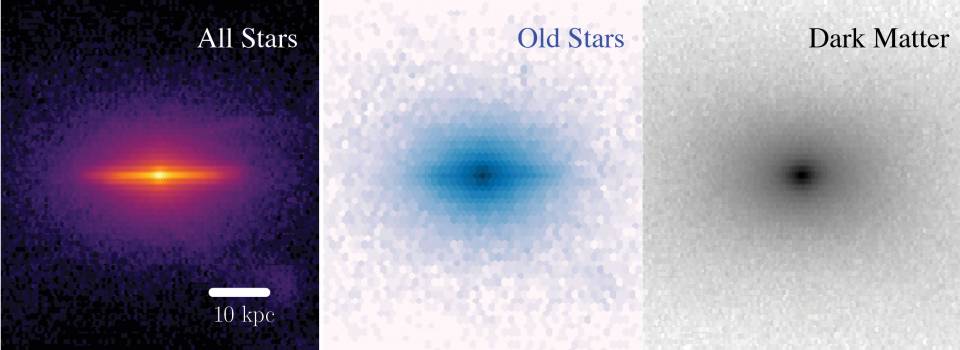
 This rendering of data from the Eris computer simulation shows that all stars in the galaxy are concentrated around the galactic center, but older stars and dark matter are more spherically distributed around the Milky Way, while younger stars are more concentrated within the disk of the galaxy. Photo courtesy of the researchers

This rendering of data from the Eris computer simulation shows that all stars in the galaxy are concentrated around the galactic center, but older stars and dark matter are more spherically distributed around the Milky Way, while younger stars are more concentrated within the disk of the galaxy. Photo courtesy of the researchers

How an international team is constraining the speed of dark matter. Just how quickly is the dark matter near Earth zipping around? The speed of dark matter has far-reaching consequences for modern astrophysical research, but this fundamental property has eluded researchers for years. In a paper published Jan...

Read More

Powerful Food-derived Antioxidant can halt, prevent Fatty Liver disease in Mice

Kiwi fruit, among others, contains a powerful antioxidant shown to halt or prevent fatty liver disease in young mice.

Kiwi fruit, among others, contains a powerful antioxidant shown to halt or prevent fatty liver disease in young mice.

As obesity continues to rise in the U.S., non-alcoholic fatty liver disease (NAFLD) has become a major public health issue, increasingly leading to cancer and liver transplants. But new research from the University of Colorado Anschutz Medical Campus has discovered that a powerful anti-oxidant found in kiwi fruit, parsley, celery and papaya known as pyrroloquinoline quinone, or PQQ, can halt or prevent the progression of fatty liver disease in the offspring of mice fed a high-fat Western-style diet.

Growing evidence suggests that childhood obesity and fatty liver disease is influenced by maternal diet and the infant’s microbiome...

Read More

A New ‘Atmospheric Disequilibrium’ could help Detect Life on other Planets

Future telescopes like the James Webb Space Telescope (right) will observe the atmospheres of distant planets to seek evidence of life. Earth (top left) has several gases in its atmosphere that reveal the presence of life, primarily oxygen and ozone. The new study finds that for the early Earth (bottom left), the combination of abundant methane and carbon dioxide would provide an alternative sign of life. Credit: NASA/Wikimedia Commons/Joshua Krissansen-Totton

Future telescopes like the James Webb Space Telescope (right) will observe the atmospheres of distant planets to seek evidence of life. Earth (top left) has several gases in its atmosphere that reveal the presence of life, primarily oxygen and ozone. The new study finds that for the early Earth (bottom left), the combination of abundant methane and carbon dioxide would provide an alternative sign of life. Credit: NASA/Wikimedia Commons/Joshua Krissansen-Totton

A new study has found a simple approach to look for life that might be more promising than just looking for oxygen. As NASA’s James Webb Space Telescope and other new giant telescopes come online they will need novel strategies to look for evidence of life on other planets...

Read More

Big Energy Savings: Building the World’s Smallest Electro-optic Modulator

Modulator researchers. Credit: Image courtesy of Oregon State University

Modulator researchers. Credit: Image courtesy of Oregon State University

Researchers at Oregon State University have designed and fabricated the world’s smallest electro-optic modulator, which could mean major reductions in energy used by data centers and supercomputers. An electro-optic modulator plays the key role in fiber optic networks. Just as a transistor is a switch for electronic signals, an electro-optic modulator is a switch for optical signals. Optical communication uses light, so the modulator turns on and off the light that sends a stream of binary signals over optical fibers.

The new modulator is 10 times smaller and can potentially be 100X more energy efficient than the best previous devices. It is roughly the size of a bacterium, measuring 0.6 by 8 microns...

Read More