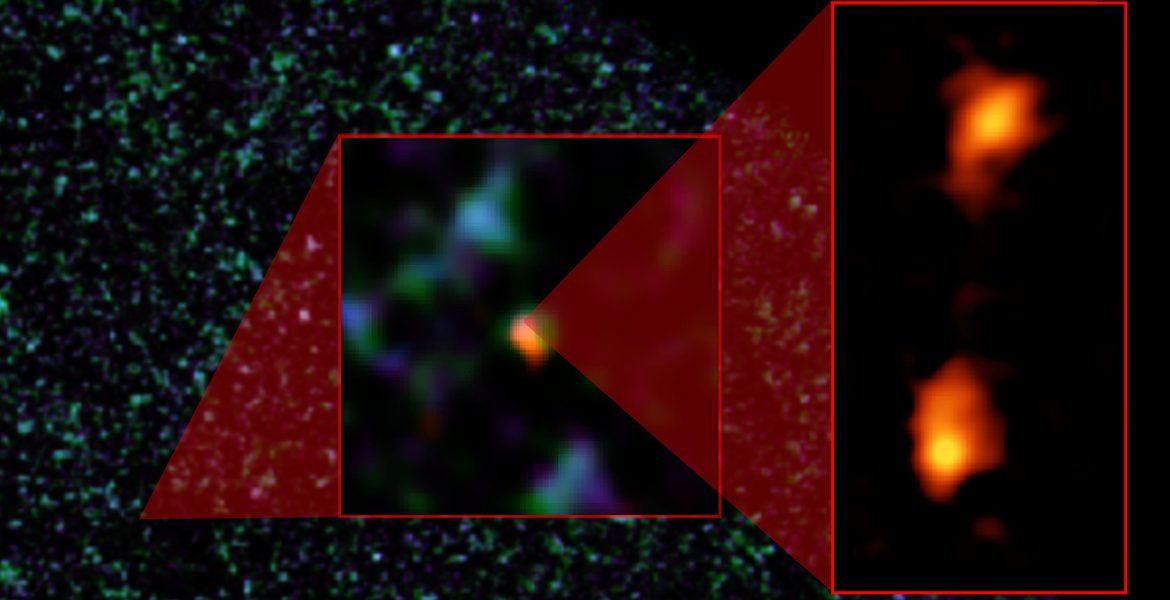
Duo of Titanic Galaxies captured in Extreme Starbursting Merger

Credit: NRAO/AUI/NSF, B. Saxton; ESA Herschel; ESO APEX; ALMA (ESO/NAOJ/NRAO); D. Riechers

Credit: NRAO/AUI/NSF, B. Saxton; ESA Herschel; ESO APEX; ALMA (ESO/NAOJ/NRAO); D. Riechers

Pair of exceptionally rare hyper-luminous galaxies discovered with ALMA. have uncovered the never-before-seen close encounter between two astoundingly bright and spectacularly massive galaxies in the early universe. These so-called hyper-luminous starburst galaxies are exceedingly rare at this epoch of cosmic history – near the time when galaxies first formed – and may represent one of the most-extreme examples of violent star formation ever observed.

Astronomers captured these 2 interacting galaxies, collectively known as ADFS-27, as they began the gradual process of merging into a single, massive elliptical galaxy...

Read More

Astronomers discover Radio Emission from a Symbiotic X-ray Binary

VLA 9 GHz image of GX 1+4. The black cross shows the most accurate position of GX 1+4, from 2MASS (nearinfrared), which is accurate to 0.1 arcsec. The half-power contour of the synthesized beam is shown in the bottom left corner. Credit: Van den Eijnden et al., 2017. Read more at: https://phys.org/news/2017-11-astronomers-radio-emission-symbiotic-x-ray.html#jCp

VLA 9 GHz image of GX 1+4. The black cross shows the most accurate position of GX 1+4, from 2MASS (nearinfrared), which is accurate to 0.1 arcsec. The half-power contour of the synthesized beam is shown in the bottom left corner. Credit: Van den Eijnden et al., 2017.

Using the Karl G. Jansky Very Large Array (VLA), an international group has detected radio emissions from the accreting X-ray pulsar and symbiotic X-ray binary system designated GX 1+4. It is the first discovery of radio emissions from a symbiotic X-ray binary and the first indication of a jet from an accreting X-ray pulsar with a strong magnetic field.

Discovered in 1970, GX 1+4 is an accreting X-ray pulsar some 14,000 light years away with a relatively long rotation period of about 120 seconds...

Read More

Biomarker may predict early Alzheimer’s disease

This image shows DAG (green-labeled peptide) targeting to the brain blood vessel (labeled red) in the hippocampus of the Alzheimer brain. Credit: Ruoslahti Lab, SBP

This image shows DAG (green-labeled peptide) targeting to the brain blood vessel (labeled red) in the hippocampus of the Alzheimer brain. Credit: Ruoslahti Lab, SBP

Peptide recognizes vasculature associated with brain inflammation. Researchers at Sanford Burnham Prebys Medical Discovery Institute (SBP) have identified a peptide that could lead to the early detection of Alzheimer’s disease (AD). The discovery, published in Nature Communications, may also provide a means of homing drugs to diseased areas of the brain to treat AD, Parkinson’s disease, as well as glioblastoma, brain injuries and stroke.

“We have identified a peptide (DAG) that recognizes a protein that is elevated in the brain blood vessels of AD mice and human patients...

Read More

Breakthrough Research suggests Potential Treatment for Autism, Intellectual Disability

Image with caption: Woo-Yang Kim, Ph.D.

Woo-Yang Kim, Ph.D.

A breakthrough in finding the mechanism and a possible therapeutic fix for autism and intellectual disability has been made by a University of Nebraska Medical Center researcher and his team at the Munroe-Meyer Institute (MMI). Woo-Yang Kim, Ph.D., associate professor, developmental neuroscience, led a team of researchers from UNMC and Creighton University into a deeper exploration of a genetic mutation that reduces the function of certain neurons in the brain.

“This is an exciting development because we have identified the pathological mechanism for a certain type of autism and intellectual disability,” Dr. Kim said...

Read More