






Learning and Staying in Shape key to Longer Lifespan, study finds

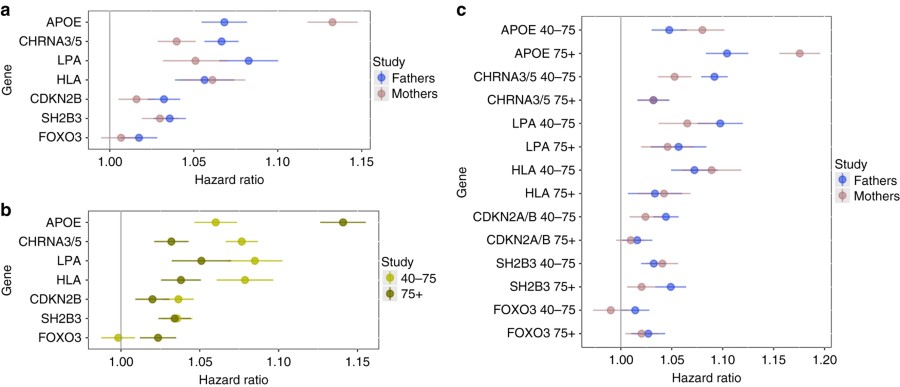
Age-specific and sex-specific effects of the 4 GWS associations in LifeGen and the validated candidate loci. The four GWS and three suggestive replicated loci were analysed for age-specific and sex-specific effects on lifespan. a The variants at APOE and CHRNA3/5 exhibit sexually dimorphic effects on parental mortality, while all other variants exhibit more modest often non-significant sex-specific differences. b The effects of each gene on male and female lifespan were meta-analysed and studied in the cases that died aged between 40 and 75 or after 75. APOE exerts a much greater effect in the older age group, while most of the other genes exhibit the opposite effect. FOXO3 appears neutral, if not positive, in the earlier age group. c Effects on mortality were studied in both age groups for both sexes. APOE has the strongest effect on females aged 75+, CHRNA3/5 acts on males aged 40−75 and all other genes display more ambiguous trends

Age-specific and sex-specific effects of the 4 GWS associations in LifeGen and the validated candidate loci. The four GWS and three suggestive replicated loci were analysed for age-specific and sex-specific effects on lifespan. a The variants at APOE and CHRNA3/5 exhibit sexually dimorphic effects on parental mortality, while all other variants exhibit more modest often non-significant sex-specific differences. b The effects of each gene on male and female lifespan were meta-analysed and studied in the cases that died aged between 40 and 75 or after 75. APOE exerts a much greater effect in the older age group, while most of the other genes exhibit the opposite effect. FOXO3 appears neutral, if not positive, in the earlier age group...

Read More
KLF-mediated lifespan extension is dependent on autophagy. Klf-3 transcript levels in wild-type animals subjected to 2 days of chronic dietary restriction (sDR, OP50 diluted to 108 cfu/ml) (a) or inhibition of TOR signaling by RNAi against let-363 (b) starting from day 1 of adulthood. All lines were raised and maintained at 20 °C. *P-value < 0.05 by Student’s T-test, N = 3 biological replicates. c qPCR analysis of a panel of autophagy-related genes in day 1 klf-3 o/e and loss of function of both klf-3 and klf-1 animals compared to wild type. Double loss of function of klf-3 and klf-1 was performed as described previously utilizing the klf-3(ok175) mutant and simultaneous RNAi feeding targeting klf-1. All lines were raised and maintained at 20 °C. *P-value < 0.05 by Student’s T-test, N = 3 biological replicates (d, representative picture). e Autophagy in klf-3 o/e animals as determined by numbers of GFP::LGG-1 punctae in seam cells (red arrow denotes GFP-positive puncta) with knockdown of bec-1 in both wild-type and klf-3 o/e animals. *P-value < 0.05, # P-value ≤ 0.1 after one-way analysis of variance followed by the Tukey’s post hoc test. N = 10–20 animals counted. (f, wild-type representative image, g, klf-3 o/e representative image) Electron microscopy images of klf-3 o/e and wild-type animals in animals aged 9 days. Arrowheads indicate sizeable (≥500 nm) autolysosomes as recognized by single-membrane limited vacuolar structures with visible mixed cytoplasmic contents. Full images reproduced in Supplementary Fig. 11, with additional images. h Lifespan analysis of wild-type and klf-3 o/e animals fed RNAi bacteria targeting bec-1 from day 1 of adulthood. All lines were raised and maintained at 20 °C. P-value < 0.05 by Mantel–Cox log-rank tests. See also Supplementary Table 6 for details of lifespan analyses and replicate experiments. All error bars represent standard error of the mean (SEM)

KLF-mediated lifespan extension is dependent on autophagy. Klf-3 transcript levels in wild-type animals subjected to 2 days of chronic dietary restriction (sDR, OP50 diluted to 108 cfu/ml) (a) or inhibition of TOR signaling by RNAi against let-363 (b) starting from day 1 of adulthood. All lines were raised and maintained at 20 °C. *P-value < 0.05 by Student’s T-test, N = 3 biological replicates. c qPCR analysis of a panel of autophagy-related genes in day 1 klf-3 o/e and loss of function of both klf-3 and klf-1 animals compared to wild type. Double loss of function of klf-3 and klf-1 was performed as described previously utilizing the klf-3(ok175) mutant and simultaneous RNAi feeding targeting klf-1. All lines were raised and maintained at 20 °C. *P-value < 0...

Read More

Spin Current Detection in Quantum Materials unlocks Potential for Alternative Electronics

A new microscopy method developed by an ORNL-led team has four movable probing tips, is sensitive to the spin of moving electrons and produces high-resolution results. Using this approach, they observed the spin behavior of electrons on the surface of a quantum material. Credit: Saban Hus and An-Ping Li/Oak Ridge National Laboratory, U.S. Dept. of Energy

A new microscopy method developed by an ORNL-led team has four movable probing tips, is sensitive to the spin of moving electrons and produces high-resolution results. Using this approach, they observed the spin behavior of electrons on the surface of a quantum material. Credit: Saban Hus and An-Ping Li/Oak Ridge National Laboratory, U.S. Dept. of Energy

A new method that precisely measures the mysterious behavior and magnetic properties of electrons flowing across the surface of quantum materials could open a path to next-generation electronics. Silicon-based semiconductors rely on the controlled electrical current responsible for powering electronics. These semiconductors can only access the electrons’ charge for energy, but electrons do more than carry a charge...

Read More

Astronomers find potential Solution into how Planets Form

This image shows V1247 Orionis, a young, hot star surrounded by a dynamic ring of gas and dust, known as a circumstellar disc. The disc can be seen in two parts: a clearly defined central ring of matter and a more delicate crescent structure located further out. Credit: Stefan Kraus

This image shows V1247 Orionis, a young, hot star surrounded by a dynamic ring of gas and dust, known as a circumstellar disc. The disc can be seen in two parts: a clearly defined central ring of matter and a more delicate crescent structure located further out. Credit: Stefan Kraus

The quest to discover how planets found in the far reaches of the universe are born has taken a new, crucial twist. A new study by an international team of scientists, led by Stefan Kraus from the University of Exeter, has given a fascinating new insight into one of the most respected theories of how planets are formed. Young stars start out with a massive disk of gas and dust that over time, astronomers think, either diffuses away or coalesces into planets and asteroids.

However, scientists are still searching...

Read More