






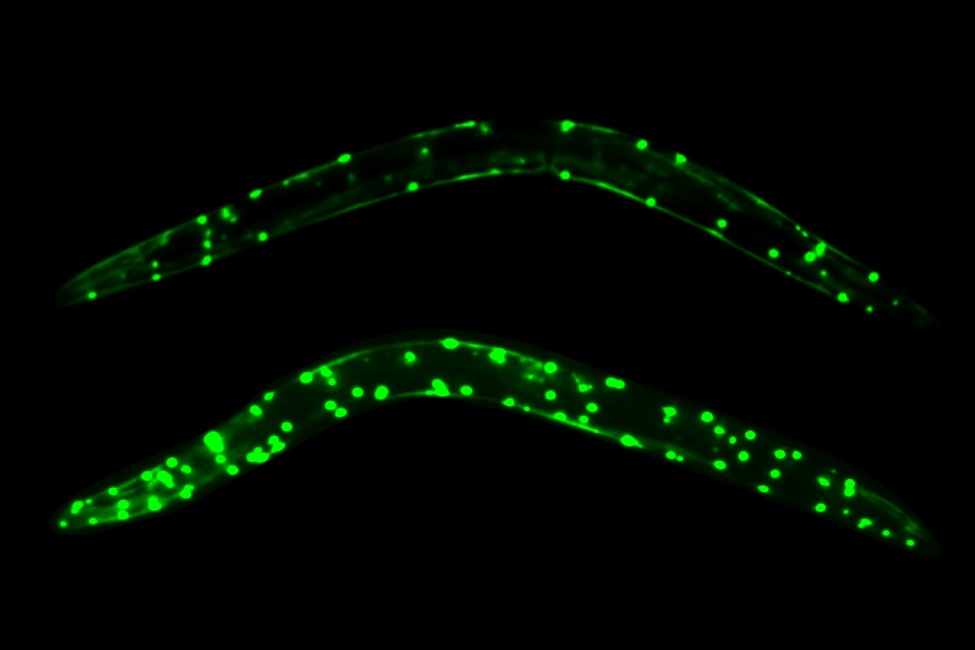
Living Computers: RNA circuits Transform Cells into Nanodevices

Alexander A. Green, Jongmin Kim, Duo Ma, Pamela A. Silver, James J. Collins, Peng Yin. Complex cellular logic computation using ribocomputing devices. Nature, 2017; DOI: 10.1038/nature23271

Alexander A. Green, Jongmin Kim, Duo Ma, Pamela A. Silver, James J. Collins, Peng Yin. Complex cellular logic computation using ribocomputing devices. Nature, 2017; DOI: 10.1038/nature23271

The interdisciplinary nexus of biology and engineering, known as synthetic biology, is growing at a rapid pace, opening new vistas that could scarcely be imagined a short time ago. In new research, Alex Green, a professor at ASU’s Biodesign Institute, demonstrates how living cells can be induced to carry out computations in the manner of tiny robots or computers...

Read More

Dawn of the cosmos: Seeing galaxies that appeared soon after the Big Bang

Dawn of the cosmos Seeing galaxies that appeared soon after the Big Bang — Sci_2017-07-26_19-55-06

Arizona State University astronomers Sangeeta Malhotra and James Rhoads, working with international teams in Chile and China, have discovered 23 young galaxies, seen as they were 800 million years after the Big Bang. Long ago, about 300,000 years after the beginning of the universe (the Big Bang), the universe was dark. There were no stars or galaxies, and the universe was filled with neutral hydrogen gas. In the next half billion years or so the first galaxies and stars appeared. Their energetic radiation ionized their surroundings, illuminating and transforming the universe.
 
This dramatic transformation, known as re-ionization, occurred sometime in the interval between 300 mill...
Read More

Gamma-ray Burst captured in unprecedented detail

This image shows the most common type of gamma-ray burst, thought to occur when a massive star collapses, forms a black hole, and blasts particle jets outward at nearly the speed of light. An international team led by University of Maryland astronomers has constructed a detailed description of a similar gamma-ray burst event, named GRB160625B. Their analysis has revealed key details about the initial 'prompt' phase of gamma-ray bursts and the evolution of the large jets of matter and energy that form as a result. Credit: NASA's Goddard Space Flight Center

This image shows the most common type of gamma-ray burst, thought to occur when a massive star collapses, forms a black hole, and blasts particle jets outward at nearly the speed of light. An international team led by University of Maryland astronomers has constructed a detailed description of a similar gamma-ray burst event, named GRB160625B. Their analysis has revealed key details about the initial ‘prompt’ phase of gamma-ray bursts and the evolution of the large jets of matter and energy that form as a result. Credit: NASA’s Goddard Space Flight Center

 
Data from multiple telescopes used to address long-standing questions about the universe’s most powerful explosions. Gamma-ray bursts are among the most energetic and explosive events in the universe...
Read More

Brain Cells found to Control Aging

Hypothalamic stem cells control ageing speed partly through exosomal miRNAs. Nature, 2017; DOI: 10.1038/nature23282

Hypothalamic stem cells control ageing speed partly through exosomal miRNAs. Nature, 2017; DOI: 10.1038/nature23282

Scientists at Albert Einstein College of Medicine have found that stem cells in the brain’s hypothalamus govern how fast aging occurs in the body. The finding, made in mice, could lead to new strategies for warding off age-related diseases and extending lifespan. The hypothalamus was known to regulate important processes including growth, development, reproduction and metabolism. In a 2013 Nature paper, Einstein researchers made the surprising finding that the hypothalamus also regulates aging throughout the body...

Read More