Graphene Electrodes offer new Functionalities in Molecular Electronic Nanodevices

The researchers performed the characterization of graphene-based molecular electronic devices at room-temperature and demonstrated that molecules covalently attached to mechanically robust graphene substrates are ideal candidates for next-generation molecular electronic devices. Credit: © Alexander Rudnev, University of Bern

The researchers performed the characterization of graphene-based molecular electronic devices at room-temperature and demonstrated that molecules covalently attached to mechanically robust graphene substrates are ideal candidates for next-generation molecular electronic devices. Credit: © Alexander Rudnev, University of Bern

An international team led by the University of Bern and the National Physical Laboratory (NPL) has revealed a new way to tune the functionality of next-generation molecular electronic devices using graphene. The results could be exploited to develop smaller, higher-performance devices for use in a range of applications including molecular sensing, flexible electronics, and energy conversion and storage, as well as robust measurement setups for resistance standards.

Na...

Read More

3D Printing breakthrough heralds ‘New Era’ for Advanced Skin Models

Direct 3D cell-printing of human skin with functional transwell system. Biofabrication, 2017; 9 (2): 025034 DOI: 10.1088/1758-5090/aa71c8

Direct 3D cell-printing of human skin with functional transwell system. Biofabrication, 2017; 9 (2): 025034 DOI: 10.1088/1758-5090/aa71c8

Scientists in South Korea have come up with a new method for 3D printing human skin, which both shortens the process and reduces the cost. Reporting their results today in the journal Biofabrication, the team from Pohang University of Science and Technology demonstrate a new 3D cell printing strategy, for engineering a 3D human skin model in a single step process...

Read More

Neutrino discovery—a step closer to finding Charge-Parity Violation

The detected pattern of an electron neutrino candidate event observed by Super-Kamiokande. Credit: University of Tokyo Read more at: https://phys.org/news/2017-06-neutrino-discoverya-closer-charge-parity-violation.html#jCp

The detected pattern of an electron neutrino candidate event observed by Super-Kamiokande. Credit: University of Tokyo

The different rates of neutrino and anti-neutrino oscillations recorded by an international collaboration of researchers in Japan—including from Kavli IPMU—is an important step in the search for a new source of asymmetry in the laws that govern matter and antimatter. The Standard Model of particle physics describes the basic building blocks of matter and how they interact. It also makes a point that for every particle created, there is an anti-particle...

Read More

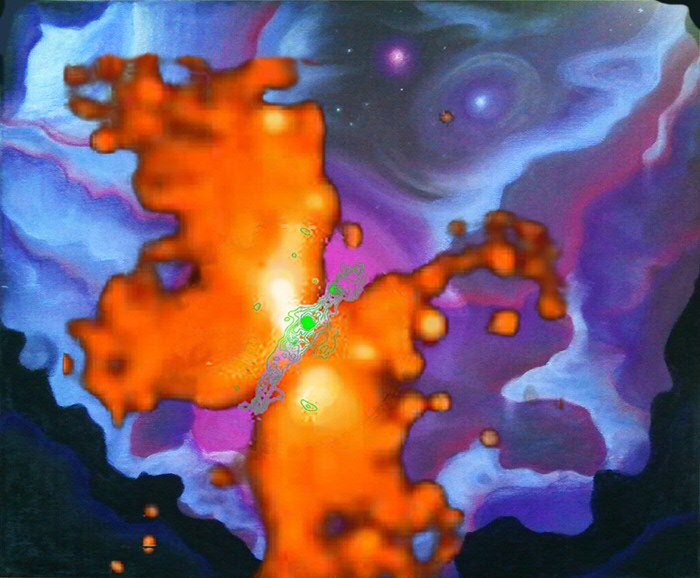
ALMA hears Birth cry of a Massive Baby Star

ALMA hears birth cry of a massive baby star

The massive protostar is surrounded by a disk of gas and dust. The outflow is launched from the surface of the outer disk. Credit: ALMA (ESO/NAOJ/NRAO)

Stars form from gas and dust floating in interstellar space. But, astronomers do not yet fully understand how it is possible to form the massive stars seen in space. One key issue is gas rotation. The parent cloud rotates slowly in the initial stage and the rotation becomes faster as the cloud shrinks due to self-gravity. Stars formed in such a process should have very rapid rotation, but this is not the case. The stars observed in the Universe rotate more slowly.

How is the rotational momentum dissipated? One possible scenario involves that the gas emanating from baby stars...

Read More