To raise new questions, new possibilities, to regard old problems from a new angle, requires creative imagination and marks real advance in science.
~Albert Einstein
Read More
Old Newtonian physics claimed that things have an objective reality separate from our perception of them. Quantum physics, and particularly Heisenberg's Uncertainty Principle, reveal that, as our perception of an object changes, the object itself literally changes.
~Marianne Williamson
Read More
ALMA has observed stars like the Sun at a very early stage in their formation and found traces of methyl isocyanate — a chemical building block of life. This is the first ever detection of this prebiotic molecule towards a solar-type protostar, the sort from which our Solar System evolved. The discovery could help astronomers understand how life arose on Earth. This image shows the spectacular region of star formation where methyl isocyanate was found. The insert shows the molecular structure of this chemical. Credit: ESO/Digitized Sky Survey 2/L. Calçada
Two teams have harnessed the power of ALMA in Chile to detect the prebiotic complex organic molecule methyl isocyanate in the multiple star system IRAS 16293-2422...
1. The universe as simulated by the Millennium Simulation is structured like Swiss cheese in filaments and voids. The Milky Way, according to UW-Madison astronomers, exists in one of the holes or voids of the large-scale structure of the cosmos. Credit: Millennium Simulation Project 2. A map of the local universe as observed by the Sloan Digital Sky Survey. The orange areas have higher densities of galaxy clusters and filaments. SLOAN DIGITAL SKY SURVEY – See more at: http://news.wisc.edu/celestial-boondocks-study-supports-the-idea-that-we-live-in-a-void/#sthash.IWArGgxR.dpuf
Cosmologically speaking, the Milky Way and its immediate neighborhood are in the boondocks. In a 2013 observational study, University of W-M astronomer Amy Barger and her then-student Ryan Keenan showed that our galaxy, in the context of the large-scale structure of the universe, resides in an enormous void – a region of space containing far fewer galaxies, stars and planets than expected. Now, a new study not only firms up the idea that we exist in one of the holes of the Swiss cheese structure of the cosmos, but helps ease the apparent disagreement or tension between different measurements of the Hubble Constant, the unit cosmologists use to describe the rate at which the universe is expanding today.
The tension arises from the realization that different techniques astrophysicists employ to measure how fast the universe is expanding give different results. “No matter what technique you use, you should get the same value for the expansion rate of the universe today,” explains Ben Hoscheit, the Wisconsin student presenting his analysis of the apparently much larger than average void that our galaxy resides in. “Fortunately, living in a void helps resolve this tension.”
The reason for that is that a void – with far more matter outside the void exerting a slightly larger gravitational pull – will affect the Hubble Constant value one measures from a technique that uses relatively nearby supernovae, while it will have no effect on the value derived from a technique that uses the cosmic microwave background (CMB), the leftover light from the Big Bang. The new Wisconsin report is part of the much bigger effort to better understand the large-scale structure of the universe. The structure of the cosmos is Swiss cheese-like in the sense that it is composed of “normal matter” in the form of voids and filaments. The filaments are made up of superclusters and clusters of galaxies, which in turn are composed of stars, gas, dust and planets. Dark matter and dark energy, which cannot yet be directly observed, are believed to comprise approximately 95% of the contents of the universe.
The void that contains the Milky Way, known as the KBC void for Keenan, Barger and the University of Hawaii’s Lennox Cowie, is at least 7X as large as the average, with a radius measuring roughly 1 billion light years. To date, it is the largest void known to science. Hoscheit’s new analysis, according to Barger, shows that Keenan’s first estimations of the KBC void, which is shaped like a sphere with a shell of increasing thickness made up of galaxies, stars and other matter, are not ruled out by other observational constraints.
“It is often really hard to find consistent solutions between many different observations,” says Barger, an observational cosmologist who also holds an affiliate graduate appointment at the University of Hawaii’s Department of Physics and Astronomy. “What Ben has shown is that the density profile that Keenan measured is consistent with cosmological observables. One always wants to find consistency, or else there is a problem somewhere that needs to be resolved.”
The bright light from a supernova explosion, where the distance to the galaxy that hosts the supernova is well established, is the “candle” of choice for astronomers measuring the accelerated expansion of the universe. Because those objects are relatively close to the Milky Way and because no matter where they explode in the observable universe, they do so with the same amount of energy, it provides a way to measure the Hubble Constant.
Alternatively, the cosmic microwave background is a way to probe the very early universe. “Photons from the CMB encode a baby picture of the very early universe,” explains Hoscheit. “They show us that at that stage, the universe was surprisingly homogeneous. It was a hot, dense soup of photons, electrons and protons, showing only minute temperature differences across the sky. But, in fact, those tiny temperature differences are exactly what allow us to infer the Hubble Constant through this cosmic technique.”
A direct comparison can thus be made, Hoscheit says, between the ‘cosmic’ determination of the Hubble Constant and the ‘local’ determination derived from observations of light from relatively nearby supernovae. The new analysis made by Hoscheit, says Barger, shows that there are no current observational obstacles to the conclusion that the Milky Way resides in a very large void. As a bonus, the presence of the void can also resolve some of the discrepancies between techniques used to clock how fast the universe is expanding. http://news.wisc.edu/celestial-boondocks-study-supports-the-idea-that-we-live-in-a-void/
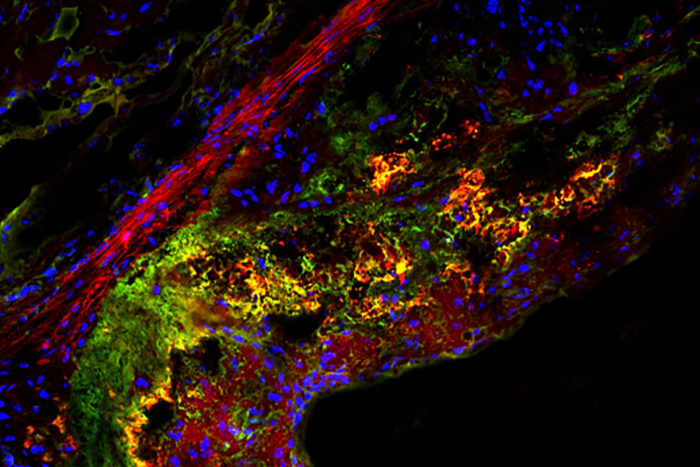
A new study shows that a type of natural sugar called trehalose triggers an important cellular housekeeping process in immune cells that helps treat atherosclerotic plaque. The image shows a cross section of a mouse aorta, the main artery in the body, with a large plaque. Straight red lines toward the upper left are the wall of the aorta. Yellow areas are where housekeeping cells called macrophages are incinerating cellular waste. Credit: Ismail Sergin
Trehalose triggers cellular housekeeping in artery-clogging. Researchers have long sought ways to harness the body’s immune system to treat disease, especially cancer...
Novel Strategy for Photopatterning Emissive Polymer Brushes for Organic Light Emitting Diode Applications
From smartphones to TVs and laptops, light emitting diode (LED) displays are ubiquitous. OLEDs (where the O denotes they are organic, or carbon-based) are among the most energy efficient of these devices, but they generally have higher production costs due to the laborious fabrication processes needed to arrange them properly. Today in ACS Central Science, researchers introduce a new way to efficiently create patterns of OLEDs.
In an LED display, the emissions from red, green and blue diodes are blended to create the white and colored light necessary to render images. It is crucially important to precisely position the different types of diodes in relation to one another...












Recent Comments