To raise new questions, new possibilities, to regard old problems from a new angle, requires creative imagination and marks real advance in science.
~Albert Einstein
Read More
Old Newtonian physics claimed that things have an objective reality separate from our perception of them. Quantum physics, and particularly Heisenberg's Uncertainty Principle, reveal that, as our perception of an object changes, the object itself literally changes.
~Marianne Williamson
Read More
The rapid brightening of Sakurai’s object (green circle) allows astronomers to study the final phases of the stellar evolution in only a few decades. The left and right panels show the brightening. The middle panel is an image obtained with the radio telescope ALMA, showing the material ejected after the star re-ignited. The material currently extends over a size similar to our entire solar system. Credit: Stefan Kimeswenger, University of Innsbruck; Peter van Hoof, Royal Observatory Belgium.
Astronomers have confirmed that one of the fastest-changing stars ever observed has entered a new stage of its evolution, offering a rare opportunity to watch a star’s life unfold on human timescales.
Using the European Southern Observatory’s Very Large Telescope (VLT) in Chile, researchers inc...
This sponge-like cryogel cancer vaccine does double duty: training immune cells while generating oxygen to help them fight tumors. Credit: Matthew Modoono/Northeastern University
When it comes to priorities in life, oxygen tops the list. Humans can go weeks without food and days without water. Take away the ability to breathe, however, and the clock starts ticking within minutes as the brain begins shutting down. But the life-giving gas does even more heavy lifting than you might think.
The immune system, which battles cancer with the help of specialized fighters, such as T cells, relies on oxygen to mount its attack.
Now, Bouvé College of Health Sciences professor and director of the pharmaceutical and biomedical sciences graduate program Stephen Hatfield and his colleagues are ...
William Overman began his Ph.D. program at Stanford Graduate School of Business at an auspicious moment: just two months before ChatGPT launched publicly in November 2022, exploding the widely held understanding of what machines are capable of.
Even as Overman began enlisting AI for his research, he grew wary of where the technology was headed. “This isn’t only about the apocalyptic potential of what could happen; I’m also thinking a lot about the future of human flourishing,” Overman says. He fears that misaligned AI could overstep its bounds—not necessarily maliciously—and inflict subtle yet real harms on people.
“To prevent that, we need to get this right,” Overman says.
“We must set up the proper interactions and training and incentive...
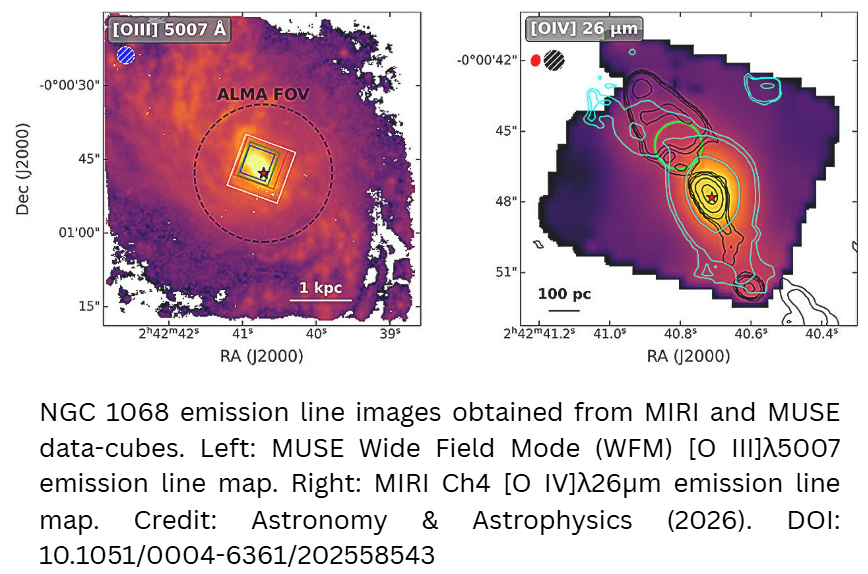
Astronomers have found that a nearby galaxy’s black hole is blasting out a far more powerful and hidden gas outflow than previously realized. Studying NGC1068, a well-known galaxy with an actively feeding black hole at its center, researchers combined new infrared observations with existing data to map how the black hole’s energy is reshaping the surrounding gas. The results are reported in a paper published Aug. 6 in Astronomy & Astrophysics.
Shaping how galaxies evolve As matter falls into supermassive black holes, it releases huge amounts of energy, driving powerful winds or outflows from the galaxy’s center. These outflows can heat the surrounding gas, expel gas and stir up the star-forming material in the galaxy, preventing it from forming new stars...












Recent Comments