








Aberrant spindles and impaired spindle poles in human cancer cells treated with the phenanthridine PJ34. (A) Small aberrant spindles were identified by confocal microscopy in randomly scanned human breast cancer MDA-MB-231 cells incubated with PJ34 (20 μM, 27 h). Spindles were immunolabeled for HSET/kifC1 (green) bound to microtubules. Similarly immunolabeled spindles are not impaired in PJ34 treated normal human breast epithelial cells MCF10A. Bars indicate the spindle length measured by the scale bar (n = 20; 3 different experiments), 95% of the spindles in MDA-MB-231 cells were shorter, 60 ± 5% in size. (B) Upper panel: Impaired spindle poles were identified in randomly scanned fixed MDA-MB-231 cells treated with PJ34 (20 μM, 27 h)...
- Study identifies key driver of inflammation, opening door to potential new treatments
- A Black Hole as light as 40 tons can exist inside a star if dark matter helps
- Diabetes drug metformin could be repurposed to help slow aging mechanisms
- More than 120 molecular species found in giant cloud near Milky Way’s center
Scientists discover Mechanism that causes Cancer Cells to Self-Destruct
March 27, 2017,
 Health/Medical, Biology/Biotechnology
Discovery Showcases Membranes that can Fix themselves
March 27, 2017,
Physics, Technology/Electronics, Chemistry/Nanotechnology
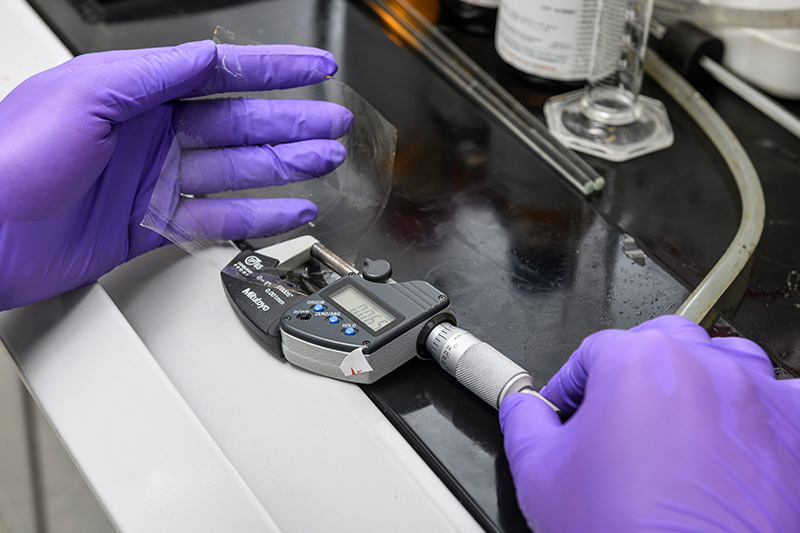
University of Delaware researchers have developed a self-healing membrane for fuel cells. Credit: Kathy F. Atkinson, University of Delaware
Self-healing membrane for hydrogen fuel cells have been developed by scientists. The membrane is typically made from a polymer called Nafion®. During fuel cell operation, it undergoes chemical and mechanical degradation, leading to cracks and pinholes that shorten its life. To address this issue, three members of the University of Delaware’s Department of Mechanical Engineering, Ajay Prasad, Liang Wang and Suresh Advani, have developed a membrane incorporating microcapsules prefilled with a Nafion® solution.
“The microcapsules are designed to rupture when they encounter defects in the membrane and then release the prefilled Nafion® solution to heal t...
Read MoreSafer Batteries made with Wood
March 27, 2017,
Physics, Technology/Electronics, Chemistry/Nanotechnology

Ying Zhang et al. High-capacity, low-tortuosity, and channel-guided lithium metal anode, Proceedings of the National Academy of Sciences (2017). DOI: 10.1073/pnas.1618871114 Credit: University of Maryland
Inspired by the structure of wood, engineers at the University of Maryland have used modified wood as a unique architecture for the negative electrode of a lithium (Li) metal battery, seeking to prevent some of the key factors that lead to battery failure. Li-ion shuttling in rechargeable batteries provides energy to power your phone, laptop, or even just a light bulb. When the battery is charged, the negative electrode: Li metal expands; and when it is discharged, the Li metal deflates...
Read More
BV R color composite of PDS 11, with North up and East to the left. This 4′×4′ composite image is constructed from our observations with the HCT and is color coded as blue, green and red in B, V , R, respectively. The image is centered on PDS 11 binary system, with the northeastern component being PDS 11A. Credit: Mathew et al., 2017.
A team of Indian astronomers has recently studied a peculiar binary system, revealing new insights into the nature of its stars. The findings allowed the researchers to reclassify PDS 11 as an old, dusty, wide binary classical T Tauri system in which both components are actively accreting...
Read More
Recent Comments