Regular Aerobic Exercise beginning in Middle Age may lessen severity of Stroke in Old Age

Regular aerobic exercise may protect the collateral circulation and lessen the severity of strokes later in life.

Regular aerobic exercise may protect the collateral circulation and lessen the severity of strokes later in life.

The network of blood vessels (collateral circulation) shrinks in number and diameter as the brain ages. Collateral circulation allows blood flow to be rerouted when arteries narrow. Using mice, researchers found that this loss of collateral vessels is prevented by exercise, according to a study presented at the American Heart Association’s International Stroke Conference 2017.

The amount of damage to the brain after a stroke and the effectiveness of recovery treatments depend significantly on the extent of collateral circulation.

Mice that started exercising regularly at 12 months-age (equivalent to 40 years-age in humans) had the same abundance of collateral vessels when they ...

Read More

Resveratrol may be an effective intervention for Lung Aging

 Inhaled resveratrol treatments slow ageing-related degenerative changes in mouse lung. Thorax, 2017; thoraxjnl-2016-208964 DOI: 10.1136/thoraxjnl-2016-208964

Inhaled, prophylactic resveratrol treatments can slow the rate of lung function decline, alveolar enlargement and alveolar epithelial type 2 cell DNA damage

For the 1st time inhaled resveratrol was shown to slow aging-related degenerative changes in mouse lung. Lung aging, characterized by airspace enlargement and decreasing lung function, is a significant risk factor for chronic human lung diseases. The study is published online in the journal Thorax. Resveratrol (RSL), a chemical found in red wine, is an antimicrobial chemical substance produced by plants to protect against infection and stress-related changes. It has previously been shown to support muscle metabolism when given orally.

RSL prophylaxis by inhalation was a novel measure taken by the research team as a potential approach f...

Read More

Polymer Additive could revolutionize Plastics Recycling

Polymer additive could revolutionize plastics recycling

Geoffrey Coates, center, in his lab with James Eagan, a postdoctoral researcher in Coates’ group and researcher Anne LaPointe. Credit: Robert Barker/University Photography

When Geoffrey Coates, Tisch University Professor of Chemistry and Chemical Biology, gives a talk about plastics and recycling, he usually opens with this question: What percentage of the 78 million tons of plastic used annually for packaging – for example, a 2-liter bottle or a take-out food container – actually gets recycled and reused in a similar way? The answer is just 2%. Sadly, nearly a third is leaked into the environment, around 14% is used in incineration and/or energy recovery, and a whopping 40% winds up in landfills.

One of the problems: Polyethylene (PE) and polypropylene (PP), 2/3 of the world’s plastic...

Read More

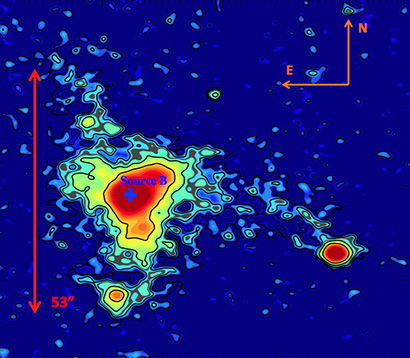
Vast Luminous Nebula poses a Cosmic Mystery

MAMMOTH-1 is an extended blob of gas in the intergalactic medium called an enormous Lyman-alpha nebula (ELAN). The color map and contours denote the surface brightness of the nebula, and the red arrows show its estimated spatial extent. (Image credit: Figure 2 of Cai et al., Astrophysical Journal)

MAMMOTH-1 is an extended blob of gas in the intergalactic medium called an enormous Lyman-alpha nebula (ELAN). The color map and contours denote the surface brightness of the nebula, and the red arrows show its estimated spatial extent. (Image credit: Figure 2 of Cai et al., Astrophysical Journal)

Glowing nebula found at the heart of a huge ‘rotocluster’ of early galaxies appears to be part of the cosmic web of filaments connecting galaxies, but what’s lighting it up? Astronomers have found an enormous, glowing blob of gas in the distant universe, with no obvious source of power for the light it is emitting. Called an “enormous Lyman-alpha nebula” (ELAN), it is the brightest and among the largest of these rare objects, only a handful of which have been observed.

ELANs are huge blobs of gas...

Read More