






New Economic Water-Splitting Catalyst: Ruthenium-based material

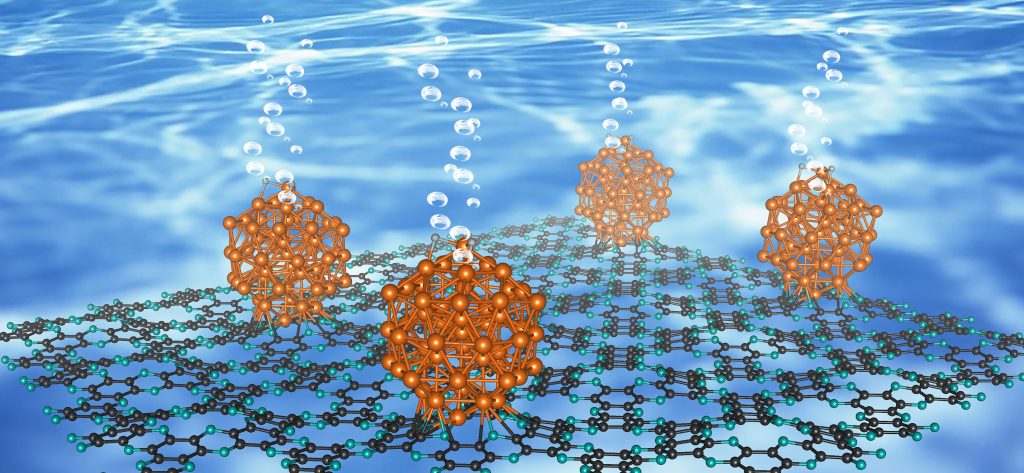
A schematic diagram illustrating the preparation of Ru@C₂N is shown in the figure above. (Ruthenium: shown in gold, Carbon: shown in grey , Nitrogen: shown in sky-blue)

A schematic diagram illustrating the preparation of Ru@C₂N is shown in the figure above. (Ruthenium: shown in gold, Carbon: shown in grey , Nitrogen: shown in sky-blue)

UNIST scientists have developed an exiting new catalyst that can split water into hydrogen almost as well as platinum can, but less costly and found frequently on Earth. As described in the journal Nature Nanotechnology, this ruthenium (Ru)-based material works almost as efficient as platinum and likely shows the highest catalytic performance not affected by the pH of the water.

The research team, led by Professor Jong-Beom Baek of the Energy and Chemical Engineering at UNIST has synthesized Ru and C2N, a 2D organic structure, to verify its performance as a water-splitting catalyst...

Read More

An Area on Mars that appears flooded in the past offers a prime Target to Search for Past Life Forms

Example of geochemically cemented crossbed strata in the interdune near Walvis Bay, Namibia. a) Google Earth image of crossbeds upwind of the windward slope of a barchan in Namibia. White arrows highlight particularly prominent examples b) Ground image of crossbeds showing general relief of interdune (<10cm) c) Wall of pit excavated in interdune (location seen in b) shows dipping sediment layers in subsurface are contiguous with protruding layers on the surface. Alternating high and low albedo layers have different salt composition and grainsize. The darker layer forms the more pronounced micro-ridges.

Example of geochemically cemented crossbed strata in the interdune near Walvis Bay, Namibia. a) Google Earth image of crossbeds upwind of the windward slope of a barchan in Namibia. White arrows highlight particularly prominent examples b) Ground image of crossbeds showing general relief of interdune (<10cm) c) Wall of pit excavated in interdune (location seen in b) shows dipping sediment layers in subsurface are contiguous with protruding layers on the surface. Alternating high and low albedo layers have different salt composition and grainsize. The darker layer forms the more pronounced micro-ridges.

Trinity College Dublin researchers have discovered a patch of land in an ancient valley on Mars that appears to have been flooded by water in the not-too-distant past...

Read More

The Heart of a far-off Star Beats for its Planet

For the first time, astronomers have observed a star pulsing in response to its orbiting planet. The star, HAT-P-2, pictured, is one of the most massive exoplanets known today. The planet, named HAT-P-2b, tracks its star in a highly eccentric orbit, flying extremely close to and around the star, then hurtling far out before eventually circling back around. Credit: Image courtesy of NASA (edited by MIT News)

For the first time, astronomers have observed a star pulsing in response to its orbiting planet. The star, HAT-P-2, pictured, is one of the most massive exoplanets known today. The planet, named HAT-P-2b, tracks its star in a highly eccentric orbit, flying extremely close to and around the star, then hurtling far out before eventually circling back around. Credit: Image courtesy of NASA (edited by MIT News)

Scientists observe first planet-induced stellar pulsations. For the first time, astronomers from MIT and elsewhere have observed a star pulsing in response to its orbiting planet.The star, which goes by the name HAT-P-2, is about 400 light years from Earth and is circled by a gas giant measuring 8X the mass of Jupiter – one of the most massive exoplanets known today...

Read More

Combating Iron in the Brain: Researchers find anti-aging micromolecule

1. Schematic model of miR-29 action in brain aging. During aging an accumulation of iron in neurons occurs. This induces expression of miR-29 that in turn represses expression of IRP-2 thereby limiting iron uptake. This mechanism counteracts aging-related damages. MiR-29 may also counteract effects aging-related phenotypes by additional mechanisms, for example modulation of pro-apoptotic BCL-2 family members 2. MiR-29 is up-regulated with age in neurons. a Genomic organization of miR-29 family in N. furzeri. Three different clusters were isolated (pri-mir-29 1, 2, 3) encoding four different mature members miR-29a, b, d, e. In red, seed sequence is reported, single nucleotide differences in blue. b Age-dependent expression of miR-29 primary transcripts (Pri-miR-29-1, 2, 3) in the brain of N. furzeri. The relative expression was evaluated by RT-qPCR, data were normalized on TATA binding protein (TBP), pri-miR-29-2 results much more expressed than the other clusters and shows a clear age-dependent up-regulation (1 way ANOVA with post-test for trend: R = 0.5285 P < 0.0001, n = 4 animals for age group). c Correlation of miR-29 with its predicted targets. Blue bars show the distribution of Pearson’s correlation coefficients between miR-29a and its predicted target. Light-blue bars show the distribution of correlation values extracted from a bootstrap (P = 10–14, Kolmogorov–Smirnoff). d, e Pri-miR-29-2 expression pattern in N. furzeri brain. d Pri-miR-29-2 signal (red) and HuC/D expression (green) in the optic tectum (TeO). Pri-miR-29-2 shows a nuclear staining and a co-localization with neuronal marker HuC/D along the periventricular gray zone (PGZ), white arrows show neurons in the optic tectum (TeO) negative for pri-miR-29-2. Scale bar = 50 μm. Cerebellum overview picture (e) shows a clear and strong expression of pri-miR-29-2 just in the granular cell layer (GCL), it is instead absent in the Purkinje cell (white arrow) and molecular layer (ML). Scale bar 100 μm

1. Schematic model of miR-29 action in brain aging. During aging an accumulation of iron in neurons occurs. This induces expression of miR-29 that in turn represses expression of IRP-2 thereby limiting iron uptake. This mechanism counteracts aging-related damages. MiR-29 may also counteract effects aging-related phenotypes by additional mechanisms, for example modulation of pro-apoptotic BCL-2 family members
2. MiR-29 is up-regulated with age in neurons. a Genomic organization of miR-29 family in N. furzeri.

The older we get, our brain ages. Cognitive abilities decline and the risk of developing neurodegenerative diseases like dementia, Alzheimer’s and Parkinson’s disease or having a stroke steadily increases...

Read More