






Bacteria links Crohn’s Disease to Arthritis

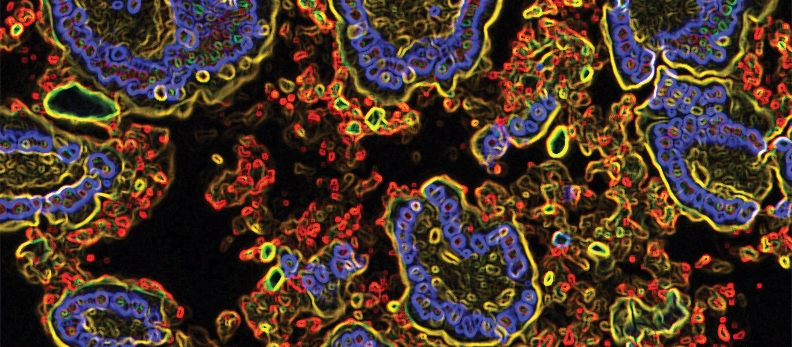
Crohn's disease bacteria drives arthritis. E. coli bacteria (red), which are abundant in the immunoglobulin-A-coated microbiota of patients with a Crohn's disease-associated condition called spondyloarthritis, promote systemic inflammation. The blue circular structures depict the nuclei of cells called epithelial cells. All images: Dr. Kenneth Simpson, Cornell University.

Crohn’s disease bacteria drives arthritis. E. coli bacteria (red), which are abundant in the immunoglobulin-A-coated microbiota of patients with a Crohn’s disease-associated condition called spondyloarthritis, promote systemic inflammation. The blue circular structures depict the nuclei of cells called epithelial cells. All images: Dr. Kenneth Simpson, Cornell University.

Patients with Crohn’s disease, a type of inflammatory bowel disease (IBD) that causes abdominal pain and diarrhea, can also experience joint pain. In Crohn’s disease, which affects about 800,000 Americans, the immune system can attack not only the bowels, but the musculoskeletal system as well, leading to spondyloarthritis, a painful condition that affects the spine and joints. Now new research, published Feb...

Read More
Most Stretchable Elastomer for 3D Printing

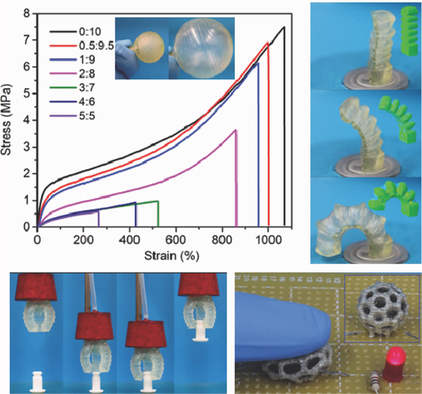
Stretchable UV curable (SUV) elastomers can be stretched by up to 1100% and are suitable for digital light processing (DLP) based 3D printing technology. DLP printing of these SUV elastomers enables the direct creation of highly deformable complex 3D hollow structures such as balloons, soft actuators, grippers, and Bucky ball electronical switches.

Stretchable UV curable (SUV) elastomers can be stretched by up to 1100% and are suitable for digital light processing (DLP) based 3D printing technology. DLP printing of these SUV elastomers enables the direct creation of highly deformable complex 3D hollow structures such as balloons, soft actuators, grippers, and Bucky ball electronical switches.

Due to its excellent material properties of elasticity, resilience, and electrical and thermal insulation, elastomers have been used in a myriad of applications. They are especially ideal for fabricating soft robots, flexible electronics and smart biomedical devices which require soft, deformable material properties for safe and smooth interactions with humans externally and internally.

However, to date, the most widely used silicon rubber-based...

Read More

Versatile 2D Material Grown in lab with many properties

Tungsten Ditelluride

A ball and stick model of the graphene-tungsten ditelluride-graphene stack used for imaging in the research.

University of Pennsylvania researchers are now among the first to produce a single, 3-atom-thick layer of a unique 2D material called tungsten ditelluride. Unlike other 2D materials, scientists believe tungsten ditelluride has what are called topological electronic states. This means that it can have many different properties not just one. When one thinks about 2D materials, graphene is probably the first that comes to mind. The tightly packed, atomically thin sheet of carbon first produced in 2004 has inspired countless avenues in research that could revolutionize everything from technology to drinking water...

Read More

New Evidence in Favor of Dark Matter: The Bars in Galaxies are Spinning more Slowly than we thought

 Kinematic Clues to Bar Evolution for Galaxies in the Local Universe: Why the Fastest Rotating Bars are Rotating Most Slowly. The Astrophysical Journal, 2017; 835 (2): 279 DOI: 10.3847/1538-4357/835/2/279

Kinematic Clues to Bar Evolution for Galaxies in the Local Universe: Why the Fastest Rotating Bars are Rotating Most Slowly. The Astrophysical Journal, 2017; 835 (2): 279 DOI: 10.3847/1538-4357/835/2/279

Fastest spinning bars are rotating most slowly because of dark matter. Why do the majority of astronomers believe in dark matter: matter whose composition is unknown but which seems to make up 80% of the mass of the galaxies? The concept was invented in the 1930’s by Fritz Zwicky who used it to explain why the galaxies in the Coma cluster are moving much more quickly than can be explained in terms of their known masses...

Read More