Novel LED Street Lights Reduce Costs

Array of low-power light-emitting diodes. Failure of a single LED does not affect the overall system. (Photo: KIT)

Array of low-power light-emitting diodes. Failure of a single LED does not affect the overall system. (Photo: KIT)

Researchers of Karlsruhe Institute of Technology (KIT) have developed a novel type of LED street light of increased efficiency. Compared to conventional LEDs, power consumption may be reduced by up to 20%. This will also decrease costs and CO2 emission. Conventional high-power diodes are replaced by a special array of LEDs. This enhances efficiency, increases service life and safety, and produces a better light.

Parallel connection of a large number of LEDs is difficult, as failure of a single diode will cause failure of the overall system or section...

Read More

Stars Align in test supporting ‘Spooky Action at a distance’

(a) The three experimental stations and related acronyms are described in the main text. Stellar photon receiving telescopes (Rx-SP) with primary mirror diameters of 0.2032 m (Meade 8-inch LX200 ACF, f = 2     m ) and 0.254 m (Meade 10-inch LX600 ACF, f = 2.032     m ) were used by Alice and Bob, respectively, although the telescope apertures were each partially covered to limit sky noise. Diameters and focal lengths of the quantum channel telescopes are Alice (Tx-EP: d = 50.8 , f = 100     mm ; Rx-EP: d = 80 , f = 400     mm ) and Bob (Tx-EP: d = 70 , f = 280     mm ; Rx-EP: d = 140 , f = 420     mm ). Latitude, longitude, and elevation for the three experimental sites are Alice ( A : 48.21645°, 16.354311°, 215.0 m), Bob ( B : 48.23160°, 16.3579553°, 200.0 m), and the Source ( S : 48.221311°, 16.356439°, 205.0 m). (b) and (c) For experimental run 1, the setup deviated from the ideal, colinear 1D case by the angles displayed. Site coordinates yield α ≈ 18 0 ° and β ≈ 16 9 ° for both runs. See Table 1 for the azimuth (az) and altitude (alt) of each star observed during each experimental run. (3D graphics taken from Google Earth, 2016.)

(a) The three experimental stations and related acronyms are described in the main text. Stellar photon receiving telescopes (Rx-SP) with primary mirror diameters of 0.2032 m (Meade 8-inch LX200 ACF, f = 2     m ) and 0.254 m (Meade 10-inch LX600 ACF, f = 2.032     m ) were used by Alice and Bob, respectively, although the telescope apertures were each partially covered to limit sky noise. Diameters and focal lengths of the quantum channel telescopes are Alice (Tx-EP: d = 50.8 , f = 100     mm ; Rx-EP: d = 80 , f = 400     mm ) and Bob (Tx-EP: d = 70 , f = 280     mm ; Rx-EP: d = 140 , f = 420     mm ). Latitude, longitude, and elevation for the three experimental sites are Alice ( A : 48.21645°, 16.354311°, 215.0 m), Bob ( B : 48.23160°, 16.3579553°, 200.0 m), and the Source ( S : 48...

Read More

Mysterious White Dwarf Pulsar discovered

This is AR Scorpii, the first discovered white dwarf pulsar. Credit: Mark Garlick/University of Warwick

This is AR Scorpii, the first discovered white dwarf pulsar. Credit: Mark Garlick/University of Warwick

An exotic binary star system 380 light-years away has been identified as an elusive white dwarf pulsar – the first of its kind ever to be discovered in the universe – thanks to research by the University of Warwick. Professors Tom Marsh and Boris Gänsicke (University of Warwick’s Astrophysics Group), with Dr David Buckley (South African Astronomical Observatory), have identified the star AR Scorpii (AR Sco) as the first white dwarf version of a pulsar – objects found in the 1960s and associated with very different objects called neutron stars.

The white dwarf pulsar has eluded astronomers for over half a century...

Read More

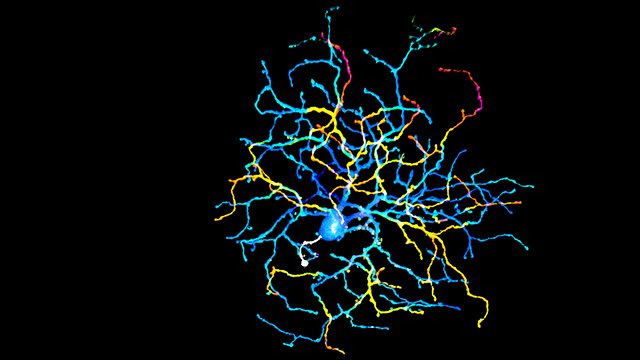
Myopia Cell discovered in Retina: Dysfunction of cell may be linked to amount of time a child spends Indoors

ON Delayed retinal ganglion cell

Image of a ON Delayed retinal ganglion cell colored by its depth in the retina. Arrowheads point out the unique “recursive” morphology of the dendrites that snake up and down.

Northwestern Medicine scientists have discovered a cell in the retina that may cause myopia when it dysfunctions. The dysfunction may be linked to the amount of time a child spends indoors and away from natural light. “This discovery could lead to a new therapeutic target to control myopia,” said Greg Schwartz, lead investigator and assistant professor of ophthalmology at Northwestern University Feinberg School of Medicine...

Read More