






How a Moon Slows the Decay of Pluto’s Atmosphere

How a moon slows the decay of Pluto's atmosphere

Charon (top) and Pluto are only separated by 12,000 or so miles. When Charon is positioned between the sun and Pluto, Georgia Tech research indicates that the moon can significantly reduce atmospheric loss  Credit: NASA-JHUAPL-SwRI

Pluto’s relationship with its moon Charon is one of the more unusual interactions in the solar system due to Charon’s size and proximity. It’s more than half of Pluto’s diameter and orbits only 12,000 or so miles away. To put that into perspective, picture our moon three times closer to Earth, and as large as Mars. A new study from the Georgia Institute of Technology provides additional insight into this relationship and how it affects the continuous stripping of Pluto’s atmosphere by solar wind...

Read More
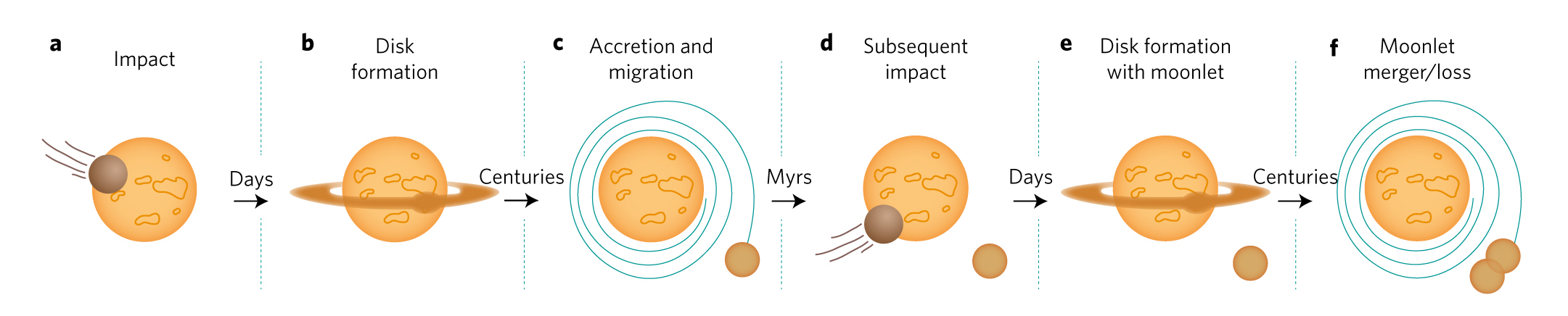
How Earth’s Previous moons Collided to Form the Moon: New Theory

 Lunar formation in the multiple-impact scenario.

Lunar formation in the multiple-impact scenario. Moon- to Mars-sized impactors strike the Earth and leave a disk of debris orbiting the planet. The debris forms “moonlets” and migrate farther away from the Earth due to a tidal interaction, but eventually settle at a distance known as the Hill radius. Here, the moonlets merge to eventually form the moon..

The Moon, and the question of how it was formed, has long been a source of fascination and wonder. Now, a team of Israeli researchers suggests that the Moon we see every night is not Earth’s first moon, but rather the last in a series of moons that orbited Earth in the past. The newly proposed theory by Prof. Hagai Perets, of Technion, and Weizmann Institute Profs...

Read More

Why High-Dose Vitamin C Kills Cancer Cells

Tumor cells have decreased ability to metabolize H2O2: Implications for pharmacological ascorbate in cancer therapy

Tumor cells have decreased ability to metabolize H2O2: Implications for pharmacological ascorbate in cancer therapy

Low levels of catalase enzyme make cancer cells vulnerable to high-dose vitamin C. Vitamin C has a patchy history as a cancer therapy, but researchers at the University of Iowa believe that is because it has often been used in a way that guarantees failure. Most vitamin C therapies involve taking the substance orally. However, the UI scientists have shown that giving vitamin C ntravenously – bypassing normal gut metabolism and excretion – creates blood levels that are 100 – 500 times higher than levels seen with oral ingestion. It is this super-high concentration in the blood that is crucial to vitamin C’s ability to attack cancer cells.

Earlier work by UI redox biology expe...

Read More

Researchers Identify New Potential Treatment for Cancer Metastasis

CDK4/6 inhibition inhibits cancer metastasis.

CDK4/6 inhibition inhibits cancer metastasis.

Breast cancer metastasis, the process by which cancer spreads, may be prevented through the new use of a class of drugs already approved by the FDA. Mayo Clinic researchers have identified that a key drug target, CDK4/6, regulates a cancer metastasis protein, SNAIL, and drugs that inhibit CDK 4/6 could prevent the spread of triple-negative breast cancer. CDK4/6 inhibitors are approved for treating estrogen positive breast cancer, but not triple-negative breast cancer.

For this study, Dr. Lou and his colleagues focused on triple-negative breast cancer, which is difficult to treat, because it does not exhibit receptors for estrogen, progesterone or the HER-2/neu gene, which are targets for many current breast cancer treatments...

Read More