






How to Turn White Fat Brown

Adipose tissue, with fat droplets in green and blood vessels in red. Credit: The laboratory of Zoltan Arany, MD, PhD, Perelman School of Medicine, University of Pennsylvania

Adipose tissue, with fat droplets in green and blood vessels in red. Credit: The laboratory of Zoltan Arany, MD, PhD, Perelman School of Medicine, University of Pennsylvania

A signaling pathway in fat cells may one day provide the key to better treatments for obesity, according to new research by the Perelman School of Medicine, University of Pennsylvania. Ordinary white adipocytes, stuff themselves with fat molecules to store up energy, and their overloading leads to obesity and related conditions, including diabetes. Brown adipocytes, which are prevalent in children as “baby fat,” but much less so in adults, do virtually the opposite: they burn energy rapidly to generate heat, and thereby protect the body from cold as well as obesity and diabetes.

About 36% of American adults are conside...

Read More
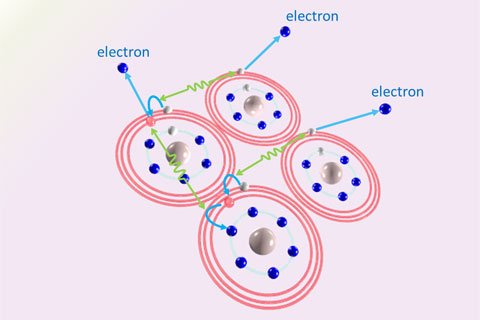
Radiation that knocks electrons out of matter

Scientists have elucidated a surprising novel mechanism of cascading electron emission caused by the Coulombic interaction between highly excited atoms.

Scientists have elucidated a surprising novel mechanism of cascading electron emission caused by the Coulombic interaction between highly excited atoms.

Tohoku University research could have implications for radiation therapy. Physical chemist Kiyoshi Ueda’s team used a free electron laser (FEL) at Japan’s SPring-8 Compact SASE Source test accelerator to investigate how electrons are ‘knocked out’ of neon atom clusters. Intense extreme ultraviolet FEL pulses were directed at the clusters and the resultant energy distribution of electrons knocked out of the clusters was measured using a ‘velocity map imaging spectrometer’.

Electrons inside a material absorb energy when the material is exposed to light. Normally, this energy is used to ‘knock electrons out’ of the material...

Read More

Simple processing technique could Cut Cost of Organic PV and Wearable Electronics

Polymer film for organic PV2

Polymer film for organic PV2 Close-up of polymer films used in polymeric solar cells doped by the new solution-based electrical doping technique. (Credit: Christopher Moore, Georgia Tech)

A simple solution-based electrical doping technique could help reduce the cost of polymer solar cells and organic electronic devices, potentially expanding the applications for these technologies. By enabling production of efficient single-layer solar cells, the new process could help move organic photovoltaics into a new generation of wearable devices and enable small-scale distributed power generation.

Developed by researchers at Georgia Institute of Technology and colleagues from 3 other institutions, the technique provides a new way of inducing p-type electrical doping in organic semiconductor films...

Read More

To Mars in 70 days: NASA finally releases its paper on controversial EM Drive Propulsion system

EM Drive in forward thrust configuration. (NASA Photo)

EM Drive in forward thrust configuration. (NASA Photo)

After months of speculation and rumor, NASA has finally released its long-awaited research paper, published in the American Institute of Aeronautics and Astronautics’ peer-reviewed Journal of Propulsion and Power. If the electromagnetic technology proves sound, it could radically change the way humans travel in space, opening up the possibility of journeys to Mars in just 70 days. But there is no shortage of skeptics who are adamant that the drive is more science fiction than science fact. Critics are quick to point out that the drive violates one of the fundamental laws of physics, namely: for every action, there is an equal and opposite reaction...

Read More