






‘Spooky’ Sightings in Crystal point to Extremely Rare Quantum Spin Liquid

Ytterbium crystal produces lots of apparent 'spooky' actions

The tiny YbMgGaO4 crystal, here perched on a stand for testing, appears to be the next extremely rare material to produce an equally as rare observable quantum spin liquid. Credit: Georgia Tech / Martin Mourigal

Inside a new exotic crystal, physicist Martin Mourigal has observed strong indications of “spooky” action, and lots of it. The results of his experiments, if corroborated over time, would mean that the type of crystal is a rare new material that can produce an observable quantum spin liquid. Currently, only a small handful of materials are believed to possibly have these properties. This new crystal was synthesized for the first time only a year ago.

A “liquid” found inside a solid object may sound confusing to many people...

Read More
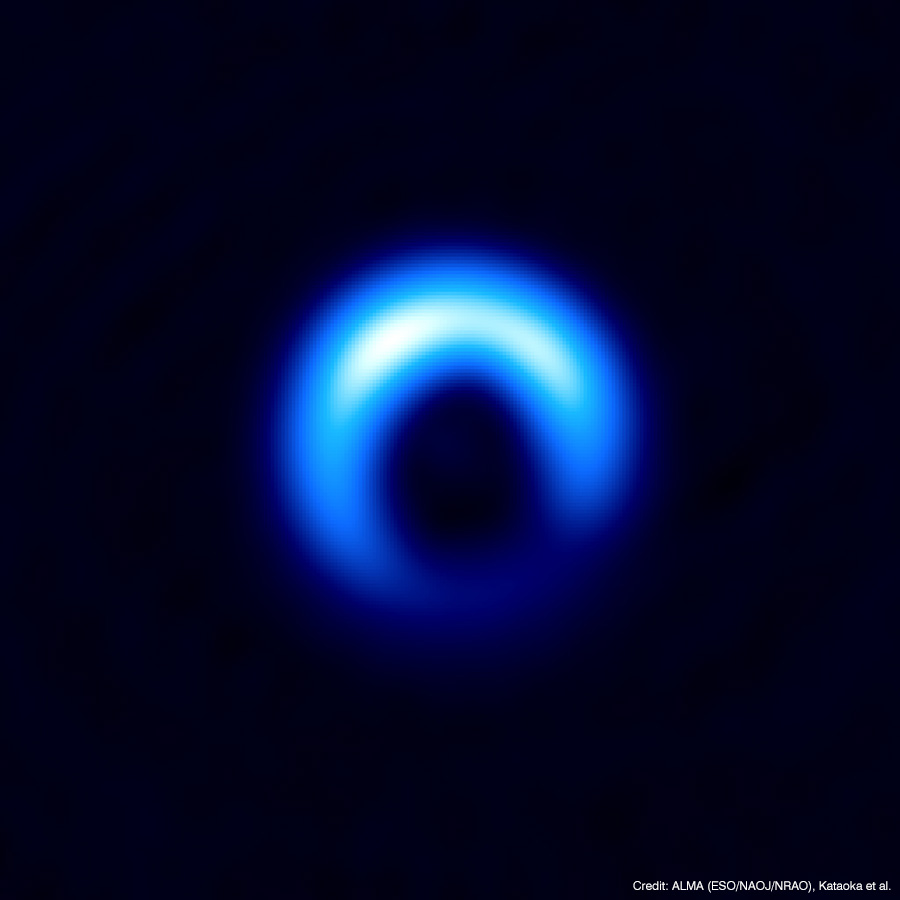
ALMA measures Size of Seeds of Planets

Dust disk around the young star HD 142527 observed with ALMA.

Dust disk around the young star HD 142527 observed with ALMA.

Researchers have for the first time, achieved a precise size measurement of small dust particles around a young star through radio-wave polarization. ALMA’s high sensitivity for detecting polarized radio waves made possible this important step in tracing the formation of planets around young stars. Astronomers have believed that planets are formed from gas and dust particles, although the details of the process have been veiled. One of the major enigmas is how dust particles as small as 1 micrometer aggregate to form a rocky planet with a diameter of 10,000 km. Difficulty in measuring the size of dust particles has prevented astronomers from tracing the process of dust growth.

Akimasa Kataoka and his collaborators have theoretic...

Read More

Cassini makes 1st Ring-grazing Plunge

Cassini makes first ring-grazing plunge

This graphic shows the closest approaches of Cassini’s final two orbital phases. Ring-grazing orbits are shown in gray (at left); Grand Finale orbits are shown in blue. The orange line shows the spacecraft’s Sept. 2017 final plunge into Saturn. Image credit: NASA/JPL-Caltech

NASA’s Saturn-orbiting Cassini spacecraft has made its first close dive past the outer edges of Saturn’s rings since beginning its penultimate mission phase on Nov. 30. Cassini crossed through the plane of Saturn’s rings on Dec. 4 at 5:09 a.m. PST at a distance of ~57,000 miles above Saturn’s cloud tops. This is the approximate location of a faint, dusty ring produced by the planet’s small moons Janus and Epimetheus, and just 6,800 miles from the center of Saturn’s F ring.

About an hour prior to the ring-plane crossing...

Read More

New Mechanism to Control Human Viral Infections discovered

This image illustrates the beginning stages of an influenza infection and shows what happens after the influenza viruses enter the human body. Credit: Centers for Disease Control and Prevention

This image illustrates the beginning stages of an influenza infection and shows what happens after the influenza viruses enter the human body. Credit: Centers for Disease Control and Prevention

A team co-led by a University of California, Riverside professor, has found a long-sought-after mechanism in human cells that creates immunity to influenza A virus, which causes annual seasonal epidemics and occasional pandemics.The research could have broad implications on the immunological understanding of human diseases caused by RNA viruses including influenza, Ebola, West Nile, and Zika viruses.

“This opens up a new way to understand how humans respond to viral infections and develop new methods to control viral infections,” said Prof. Shou-Wei Ding...

Read More