






Sponge-like materials Capture, Store, and Release Essential small molecules

The schematic image of molecular structure shows trapped gas (shown in green) in the nanospace of MOF/PCP. The materials acting like sponge capture, store, and release gas molecules. Credit: Copyright : Ryotaro MATSUDA

The schematic image of molecular structure shows trapped gas (shown in green) in the nanospace of MOF/PCP. The materials acting like sponge capture, store, and release gas molecules. Credit: Copyright : Ryotaro MATSUDA

Prof. Ryotaro Matsuda, Nagoya University, and Prof. Susumu Kitagawa, Kyoto University, won the contest “Air Liquide Essential Molecules Challenge.” For the first edition of the challenge, their project was selected as 1 in 3 from a total of 130 scientific proposals submitted by academic teams, R&D departments, and start-ups from 25 countries.

Essential molecules, eg. O2, N2, C2H2, CO, CO2, NO, NO2, and/or noble gases, are fundamental resources for our cultural lives...

Read More
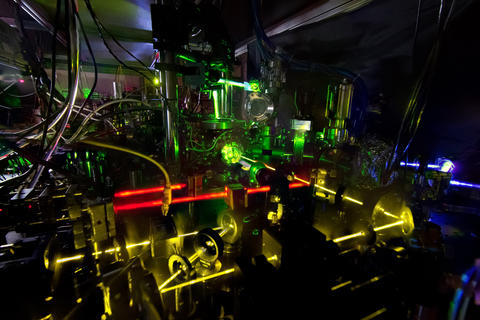
NIST debuts Dual Atomic Clock—and a new Stability record

Ytterbium Clock

One of NIST’s ytterbium lattice atomic clocks. NIST physicists combined two of these experimental clocks to make the world’s most stable single atomic clock. The image is a stacked composite of about 10 photos in which an index card was positioned in front of the lasers to reveal the laser beam paths. Credit: N. Phillips/NIST

What could be better than a world-leading atomic clock? 2 clocks in 1. Physicists NIST have combined two experimental atomic clocks based on ytterbium atoms to set yet another world record for clock stability. Stability can be thought of as how precisely the duration of each clock tick matches every other tick that comes before and after...

Read More

Violent Collision of Massive Supernova with surrounding gas powers Superluminous Supernovae

Artist's conception of a shock-interacting supernova. Successive eruptions of a massive star produce ejecta with different velocities: the blue ring corresponds to slowly moving layers which are punched by fast ejecta (red-to-yellow) which shoots out. Interaction of those gas masses is via radiating shock waves which produce enormous amounts of light. This explains the phenomenon of Superluminous Supernovae with minimum requirements to the energy budget of explosions. (Credit: Kavli IPMU)

Artist’s conception of a shock-interacting supernova. Successive eruptions of a massive star produce ejecta with different velocities: the blue ring corresponds to slowly moving layers which are punched by fast ejecta (red-to-yellow) which shoots out. Interaction of those gas masses is via radiating shock waves which produce enormous amounts of light. This explains the phenomenon of Superluminous Supernovae with minimum requirements to the energy budget of explosions. (Credit: Kavli IPMU)

In a unique study, an international team including Kavli IPMU simulated the violent collisions between supernovae and its surrounding gas— which is ejected before a supernova explosion, thereby giving off an extreme brightness...

Read More

Connection found between Memory Mechanisms, Resistance to Epilepsy

eEF2 pathways regulate cellular protein translation. (A) Activation of NMDA receptor enables Ca2+ to enter the cell. In the presence of Ca2+ and calmodulin (CaM) elongation factor 2 kinase (eEF2K) is activated, leading to increased phosphorylation (and inhibition) of elongation factor 2 (eEF2) and overall decreased protein translation. (B) Protein kinase A (PKA) can phosphorylate eEF2K, thereby reducing eEF2K dependency on calmodulin and Ca2+, making eEF2K more active. In the presence of calmodulin and Ca2+, eEF2K inhibits eEF2 activity by phosphorylation, which results in attenuated cap-dependent translation, but evidently, can increase translation of other proteins like Arc, BDNF, and, αCAMKII. (C) Possible mTOR pathway for translation regulation. mTOR can regulate eEF2 phosphorylation and, consequently, elongation by phosphorylation of S6K1 for example, which can then inhibit eEF2K activity by phosphorylation (different phosphorylation site from PKA), leading to decreased phospho-eEF2 levels and increased elongation rate.

eEF2 pathways regulate cellular protein translation

A new study exposes a new biological mechanism that, on the one hand, damages a very specific type of memory, but at the same time provides resistance to epilepsy. Research student Elham Taha from the laboratory of Prof. Kobi Rosenblum explains: “In both healthy and sick brains, the relationship between the activities of the nerve cells that cause the transfer of information and activities delaying the transmission of information is extremely important. We know that damage to this relationship forms the basis of various brain diseases, such as neuro-developmental diseases and epilepsy. The aim of our study was to isolate molecular components that serve the creation of long-term memories...

Read More