






New Quantum States for better Quantum Memories

Ein künstlicher Diamant unter dem optischen Mikroskop. Da der Diamant viele Stickstoff Fehlstellen enthält, fluoresziert er in roter Farbe.

An artificial diamond under the optical microscope. The diamond fluoresces because due to a number of nitrogen defects.

How can quantum information be stored as long as possible? An important step forward in the development of quantum memories has been achieved by a research team of TU Wien. Conventional memories used in today’s computers only differentiate between the bit values 0 and 1. In quantum physics, however, arbitrary superpositions of these 2 states are possible. Most of the ideas for new quantum technology devices rely on this “Superposition Principle.” One of the main challenges in using such states is that they are usually short-lived. Only for a short period of time can information be read out of quantum memories reliably, after that it is irrecoverable.

A team at TU Wien has...

Read More
Supersonic Spray yields new Nanomaterial for Bendable, Wearable Electronics

Left, photograph of a large-scale silver nanowire-coated flexible film. Right, silver nanowire particles viewed under the microscope. Credit: S.K. Yoon, Korea University

Left, photograph of a large-scale silver nanowire-coated flexible film. Right, silver nanowire particles viewed under the microscope. Credit: S.K. Yoon, Korea University

A new, ultrathin film that is both transparent and highly conductive to electric current has been produced by a cheap and simple method devised by an international team of nanomaterials researchers from University of Illinois at Chicago and Korea University. The film is also bendable and stretchable, offering potential applications in roll-up touchscreen displays, wearable electronics, flexible solar cells and electronic skin.

The new film is made of fused silver nanowires, and is produced by spraying the nanowire particles through a tiny jet nozzle at supersonic speed...

Read More

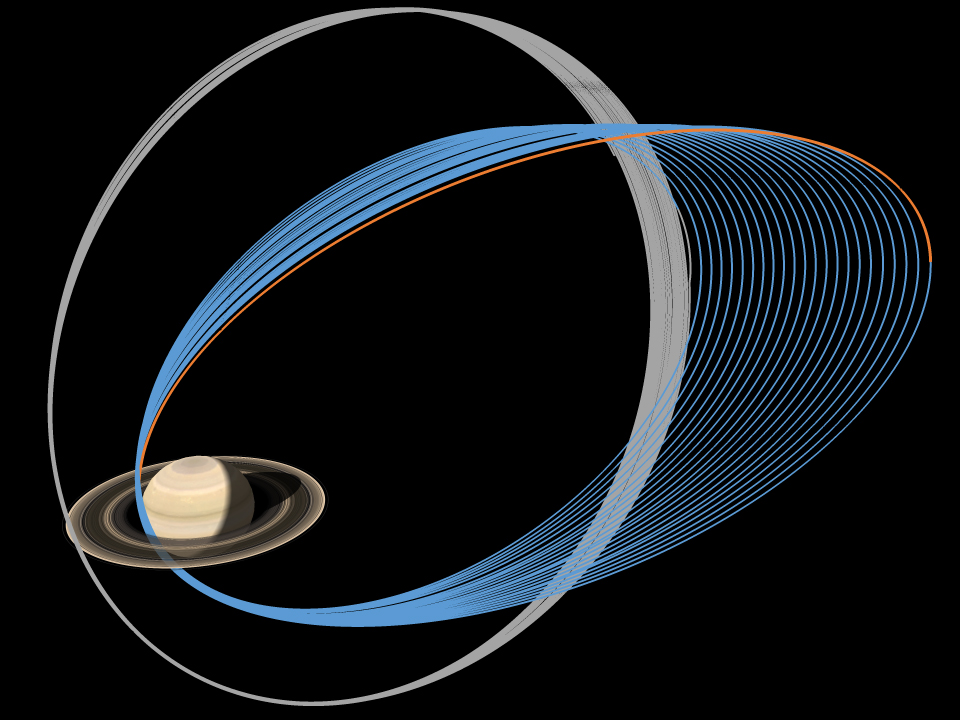
Cassini Prepares for ‘Ring-Grazing Orbits’

This diagram shows Saturns ring-grazing and planet-grazing orbits

This graphic illustrates the Cassini spacecraft’s trajectory, or flight path, during the final two phases of its mission. The view is toward Saturn as seen from Earth. The 20 ring-grazing orbits are shown in gray; the 22 grand finale orbits are shown in blue. The final partial orbit is colored orange. Image credit: NASA/JPL-Caltech/Space Science Institute

A thrilling ride is about to begin for NASA’s Cassini spacecraft. Engineers have been pumping up the spacecraft’s orbit around Saturn this year to increase its tilt with respect to the planet’s equator and rings. And on Nov. 30, following a gravitational nudge from Saturn’s moon Titan, Cassini will enter the first phase of the mission’s dramatic endgame...

Read More

Mars Ice Deposit holds as much water as Lake Superior

This vertically exaggerated view shows scalloped depressions in a part of Mars where such textures prompted researchers to check for buried ice, using ground-penetrating radar aboard NASA's Mars Reconnaissance Orbiter. Credit: NASA/JPL-Caltech/Univ. of Arizona

This vertically exaggerated view shows scalloped depressions in a part of Mars where such textures prompted researchers to check for buried ice, using ground-penetrating radar aboard NASA’s Mars Reconnaissance Orbiter. Credit: NASA/JPL-Caltech/Univ. of Arizona

Frozen beneath a region of cracked and pitted plains on Mars lies about as much water as what’s in Lake Superior, largest of the Great Lakes, researchers using NASA’s Mars Reconnaissance Orbiter have determined. Scientists examined part of Mars’ Utopia Planitia region, in the mid-northern latitudes, with the orbiter’s ground-penetrating Shallow Radar (SHARAD) instrument. Analyses of data from >600 overhead passes with the onboard radar instrument reveal a deposit more extensive in area than the state of New Mexico...

Read More