


Astrophysicists explore our galaxy’s magnetic turbulence in unprecedented detail using a new computer model

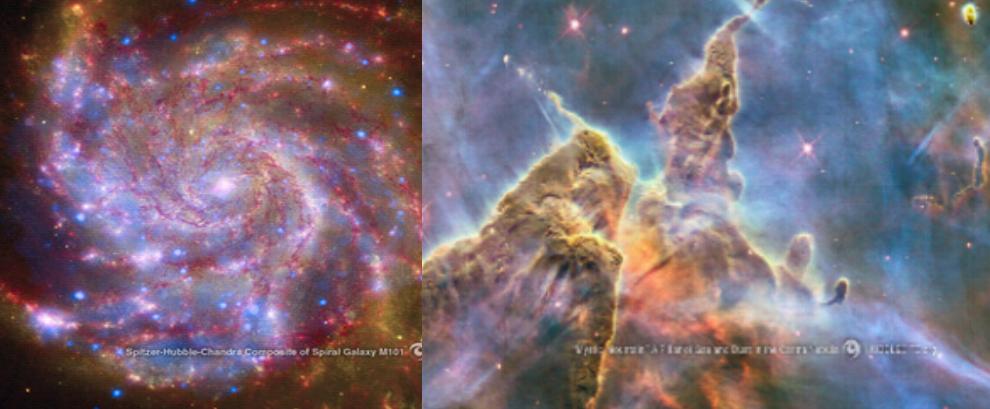
A close up of colourful swirls and lines, a composite image of the Phantom Galaxy.
A composite image of the Phantom Galaxy and (inset) a high-resolution simulation of galactic turbulence with magnetic field lines in white. Photo: ESA/Webb, NASA & CSA, J. Lee and the PHANGS-JWST Team; Acknowledgement: J. Schmidt; Simulation: J. Beattie.

“Turbulence remains one of the greatest unsolved problems in classical mechanics,” says James Beattie, a postdoctoral researcher at the Canadian Institute for Theoretical Astrophysics (CITA) in the Faculty of Arts & Science at the University of Toronto, who also holds a joint appointment at Princeton University.

“This despite the fact that turbulence is ubiquitous: from swirling milk in our coffee to chaotic flows in the oceans, solar wind, interstellar medium, even the plasma between galaxies.

“The key distinction in astro...

Read More

Forgotten cell clusters may hold key to diabetic neuropathy pain

Human dorsal root ganglia in a case of diabetic peripheral neuropathy show formation of Nageotte nodules (circled in pink), which appear to be a strong indicator of nerve cell death.

A phenomenon largely ignored since its discovery 100 years ago appears to be a crucial component of diabetic pain, according to new research from The University of Texas at Dallas’s Center for Advanced Pain Studies (CAPS).

Findings from a new study published in Nature Communications suggest that cell clusters called Nageotte nodules are a strong indicator of nerve cell death in human sensory ganglia. These could prove to be a target for drugs that would protect these nerves or help manage diabetic neuropathy.

“The key finding of our study is really a new view of diabetic neuropathic pain,” said Dr...

Read More

Universe decays faster than thought, but still takes a long time

Uiteenvallende neutronenster

The universe is decaying much faster than thought. This is shown by calculations of three scientists at Radboud University on the so-called Hawking radiation. They calculate that the last stellar remnants take about 10^78 years (a 1 with 78 zeros) to perish. That is much shorter than the previously postulated 10^1100 years (a 1 with 1100 zeros). The researchers publish their findings, with a wink and dead-seriously, in the Journal of Cosmology and Astroparticle Physics.

The research by black hole expert Heino Falcke, quantum physicist Michael Wondrak, and mathematician Walter van Suijlekom (all from Radboud University, Nijmegen, the Netherlands) is a follow-up to a 2023 paper by the same trio...

Read More

Heart rhythm disorder traced to bacterium lurking in gums

Heart rhythm disorder traced to bacterium lurking in our gums
Immunohistochemical staining in mice shows Porphyromonas gingivalis (green) entering cardiac muscle through small blood vessels in the left atrium. Credit: Shunsuke Miyauchi/Hiroshima University

Tempted to skip the floss? Your heart might thank you if you don’t. A new study from Hiroshima University (HU) finds that the gum disease bacterium Porphyromonas gingivalis (P. gingivalis) can slip into the bloodstream and infiltrate the heart. There, it quietly drives scar tissue buildup—known as fibrosis—distorting the heart’s architecture, interfering with electrical signals, and raising the risk of atrial fibrillation (AFib).

Clinicians have long noticed that people with periodontitis, a common form of gum disease, seem more prone to cardiovascular problems...

Read More