To raise new questions, new possibilities, to regard old problems from a new angle, requires creative imagination and marks real advance in science.
~Albert Einstein
Read More
Old Newtonian physics claimed that things have an objective reality separate from our perception of them. Quantum physics, and particularly Heisenberg's Uncertainty Principle, reveal that, as our perception of an object changes, the object itself literally changes.
~Marianne Williamson
Read More
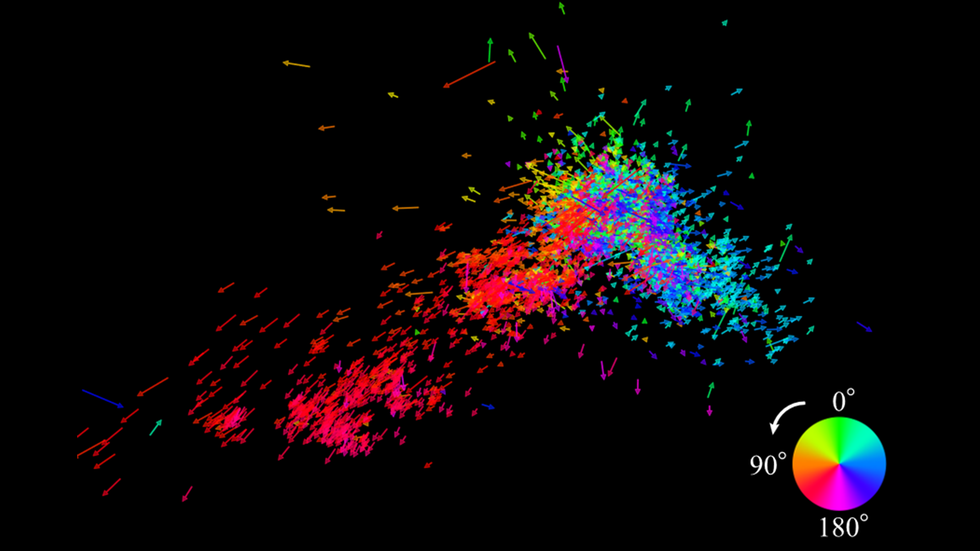
Velocities of massive star candidates within the SMC shown as vectors. The colors of the arrows represent the direction of motion. Relative to the LMC, located at the bottom left of the image, most red arrows show movement towards the LMC, whereas most light blue arrows show movement away from the LMC, suggesting they are being pulled apart. (credit: Satoya Nakano)
Our closest neighboring galaxy may be being torn apart. Is the nearest galaxy to ours being torn apart? Research suggests so. A team led by Satoya Nakano and Kengo Tachihara at Nagoya University in Japan has revealed new insights into the motion of massive stars in the Small Magellanic Cloud (SMC), a small galaxy neighboring the Milky Way...
A research team led by Virginia Commonwealth University and Columbia University has gained novel insights into a protein suspected to be involved in benzodiazepine-related inflammation. (Getty Images)
Benzodiazepines like Valium and Xanax are often prescribed to treat anxiety, insomnia and seizures. While these drugs can be effective as a short-term treatment, researchers are trying to better understand the impact of benzodiazepines after extended use.
Some experts believe long-term use of the medication may influence inflammation levels in our bodies, as previous research has shown that benzodiazepines may increase the risk of developing or worsening inflammatory conditions, like lung inflammation and inflammatory bowel disease...
In recent years, computer scientists have created various highly performing machine learning tools to generate texts, images, videos, songs and other content. Most of these computational models are designed to create content based on text-based instructions provided by users.
Researchers at the Hong Kong University of Science and Technology recently introduced AudioX, a model that can generate high quality audio and music tracks using texts, video footage, images, music and audio recordings as inputs. Their model, introduced in a paper published on the arXiv preprint server, relies on a diffusion transformer, an advanced machine learning algorithm that leverages the so-called transformer architecture to generate content by progressively de-noising the input data it receives.
The Whirlpool Galaxy, M51, is a spiral galaxy located 31 million light-years away. Credit: NASA
A new study in Monthly Notices of the Royal Astronomical Society by researchers including István Szapudi of the University of Hawaiʻi at Mānoa Institute for Astronomy suggests the universe may rotate—just extremely slowly. The finding could help solve one of astronomy’s biggest puzzles.
“To paraphrase the Greek philosopher Heraclitus of Ephesus, who famously said ‘panta rhei’ (everything moves), we thought that perhaps panta kykloutai—everything turns,” said Szapudi.
Current models say the universe expands evenly in all directions, with no sign of rotation. This idea fits most of what astronomers observe...













Recent Comments