To raise new questions, new possibilities, to regard old problems from a new angle, requires creative imagination and marks real advance in science.
~Albert Einstein
Read More
Old Newtonian physics claimed that things have an objective reality separate from our perception of them. Quantum physics, and particularly Heisenberg's Uncertainty Principle, reveal that, as our perception of an object changes, the object itself literally changes.
~Marianne Williamson
Read More
The core of the Phoenix cluster is shown across the whole electromagnetic spectrum. The bright purples represent X-rays produced by the hot gas, and the dashed purple outlines show regions where this hot gas has been pushed away by the radio jets from the supermassive black hole. The radio jets themselves are shown in red colors. The blues and yellows represent visible light emitted by cool gas and stars. The green contours show the “warm” gas that is in the process of cooling, newly measured in the MIT study with JWST. Credit: NASA
The core of a massive cluster of galaxies appears to be pumping out far more stars than it should. Now researchers at MIT and elsewhere have discovered a key ingredient within the cluster that explains the core’s prolific starburst.
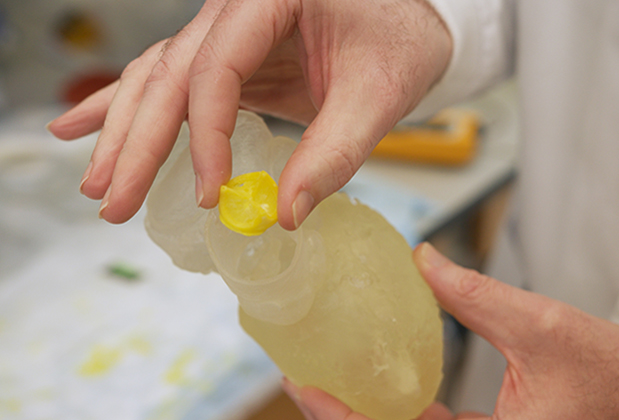
The bioresorbable heart valve (yellow) that promotes tissue regeneration and a 3D-printed heart model.
Every year, more than 5 million people in the U.S. are diagnosed with heart valve disease, but this condition has no effective long-term treatment. When a person’s heart valve is severely damaged by a birth defect, lifestyle, or aging, blood flow is disrupted. If left untreated, there can be fatal complications.
Valve replacement and repair are the only methods of managing severe valvular heart disease, but both often require repeated surgeries that are expensive, disruptive, and life-threatening. Most replacement valves are made of animal tissue and last up to 10 or 15 years before they must be replaced...
VNA equipment (left) and the magnon device (right) used by the research group to observe the magnon microstructure. Credit: Korea Research Institute of Standards and Science (KRISS)
A Korean research team has succeeded in securing a basic technology for further improving the completeness level of neuromorphic devices. Their paper is published in the journal Nature Communications.
Researchers from the Korea Research Institute of Standards and Science observed the fine structure of the magnon, which is attracting attention as a key material for neuromorphic devices. As areas that are approximately 1,000 times finer than before were observed successfully, it is expected that the results will enable the design of more sophisticated neuromorphic devices.
Aomawa Shields, UC Irvine associate professor of physics and astronomy, headed a study comparing the climates of two exoplanets. Computer simulations led her team to conclude that white dwarf stars – previously considered inhospitable to life-supporting exoplanets – could, in fact, host planets in their habitable zones with comparatively temperate climates. Steve Zylius / UC Irvine
Among the roughly 10 billion white dwarf stars in the Milky Way galaxy, a greater number than previously expected could provide a stellar environment hospitable to life-supporting exoplanets, according to astronomers at the University of California, Irvine.
In a paper published recently in The Astrophysical Journal, a research team led by Aomawa Shields, UC Irvine associate professor of physics and as...












Recent Comments