To raise new questions, new possibilities, to regard old problems from a new angle, requires creative imagination and marks real advance in science.
~Albert Einstein
Read More
Old Newtonian physics claimed that things have an objective reality separate from our perception of them. Quantum physics, and particularly Heisenberg's Uncertainty Principle, reveal that, as our perception of an object changes, the object itself literally changes.
~Marianne Williamson
Read More
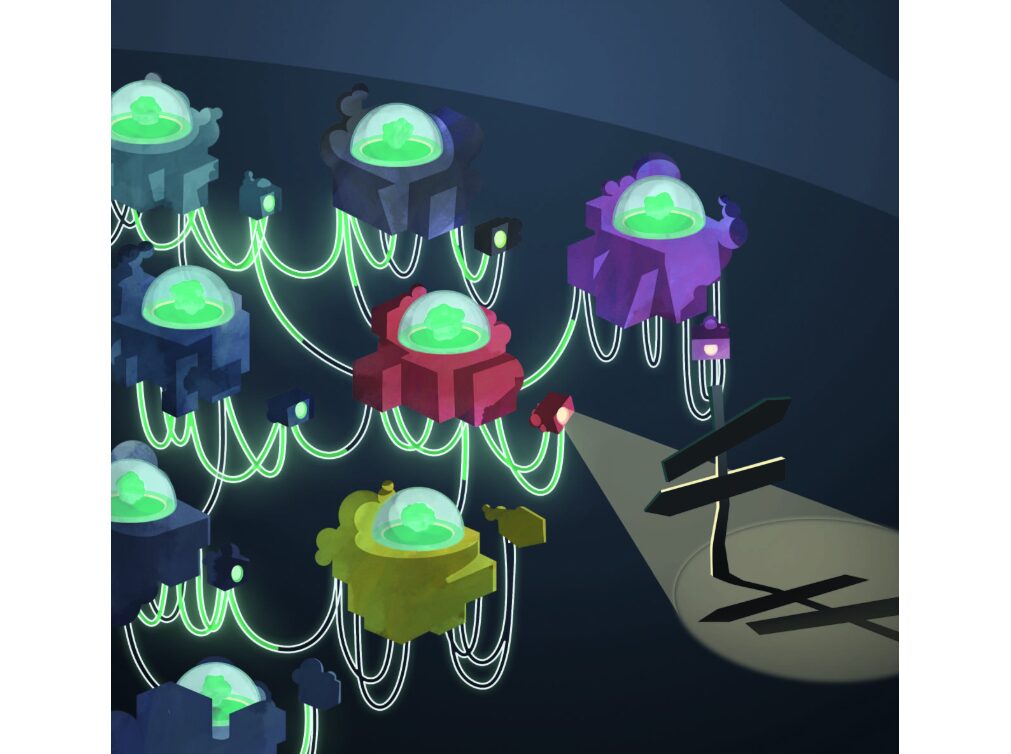
Here, each neuron is represented as spacecrafts, with their pilots in the cockpits depicted in the shape of protein 3D structures. These spacecrafts collectively process and transmit information to the final red neuron to make decisions on space navigation. The wires that connect the neurons, with the green substance inside, indicate the flow of biological information. Credit: Ehmad Chehre
Westlake University in China and the California Institute of Technology have designed a protein-based system inside living cells that can process multiple signals and make decisions based on them.
The researchers have also introduced a unique term, “perceptein,” as a combination of protein and perceptron...
This image made available by NASA shows an artist’s rendering of the Parker Solar Probe approaching the Sun. It’s designed to take solar punishment like never before, thanks to its revolutionary heat shield that’s capable of withstanding 2,500 degrees Fahrenheit (1,370 degrees Celsius). Credit: Steve Gribben/Johns Hopkins APL/NASA via AP, File
A NASA spacecraft aims to fly closer to the sun than any object sent before. The Parker Solar Probe was launched in 2018 to get a close-up look at the sun. Since then, it has flown straight through the sun’s corona: the outer atmosphere visible during a total solar eclipse.
The next milestone: closest approach to the sun. Plans call for Parker on Tuesday to hurtle through the sizzling solar atmosphere and pass within a record-breaking 3...
Kirk Staschke and Noah Sommers, a PhD student at the IU School of Medicine, at the microscope. | Photo courtesy of Kirk Staschke
New research by a team of Indiana University School of Medicine scientists and their collaborators has uncovered a novel vulnerability in prostate cancer animal models that starves prostate tumors of critical nutrients and stunts their growth, which could lead to the development of new treatments for the deadly disease.
Led by IU School of Medicine’s Kirk Staschke, Ph.D., assistant research professor of biochemistry and molecular biology, and Ronald C. Wek, Ph.D., Showalter Professor of Biochemistry, the study was recently published in Science Signaling.
Prostate cancer is a leading cause of cancer deaths in American men...
PTE measurement results at the ERWPT resonance frequency in the midrange (2m): Almost the same PTE in the lateral plane (xy-plane), demonstrating arrangement free characteristics, while the PTE and resonance frequency vary depending on the z-direction position. Credit: Advanced Science (2024). DOI: 10.1002/advs.202407827
A groundbreaking advancement in technology is paving the way for mobile phones and other electronic devices to recharge simply by being kept in a pocket. This innovative system enables wireless charging throughout three-dimensional (3D) spaces, encompassing walls, floors, and air.
On December 12, Professor Franklin Bien and his research team in the Department of Electrical Engineering at UNIST announced the creation of a revolutionary electric resonance-based wire...












Recent Comments