





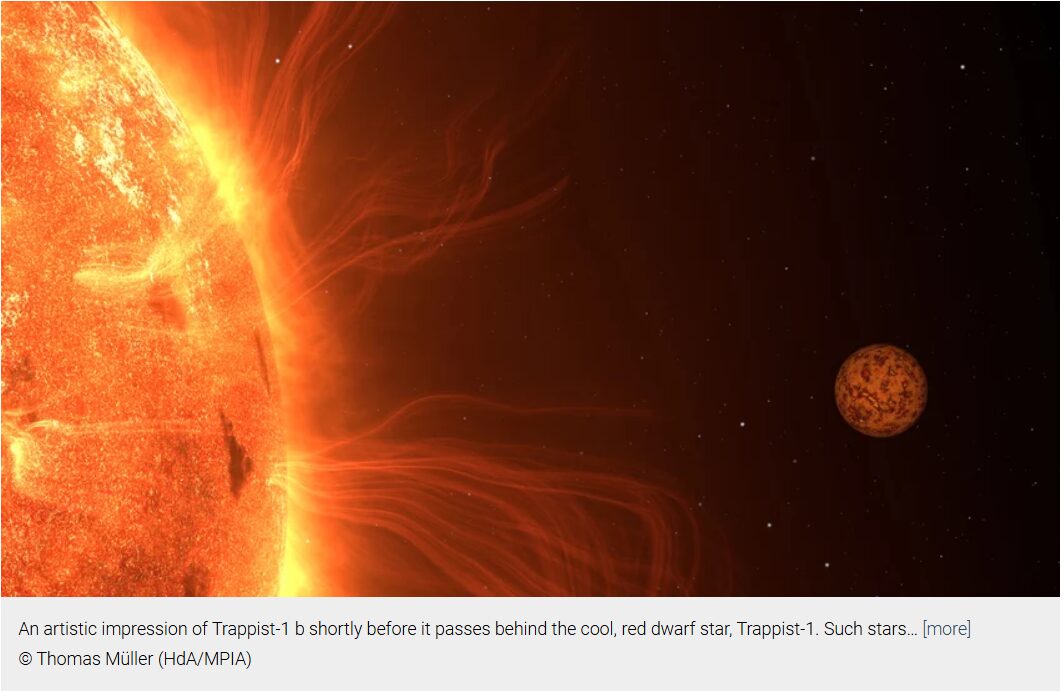
Does the Exoplanet Trappist-1 b have an Atmosphere after all?

New observations reveal the challenges of detecting planetary atmospheres

Recent measurements with the James Webb Space Telescope (JWST) cast doubt on the current understanding of the exoplanet Trappist-1 b’s nature. Until now, it was assumed to be a dark rocky planet without an atmosphere, shaped by a billion-year-long cosmic impact of radiation and meteorites. The opposite appears to be true. The surface shows no signs of weathering, which could indicate geological activity such as volcanism and plate tectonics. Alternatively, a planet with a hazy atmosphere composed of carbon dioxide is also viable. The results demonstrate the challenges of determining the properties of exoplanets with thin atmospheres.

Trappist-1 b is one of seven rocky planets orbiting the star Trappist-1, ...

Read More
Researchers Find Previously Unknown Links between Microbial Bile Acids and the Risk of Colon Cancer

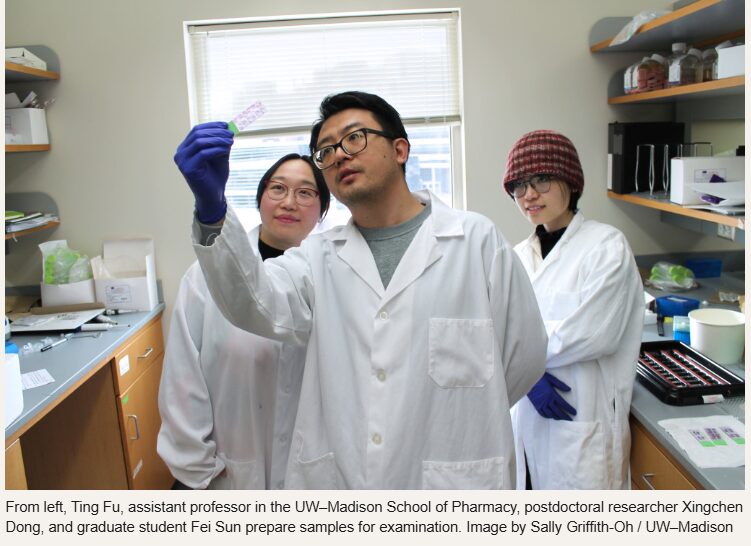
Microbes living in our guts help us digest food by reshaping the bile acids that our livers produce for breaking down fats. It turns out that two of these microbially-modified bile acids may affect our risk—in opposite directions—for developing colon cancer.

The link between these bile acids and colon cancer risk was recently uncovered as University of Wisconsin–Madison scientists sought to better understand the relationship between gut microbes and our bodies.

In many ways, that relationship revolves around a specific protein called the farnesoid X receptor, or FXR, which helps maintain a healthy gut through its intimate relationship with bile acids...

Read More

Tiny Chips promise Swift Disease Diagnosis from a Single Breath

Out of thin air: Researchers create microchips capable of detecting and diagnosing diseases
Site-selective immobilization of different bioreceptors on individual field-effect transistors, achieved through the use of thermal scanning probe lithography. Each bioreceptor can be tuned to detect a different disease. Credit: NYU Tandon School of Engineering

In a world grappling with a multitude of health threats—ranging from fast-spreading viruses to chronic diseases and drug-resistant bacteria—the need for quick, reliable, and easy-to-use home diagnostic tests has never been greater. Imagine a future where these tests can be done anywhere, by anyone, using a device as small and portable as your smartwatch. To do that, you need microchips capable of detecting miniscule concentrations of viruses or bacteria in the air.

Now, new research shows it’s possible to develop and buil...

Read More

Simulation Sheds Light on Earth’s Magnetic Field Generation while Advancing Neuromorphic Computing

New simulation method sharpens our view into the Earth’s interior—method could advance neuromorphic computing for AI
Structure of the Earth. Credit: B. Schröder/HZDR/NASA/Goddard Space Flight Center Scientific Visualization Studio

How does the Earth generate its magnetic field? While the basic mechanisms seem to be understood, many details remain unresolved. A team of researchers from the Center for Advanced Systems Understanding at the Helmholtz-Zentrum Dresden-Rossendorf, Sandia National Laboratories (U.S.) and the French Alternative Energies and Atomic Energy Commission has introduced a simulation method that promises new insights into the Earth’s core.

The method, presented in the Proceedings of the National Academy of Sciences, simulates not only the behavior of atoms, but also the magnetic properties of materials...

Read More