
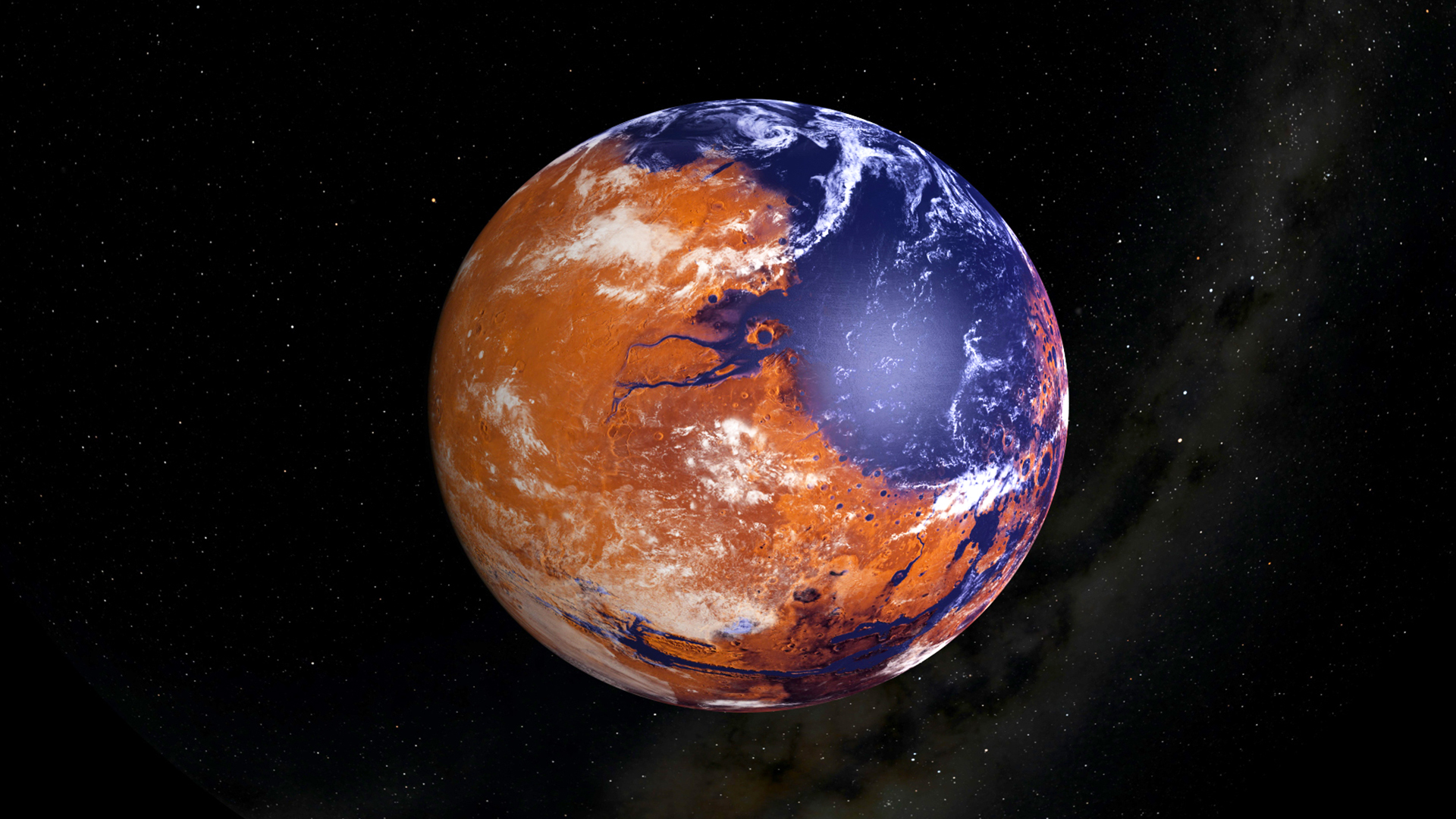
NASA/MAVEN/The Lunar and Planetary Institute
NASA’s Curiosity rover, currently exploring Gale crater on Mars, is providing new details about how the ancient Martian clim...
Read More


Until we recognize the essential role of biology, our attempts to truly unify the universe will remain a train to nowhere. ~Robert Lanza Read More

Good health is not something we can buy. However, it can be an extremely valuable savings account. ~Anne Wilson Schaef Read More

The only way forward, if we are going to improve the quality of the environment, is to get everybody involved. ~Richard Rogers Read More

To raise new questions, new possibilities, to regard old problems from a new angle, requires creative imagination and marks real advance in science. ~Albert Einstein Read More

Old Newtonian physics claimed that things have an objective reality separate from our perception of them. Quantum physics, and particularly Heisenberg's Uncertainty Principle, reveal that, as our perception of an object changes, the object itself literally changes. ~Marianne Williamson Read More

Astronomy compels the soul to look upwards and leads us from this world to another. ~ Read More
October 9, 2024,
 Astronomy/Space
NASA’s Curiosity rover, currently exploring Gale crater on Mars, is providing new details about how the ancient Martian clim...
Read More
October 9, 2024,
Health/Medical, Biology/Biotechnology
-with-attached-phosphate-tags-(red-and-orange-spheres)-blocks-the-active-site-of-ck1%CE%B4.png?sfvrsn=d7704e60_2)
Scientists from Duke-NUS Medical School and the University of California, Santa Cruz, have discovered the secret to regulating our internal clock. They identified that this regulator sits right at the tail end of Casein Kinase 1 delta (CK1δ), a protein which acts as a pacesetter for our internal biological clock or the natural 24-hour cycles that control sleep-wake patterns and other daily functions, known as circadian rhythm.
Published in ...
Read More
October 8, 2024,
Chemistry/Nanotechnology, Environment/Geology
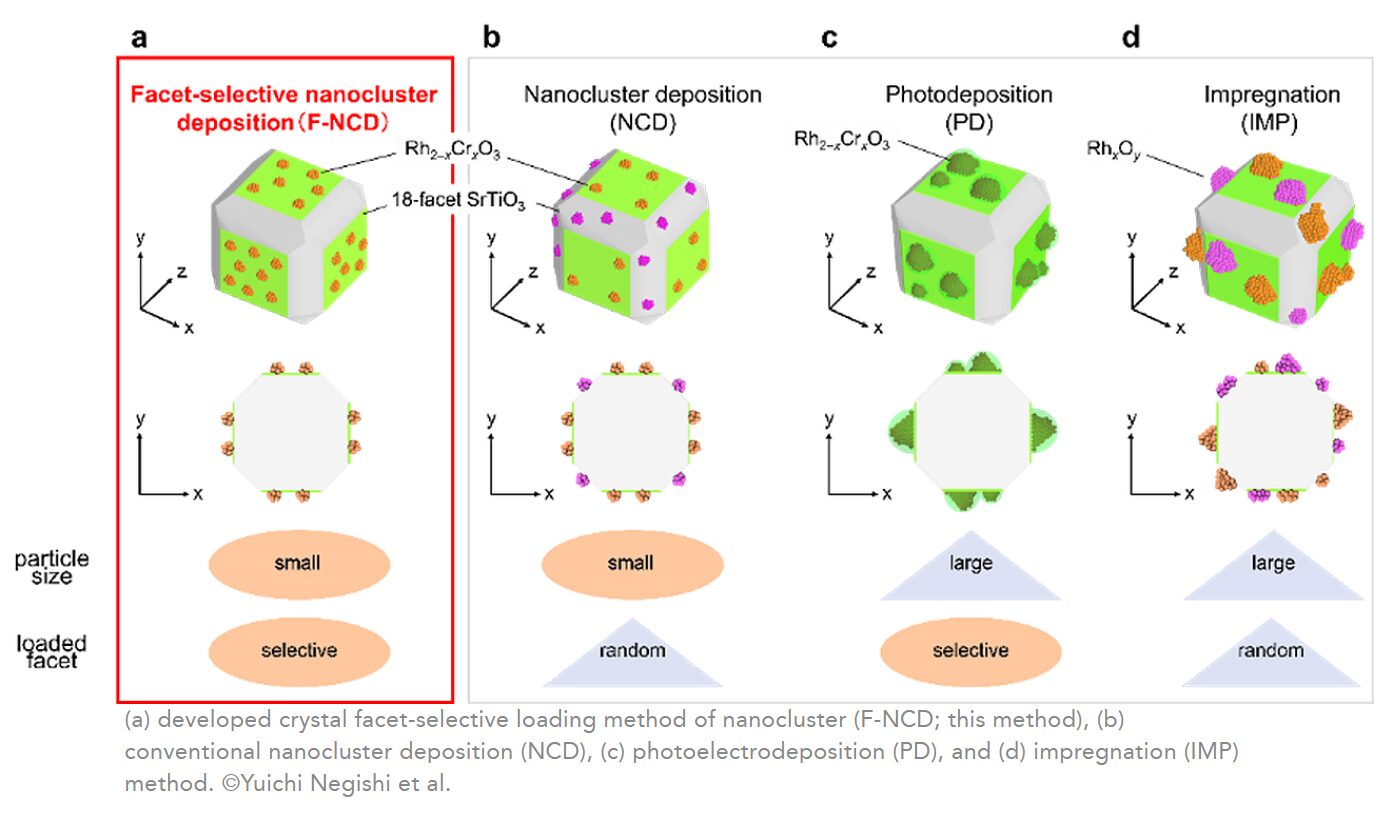
Researchers have developed a novel method using facet-selective, ultrafine cocatalysts to efficiently split water to create hydrogen – a clean source of fuel. Scientists are urgently searching for clean fuel sources – such as hydrogen – to move towards carbon neutrality. A breakthrough for improving the efficiency of the photocatalytic reaction that splits water into hydrogen has been made by a team of researchers from Tohoku University, Tokyo University of Science and Mitsubishi Materials Corporation.
“Water-splitting photocatalysts can produce hydrogen (H2) from only sunlight and water,” explains Professor Yuichi Negishi, the lead researcher of this project (Tohoku University), “However, the process hasn’t been optimized sufficiently for practical applications...
Read More
October 8, 2024,
Astronomy/Space
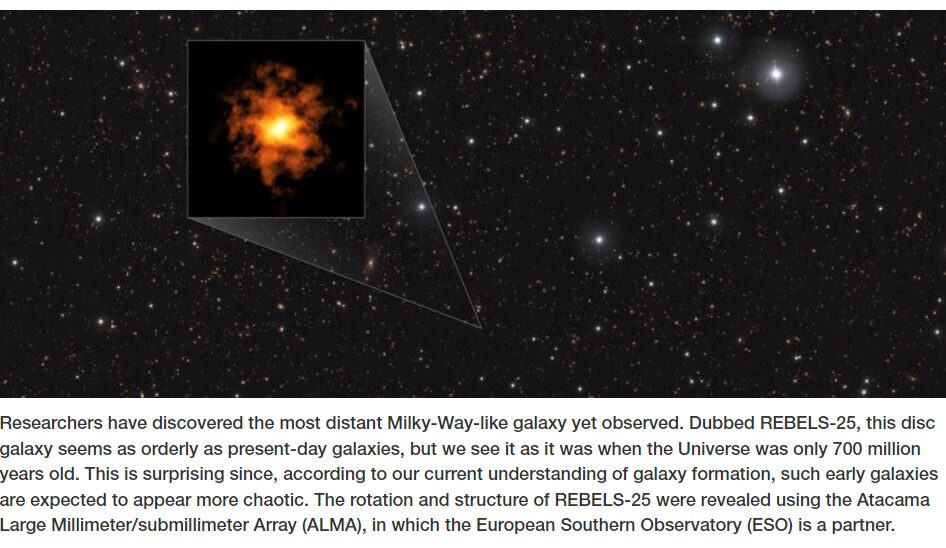
Researchers have discovered the most distant Milky-Way-like galaxy yet observed. Dubbed REBELS-25, this disc galaxy seems as orderly as present-day galaxies, but we see it as it was when the Universe was only 700 million years old. This is surprising since, according to our current understanding of galaxy formation, such early galaxies are expected to appear more chaotic. The rotation and structure of REBELS-25 were revealed using the Atacama Large Millimeter/submillimeter Array (ALMA), in which the European Southern Observatory (ESO) is a partner.
The galaxies we see today have come a long way from their chaotic, clumpy counterparts that astronomers typically observe in the early Universe...
Read More
Recent Comments