









‘Chameleon’ chip adapts to changing data speeds, cutting prediction errors by up to 40-fold
August 9, 2026,
 Physics, Technology/Electronics
Rare ultra-magnetic star may be key to solving 90-year old quantum cold case
August 9, 2026,
Astronomy/Space
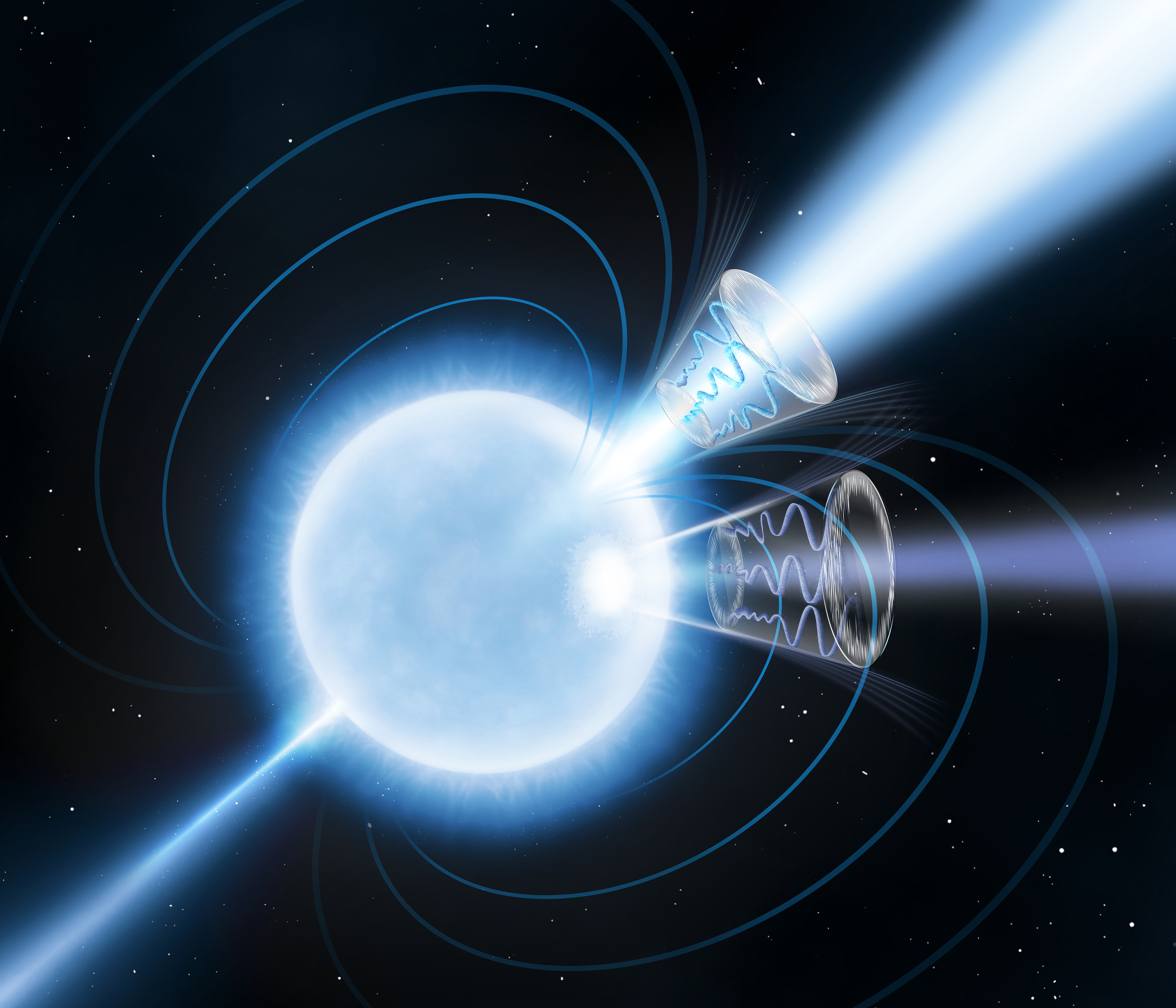
Astronomers may have just confirmed one of the quirkiest aspects of quantum mechanics: that seemingly empty space can alter the behavior of light. This phenomenon, called “vacuum birefringence,” was first predicted nearly 90 years ago by Werner Heisenberg, one of the founding fathers of quantum mechanics. He suggested that even a perfect vacuum should be teeming with “virtual particles” that rapidly pop in and out of existence.
The astronomers, including Dr Marcus Lower from Swinburne University of Technology, used the properties of a magnetar—a rare type of neutron star with the strongest magnetic fie...
Read MoreEngineered human neurons rebuild damaged spinal cord circuits
August 8, 2026,
Health/Medical, Biology/Biotechnology

Spinal cord injuries affect an estimated 15 to 20 million people worldwide, often causing lasting impairments in movement, sensation and independence. Such injuries can be especially devastating when they occur at the level of the neck, where damaged spinal circuits disrupt signals that control the diaphragm, the main muscle used for breathing.
Despite advances in emergency care and rehabilitation, no approved therapies exist to rebuild the neurons and connections lost after a spinal cord injury. But new research from scientists at Gladstone Institutes offers hope for a regenerative treatment in the future.
The study, published in Science Translational Med...
Read MoreDiffuse interfilament gas is likely a key fuel source for massive star formation
August 7, 2026,
Astronomy/Space

Researchers from Kyushu University have discovered that diffuse gas surrounding dense filaments in a nearby stellar nursery plays a much larger role in star formation than previously recognized...
Read More
Recent Comments