To raise new questions, new possibilities, to regard old problems from a new angle, requires creative imagination and marks real advance in science.
~Albert Einstein
Read More
Old Newtonian physics claimed that things have an objective reality separate from our perception of them. Quantum physics, and particularly Heisenberg's Uncertainty Principle, reveal that, as our perception of an object changes, the object itself literally changes.
~Marianne Williamson
Read More
Holding the screen up to an array of magnets of different strengths can rewrite the magnetic properties of the pixels in targeted areas of the screen. Different arrays of magnets will program different images into the device. Credit: Jeremy Little, Michigan Engineering
A flexible screen inspired in part by squid can store and display encrypted images like a computer—using magnetic fields rather than electronics. The research is reported in Advanced Materials by University of Michigan engineers.
“It’s one of the first times where mechanical materials use magnetic fields for system-level encryption, information processing and computing...
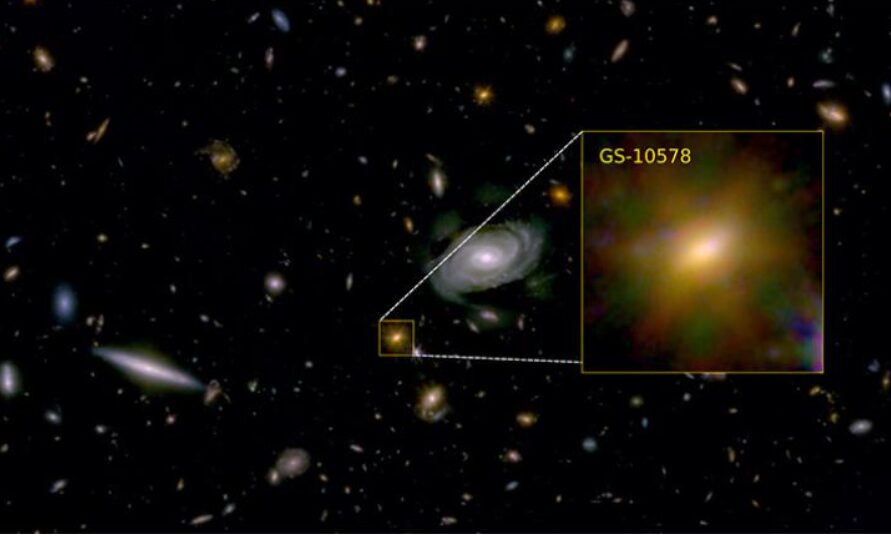
Astronomers have used the NASA/ESA James Webb Space Telescope to confirm that supermassive black holes can starve their host galaxies of the fuel they need to form new stars. The results are reported in the journal Nature Astronomy.
The international team, co-led by the University of Cambridge, used Webb to observe a galaxy roughly the size of the Milky Way in the early universe, about two billion years after the Big Bang. Like most large galaxies, it has a supermassive black hole at its center. However, this galaxy is essentially ‘dead’: it has mostly stopped forming new stars.
“Based on earlier observations, we knew this galaxy was in a quenched state: it’s not forming many stars given its size, and we expect there is a link between the black hole and the end of star formation...
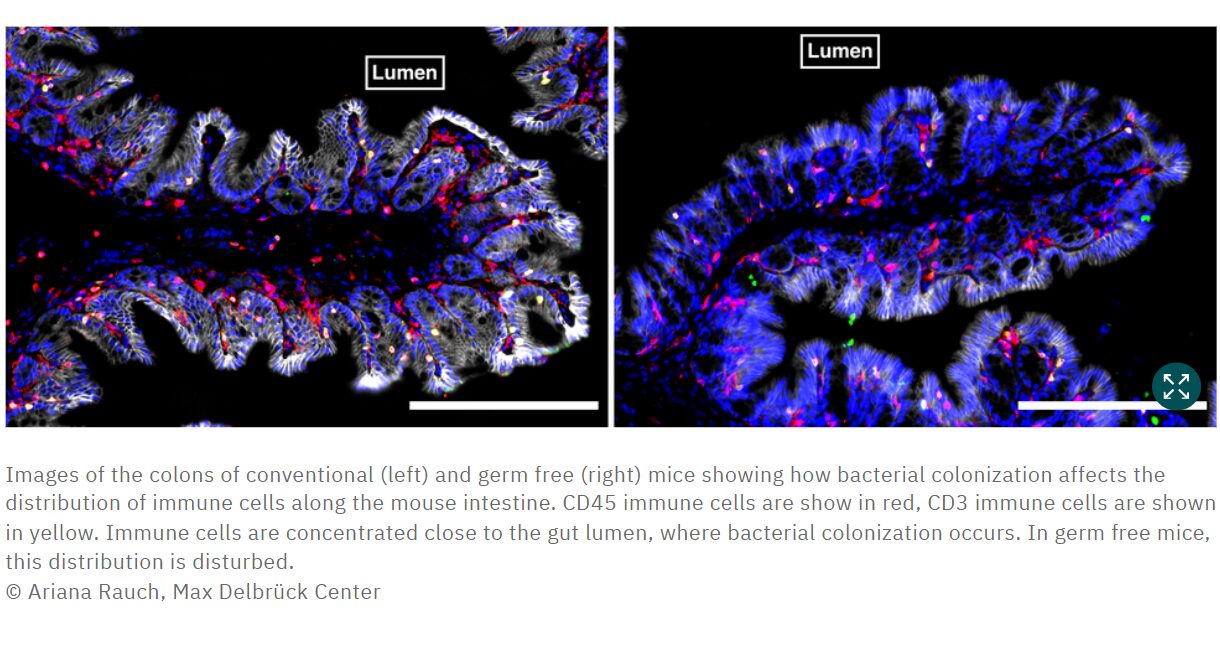
Researchers at the Experimental and Clinical Research Center of Max Delbrück Center and Charité — Universitätsmedizin Berlin (ECRC) have found that different anatomical sections of the gastrointestinal tracts of mice carry different compositions of microbial communities. Moreover, the specific makeup of the microbiota can influence the type and abundance of immune cells in any particular region. The study, which was published in Gut Microbes, maps the complex spatial organization of immune cells and microbial communities, providing a tool for studying the interaction between gut microbes and inflammatory diseases.
Previous research has hinted at the existence of “hotspots” along the GI tract where specific immune cells and microbes might interact more intensely.
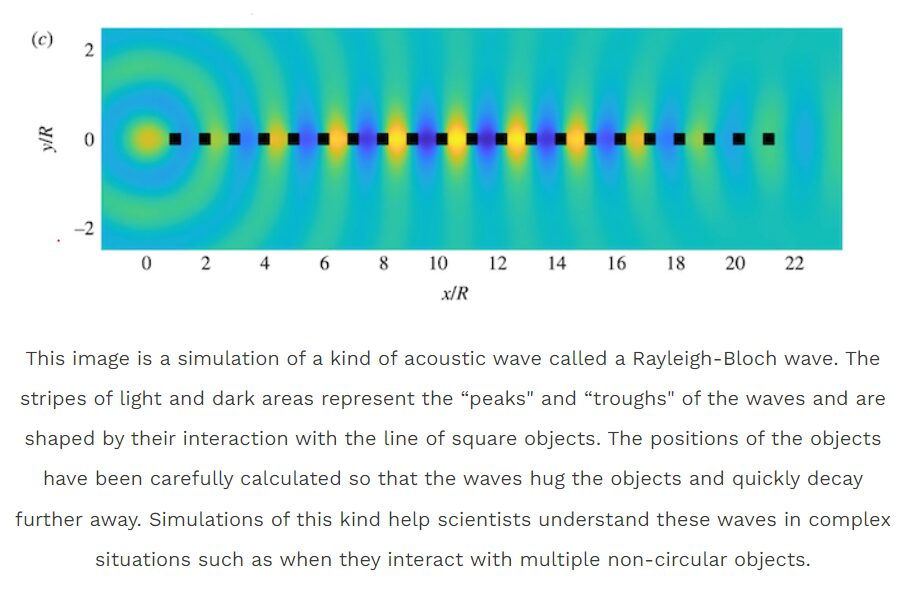
New software simulates complex wave scattering for metamaterial design. Could invisibility cloaks become a reality? New research brings this science fiction concept a step closer, with a breakthrough software package that simulates how waves interact with complex materials.
A new software package developed by researchers at Macquarie University can accurately model the way waves — sound, water or light — are scattered when they meet complex configurations of particles.
This will vastly improve the ability to rapidly design metamaterials — exciting artificial materials used to amplify, block or deflect waves.
The findings, published in the journal Proceedings of the Royal Society A on 19 June 2024, demonstrated the use of TMATSOLVER — a multipole-based tool that models interac...











Recent Comments