Mars Rover continues progress along Upper Gediz Vallis Ridge

Sols 4159-4160: A fully loaded first sol
This image was taken by Chemistry & Camera (ChemCam) onboard NASA’s Mars rover Curiosity on Sol 4158 (2024-04-17 07:52:27 UTC). Credit: NASA/JPL-Caltech/LANL

Curiosity continues to make progress along the margin of upper Gediz Vallis ridge, investigating the broken bedrock in our workspace and acquiring images of the ridge deposit as the rover drives south.

Today’s 2-sol plan focused on a DRT, contact science, and drive on the first sol, followed by untargeted remote sensing on the second sol. The team had to make some decisions at the start of planning about whether to drive on the first or second sol of this plan, and how that would affect the upcoming weekend activities.

As it turned out, the team was able to fit all of the desired contact science and remote sensing activities...

Read More

Researchers discover how Gut Muscle can be Vital for Growth, Repair and Treatments

Gut muscle vital for absorbing fats forms like scars
Intestinal villus with myofibroblast progenitor cells (magenta) differentiate into smooth muscle fibers (cyan) that support dietary fat absorption. Credit: Kurpios Lab/Provided

By discovering how a type of smooth muscle—which is essential for mechanical aspects of absorbing fats from food—forms in the gut, Cornell scientists have opened doors to making Artificial Muscle, Repairing muscle following gut surgeries, and treating inflammatory bowel disease and obesity.

The findings, published in a study in Developmental Cell, reveal that intestinal smooth muscle originates in embryos and forms by the same process that is a hallmark of creating scar tissue when a wound heals.

The smooth muscle sits inside tiny finger-like projections called villi, which absorb fats—also known as li...

Read More

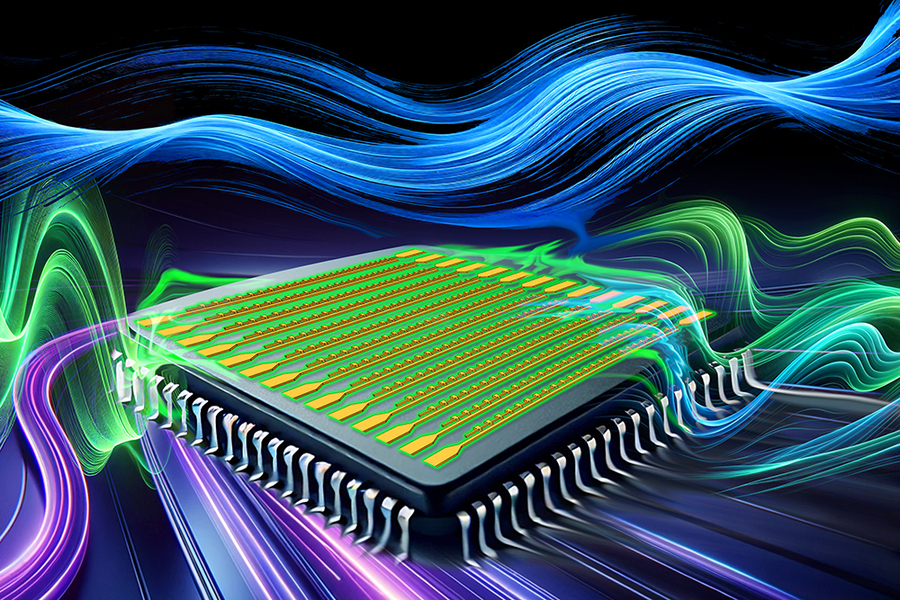
Researchers Develop Energy-Efficient Probabilistic Computer by Combining CMOS with Stochastic Nanomagnet

Researchers develop energy-efficient computer by combining CMOS with stochastic nanomagnet
A schematic illustrating the difference in the current deterministic CMOS computer (a), near-future heterogeneous version of the probabilistic computer, and (c) the final form of the probabilistic computer fully based on the spintronics technology. The table on the right side represents the comparison between them in terms of the chip area, energy consumption, and manufacturability. Credit: Shunsuke Fukami and Kerem Camsari

Researchers at Tohoku University and the University of California, Santa Barbara, have unveiled a probabilistic computer prototype. Manufacturable with a near-future technology, the prototype combines a complementary metal-oxide semiconductor (CMOS) circuit with a limited number of stochastic nanomagnets, creating a heterogeneous probabilistic computer.

Developin...

Read More

Peptides on interstellar ice: Study finds presence of water molecules is not a major obstacle for formation

Peptides on interstellar ice: Study finds presence of water molecules not a major obstacle for formation
Dr. Serge Krasnokutski, Laboratory Astrophysics and Cluster Physics group at the Max Planck Institute for Astronomy at Friedrich Schiller University Jena, investigates the formation of biomolecules under space conditions with a vacuum chamber. Credit: Jens Meyer / University of Jena

A research team led by Dr. Serge Krasnokutski from the Astrophysics Laboratory at the Max Planck Institute for Astronomy at the University of Jena had already demonstrated that simple peptides can form on cosmic dust particles. However, it was previously assumed that this would not be possible if molecular ice, which covers the dust particle, contains water—which is usually the case.

Now the team, in collaboration with the University of Poitiers, France, has discovered that the presence of water molecu...

Read More