To raise new questions, new possibilities, to regard old problems from a new angle, requires creative imagination and marks real advance in science.
~Albert Einstein
Read More
Old Newtonian physics claimed that things have an objective reality separate from our perception of them. Quantum physics, and particularly Heisenberg's Uncertainty Principle, reveal that, as our perception of an object changes, the object itself literally changes.
~Marianne Williamson
Read More
Courtesy of SwRI An SwRI-led team used NASA’s Webb telescope, shown in the bottom right corner of this illustration, to confirm the presence of hydrated minerals on the surface of Psyche, a massive and heavily metallic body in the main asteroid belt. These findings suggest a complex history for this interesting asteroid, which many scientists think could be the remnant core of a protoplanet, including impacts with hydrated asteroids.
Webb telescope data indicate a complex history for the metallic asteroid. Using data from NASA’s James Webb Space Telescope, a Southwest Research Institute-led team has confirmed hydroxyl molecules on the surface of the metallic asteroid Psyche...
A Yale School of Medicine team reports in a new study that an artificial intelligence (AI) model was able to reliably diagnose people living with Marfan syndrome from a simple facial photograph.
Marfan syndrome is a genetic disorder, affecting about 1 in 3,000 people, which impacts the body’s connective tissues. “Patients living with Marfan syndrome are usually very tall and thin,” said John Elefteriades, MD, professor of surgery at Yale School of Medicine and senior author of the study. “They have long faces and are prone to spine and joint issues. However, many are not diagnosed.”
Marfan syndrome increases the risk for aortic dissection, where the aorta splits suddenly after becoming enlarged...
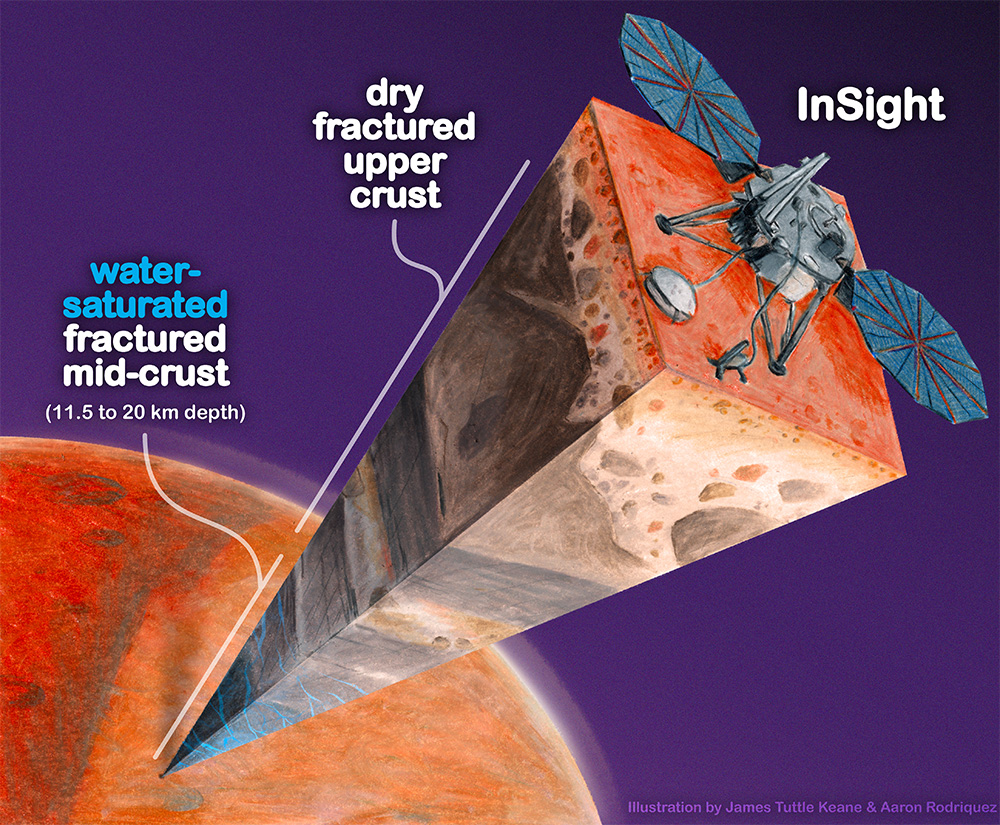
A cutout of the Martian interior beneath NASA’s Insight lander. The top 5 kilometers of the crust appear to be dry, but a new study provides evidence for a zone of fractured rock 11.5-20 km below the surface that is full of liquid water — more than the volume proposed to have filled hypothesized ancient Martian oceans. James Tuttle Keane and Aaron Rodriquez, courtesy of Scripps Institution of Oceanography
Using seismic activity to probe the interior of Mars, geophysicists have found evidence for a large underground reservoir of liquid water—enough to fill oceans on the planet’s surface.
The data from NASA’s Insight lander allowed the scientists to estimate that the amount of groundwater could cover the entire planet to a depth of between 1 and 2 kilometers, or about a mile.
Selective serotonin releasing agent is not negated by 5-HT1A supersensitivity, resulting in a rapid onset of pro-serotonergic activity.
Increasing serotonin can change how people learn from negative information, as well as improving how they respond to it, according to a new study published in the journal Nature Communications.
The study by scientists at the University of Oxford’s Department of Psychiatry and the National Institute of Health and Care Research (NIHR) Oxford Health Biomedical Research Center (OH BRC) found people with increased serotonin levels had reduced sensitivity to punishing outcomes (for example, losing money in a game) without significantly affecting sensitivity to rewarding ones (winning money).
The study involved 26 participants who were given the drug t...













Recent Comments