New Chip Opens Door to AI Computing at Light Speed

Streaks of blue light representing information run from right to left.
Computing at the speed of light may reduce the energy cost of training AI. (Narongrit Doungmanee via Getty Images)

University of Pennsylvania engineers have developed a new chip that uses light waves, rather than electricity, to perform the complex math essential to training AI. The chip has the potential to radically accelerate the processing speed of computers while also reducing their energy consumption.

The silicon-photonic (SiPh) chip’s design is the first to bring together Benjamin Franklin Medal Laureate and H...

Read More

Brightest and Fastest-Growing: Astronomers Identify Record-Breaking Quasar

Brightest and fastest-growing: astronomers identify record-breaking quasar
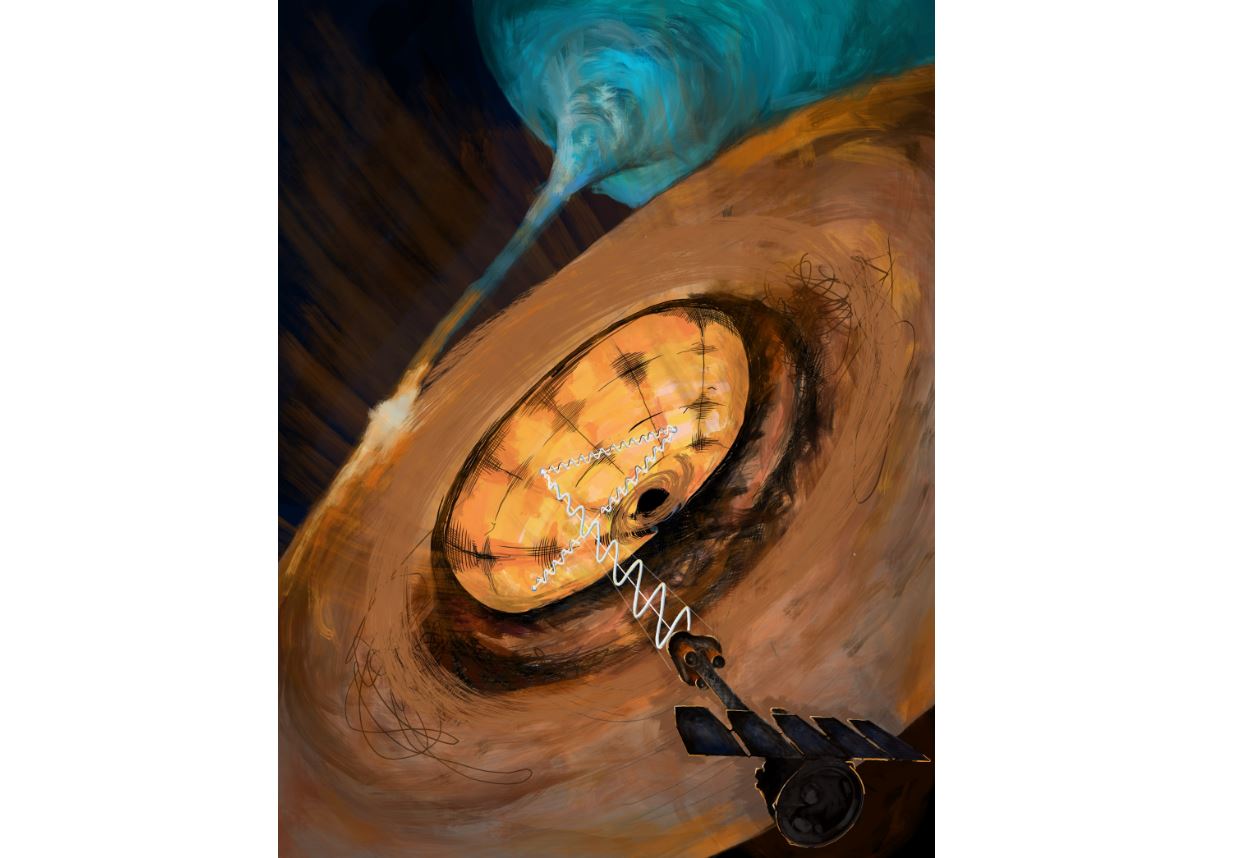
This artist’s impression shows the record-breaking quasar J059-4351, the bright core of a distant galaxy that is powered by a supermassive black hole. Using ESO’s Very Large Telescope (VLT) in Chile, this quasar has been found to be the most luminous object known in the universe to date. The supermassive black hole, seen here pulling in surrounding matter, has a mass 17 billion times that of the sun and is growing in mass by the equivalent of another sun per day, making it the fastest-growing black hole ever known. Credit: ESO/M. Kornmesser

Using the European Southern Observatory’s (ESO) Very Large Telescope (VLT), astronomers have characterized a bright quasar, finding it to be not only the brightest of its kind but also the most luminous object ever observed...

Read More

Evidence of Geothermal Activity within Icy Dwarf Planets

Illustration points to three possibilities of subsurface geothermal processes that could explain how methane ended up on the surfaces of Eris and Makemake
ERIS AND MAKEMAKE INTERNAL PROCESSES

Webb telescope observes potentially young Methane deposits on surfaces of Eris, Makemake. A team co-led by Southwest Research Institute found evidence for hydrothermal or metamorphic activity within the icy dwarf planets Eris and Makemake, located in the Kuiper Belt. Methane detected on their surfaces has the tell-tale signs of warm or even hot geochemistry in their rocky cores, which is markedly different than the signature of methane from a comet.

“We see some interesting signs of hot times in cool places,” said SwRI’s Dr. Christopher Glein, an expert in planetary geochemistry and lead author of a paper about this discovery.

The Kuiper Belt is a vast donut-shaped region of icy bodies beyond the orbit of Neptune at the edge of the solar syste...

Read More

Programming Cells to Organize their Molecules may open the door to New Treatments

Spirals of green, yellow and orange depict various proteins moving in waves in a cell on a black background.
The Coyle Lab tested their tool in human cells by programming multiple proteins, each represented by a different color, to move in various wave patterns. The tool they developed allows researchers to essentially program molecules to move around a cell to specific locations over time. University of Wisconsin–Madison

Researchers can engineer cells to express new genes and produce specific proteins, giving the cells new parts to work with. But, it’s much harder to provide cells with instructions on how to organize and use those new parts. Now, new tools from University of Wisconsin–Madison researchers offer an innovative way around this problem.

Their research is published in the journal Cell.

Everything a cell does depends on how molecules are organized within the cell...

Read More