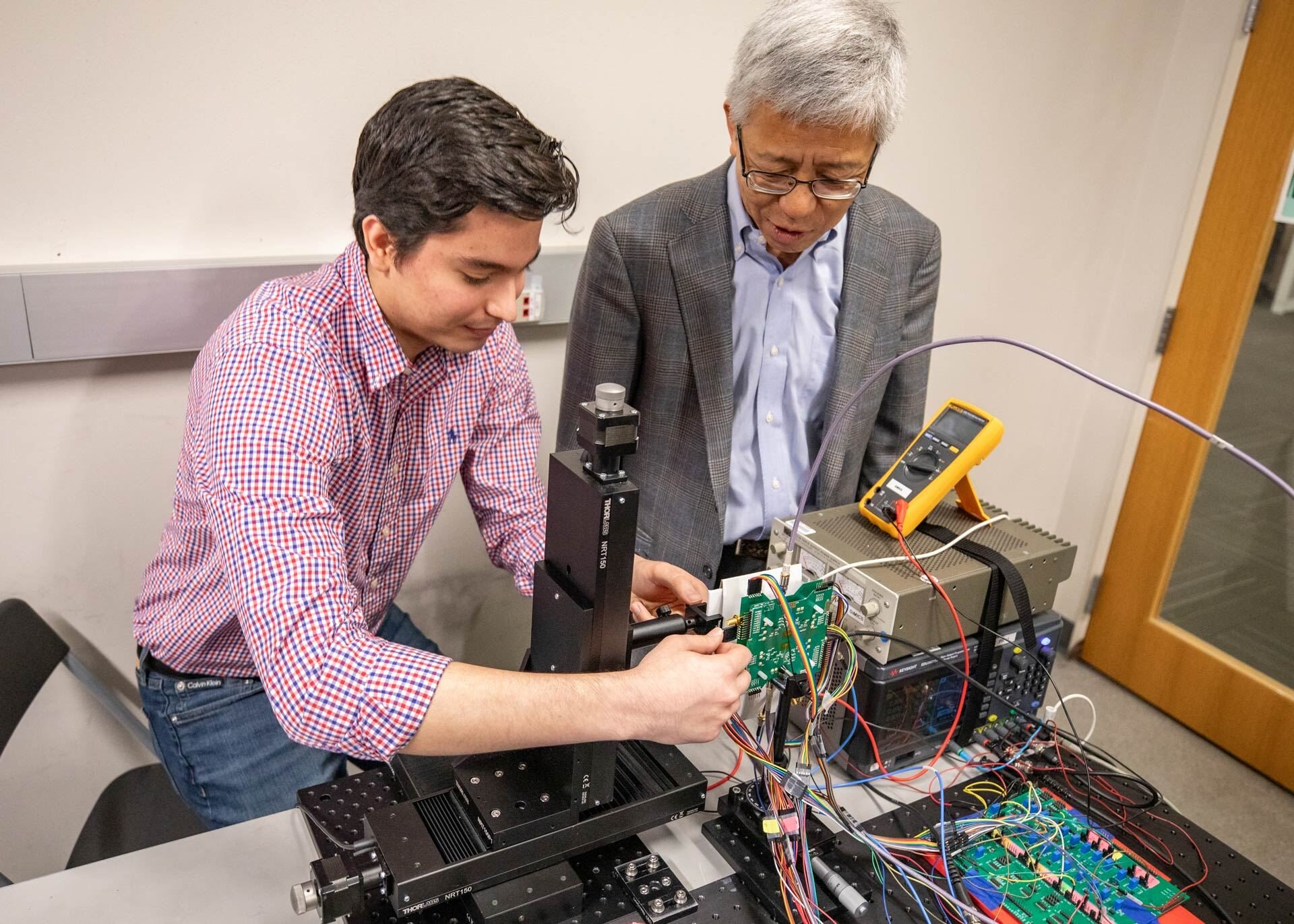
Photonics-based Wireless Link Breaks Speed Records for Data Transmission

20240131_1_fig_3.png

Researchers from Osaka University and IMRA AMERICA use a stimulated Brillouin scattering laser to generate the signals needed by sub-terahertz transmitters and receivers, enabling super-high communication speeds for our tablets and phones.

Researchers demonstrated a 300 GHz-band wireless link that was able to transmit data over a single channel at a rate of 240 gigabits per second. The wireless communication system employs signal generators based on lasers that have ultra-low phase noise in the sub-terahertz band. This rate is the highest so far reported at these frequencies and is a substantial step forward in 300 GHz-band communications for 6G networks.

From coffee-shop customers who connect their laptop to the local Wi-Fi network to remote weather monitoring stations in the A...

Read More

Gas on the run – ALMA spots the Shadow of a Molecular Outflow from a Quasar when the Universe was less than one billion years old

The molecular gas outflow from the quasar includes hydroxyl (OH) (top). Due to the motion of the molecular gas toward the observer, the OH peak in the absorption spectrum (bottom, dashed blue line) appears at a shorter wavelength (solid blue line), a phenomenon known as the Doppler effect. (Illustration: ALMA (ESO/NAOJ/NRAO) modified from Dragan Salak, et al. The Astrophysical Journal. February 1, 2024)
The molecular gas outflow from the quasar includes hydroxyl (OH) (top). Due to the motion of the molecular gas toward the observer, the OH peak in the absorption spectrum (bottom, dashed blue line) appears at a shorter wavelength (solid blue line), a phenomenon known as the Doppler effect. (Illustration: ALMA (ESO/NAOJ/NRAO) modified from Dragan Salak, et al. The Astrophysical Journal. February 1, 2024)

Theoretical predictions have been confirmed with the discovery of an outflow of molecular gas from a quasar when the Universe was less than a billion years old.

A quasar is a compact region powered by a supermassive black hole located in the center of a massive galaxy.

They are extremely luminous, with a point-like appearance similar to stars, and are extremely distant from Earth...

Read More

US Patient ‘Happy Again’ after Brain Implant Treats Epilepsy and OCD

Dr. Ahmed Raslan, professor of neurological surgery, talks about the placement of a brain implant with patient Amber Pearson
Dr. Ahmed Raslan, professor of neurological surgery, talks about the placement of a brain implant with patient Amber Pearson.

American Amber Pearson used to wash her hands until they bled, terrified by the idea of contamination from everyday items, a debilitating result of her obsessive compulsive disorder (OCD).

But the repetitive rituals of her condition are largely consigned to memory, thanks to a revolutionary brain implant that is being used to treat both her epilepsy and her OCD.

“I’m actually present in my daily life and that’s incredible,” the 34-year-old told AFP.

“Before, I was just constantly in my head worrying about my compulsions.”

Brain implants have hit the headlines recently with Elon Musk’s announcement that his Neuralink company had placed a chip in a pat...

Read More

A Physical Qubit with built-in Error Correction

The creation of a photonic “Schrödinger cat state” – in other words the quantum superposition of states of the laser pulse amplitude that can be distinguished on a macroscopic scale (white or black cat) – can only be achieved using the most advanced quantum optical techniques and has already been demonstrated to be possible. In the present experiment that is subject of the research paper, it proved to be feasible to extend this to three states (white, gray, and black cats). This light state thus approaches a logical quantum state in which errors can be, in principle, universally corrected. (ill./ ©: Peter van Loock)

There has been significant progress in the field of quantum computing.

Big global players, such as Google and IBM, are already offering cloud-based quantum com...

Read More