To raise new questions, new possibilities, to regard old problems from a new angle, requires creative imagination and marks real advance in science.
~Albert Einstein
Read More
Old Newtonian physics claimed that things have an objective reality separate from our perception of them. Quantum physics, and particularly Heisenberg's Uncertainty Principle, reveal that, as our perception of an object changes, the object itself literally changes.
~Marianne Williamson
Read More
Artist’s conception illustrating the aftermath of an intermediate-mass black hole tearing apart a passing star, resulting in an accretion disk and narrow relativistic jet (top left). The dotted line indicates our line of sight from Earth. The jet’s off-axis afterglow only became visible once the expanding radio emission (bottom right) had grown wide enough to sweep into our line of sight, causing that emission to brighten dramatically years after the initial event. Credit: NSF/AUI/NSF NRAO/M.Weiss
Chinese astronomers report the detection of a peculiar optical transient event that occurred in the center of a dwarf galaxy. The newly discovered event, designated AT2019ijncn a paper published July 6 in The Astrophysical Journal Letters.
One of the rarest transients Among astronomical tra...
Biomedical engineers at Duke University have developed an injectable biomaterial that helps transform the cavity left behind after a stroke caused by a blood clot into an environment more supportive of repair. By recruiting the body’s own immune cells, the treatment promoted the growth of new blood vessels, supported neural remodeling and improved motor performance in mice. The work appears in Cell Biomaterials.
Every year, millions of people experience strokes caused by blood clots, called ischemic strokes. Immediate treatments, including clot-dissolving drugs and mechanical removal of the clot, can restore blood flow and preserve threatened brain tissue. But these treatments cannot replace tissue that has already been lost.
Large strokes can result in substantial tissue loss a...
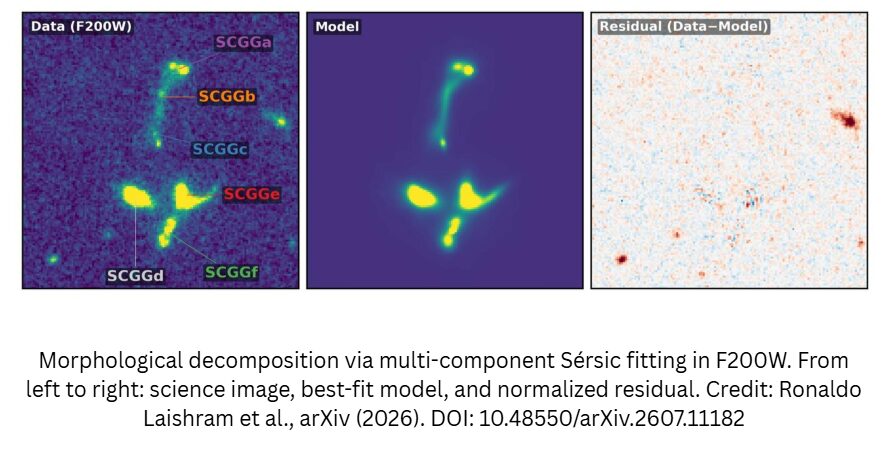
Astronomers have discovered a remarkably tiny group of six young galaxies just 1.2 billion years after the Big Bang. This may be a rare glimpse of how some of the universe’s largest galaxies formed. The paper outlining the findings was submitted to the arXiv preprint server on July 13.
Chaotic patches The widely accepted cosmological model of the universe known as the Lambda Cold Dark Matter Model suggests that galaxies primarily form hierarchically through mergers. That means they grow piece by piece, as smaller galaxies merge over billions of years. In this context, dense regions in the early universe serve as natural laboratories to test this idea.
These dense patches, known as protoclusters and proto-groups, are young clusters of galaxies packed into a region just tens of tho...
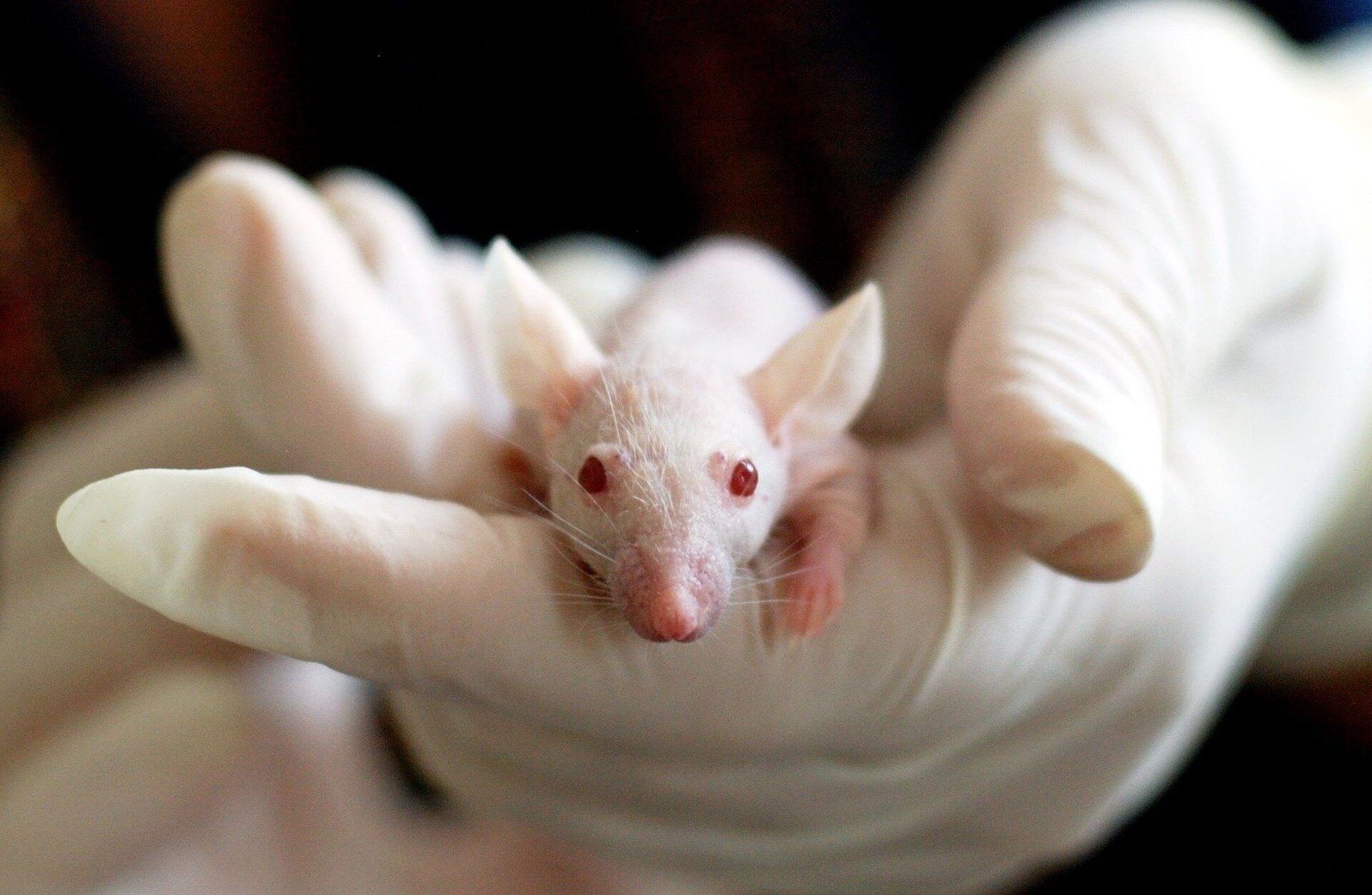
A new mouse study led by UCLA Health suggests that inflammation during pregnancy can trigger autism-like changes in offspring, but those brain and behavioral effects may be rapidly, though temporarily, reversible in adulthood with a single dose of the immunosuppressive drug rapamycin.
Even mild inflammation during midpregnancy has been shown to result in autism-like symptoms in offspring, abnormal brain growth, seizures and heightened sensitivity to everyday sensory input that persist into adulthood.
In the study published in the journal Nature Communications, UCLA researchers found that a single dose of rapamycin significantly improved brain signaling and behavioral symptoms in these offspring within about two hours, too short a time to correct ...











Recent Comments