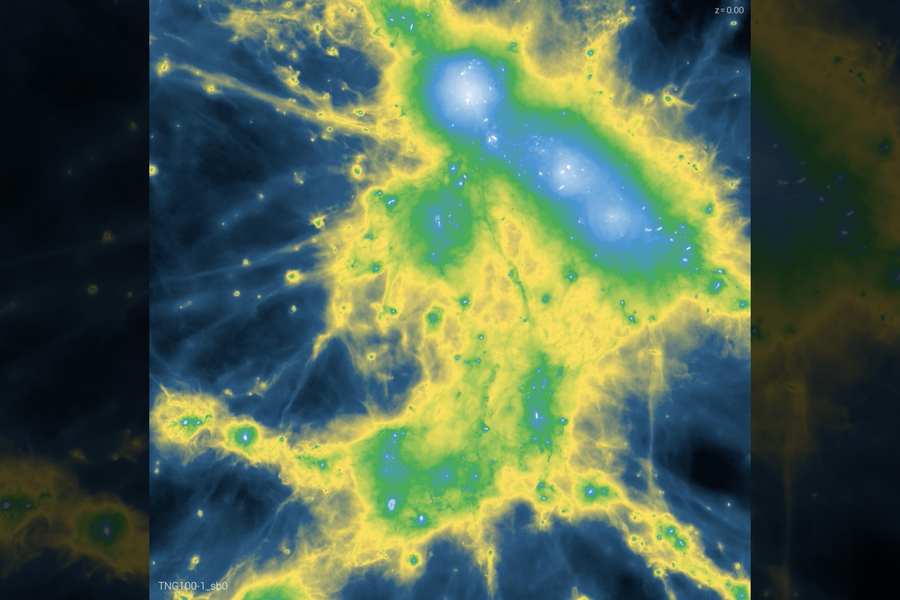
Milky Way is embedded in a ‘large-scale sheet’ of dark matter, which explains motions of nearby galaxies

The Milky Way is embedded in a 'large-scale sheet' and this explains the motions of nearby galaxies
Various projections of the posterior mean density of the constrained simulation ensemble, normalized by the cosmic mean density. Credit: Nature Astronomy (2026). DOI: 10.1038/s41550-025-02770-w. https://www.nature.com/articles/s41550-025-02770-w

Computer simulations carried out by astronomers from the University of Groningen in collaboration with researchers from Germany, France and Sweden show that most of the (dark) matter beyond the Local Group of galaxies (which includes the Milky Way and the Andromeda galaxy) must be organized in an extended plane. Above and below this plane are large voids. The observed motions of nearby galaxies and the joint masses of the Milky Way and the Andromeda galaxy can only be properly explained with this “flat” mass distribution...

Read More

Single gene found to influence gut bacteria balance and IBD susceptibility

Declan McCole

Two recent studies from the University of California, Riverside, published in the same issue of Gut Microbes highlight the role of a gene called PTPN2 in protecting the gut from harmful bacteria linked to inflammatory bowel disease (IBD).

Led by Declan McCole, a professor of biomedical sciences in the School of Medicine, the studies show that when PTPN2 does not function properly, the gut becomes more vulnerable to infection and inflammation.

People with IBD often have higher levels of AIEC, a harmful type of E. coli bacteria. AIEC can attach to the gut lining, invade gut cells, damage the gut’s protective barrier, and worsen inflammation.

Normally, PTPN2 helps maintain gut health by controlling inflammation and supporting a balanced gut microbiome...

Read More

Origami-inspired ring lets users ‘feel’ virtual worlds

A ring that lets users 'feel' virtual worlds
A wearable haptic force-feedback ring with a three-axis force-sensing skin. A) We developed a wearable haptic ring, OriRing, which weighs only 18 g and generates forces of up to 6.5 N. The design incorporates a folding-based prismatic joint, a three-axis force-sensing skin, inkjet-printed bending sensors, SPAs and 3D printed ring frames. B) Force-sensing skin consists of an upper layer with soft pyramid microstructures, a lower layer with four resistive pixels and a spacer separating the two layers. This design enables the detection of both normal and shear forces. C) With its multimodal sensing and actuation capabilities, OriRing renders the size and stiffness of virtual objects through kinaesthetic and proprioceptive feedback...
Read More

Astrophysicists discover largest sulfur-containing molecular compound in space

Researchers at the Max Planck Institute for Extraterrestrial Physics (MPE), in collaboration with astrophysicists from the Centro de Astrobiología (CAB), CSIC-INTA, have identified the largest sulfur-bearing molecule ever found in space: 2,5-cyclohexadiene-1-thione (C₆H₆S). They made this breakthrough by combining laboratory experiments with astronomical observations. The molecule resides in the molecular cloud G+0.693–0.027, about 27,000 light-years from Earth near the center of the Milky Way.

With a stable six-membered ring and a total of 13 atoms, it far exceeds the size of all previously detected sulfur-containing compounds in space. The study is published in Nature Astronomy.

Significance of the discovery for astrochemistry
“This is the first unambiguous detection of ...

Read More