Astronomers Observe the Effect of Dark Matter on the Evolution of the Galaxies

Astronomers observe the effect of dark matter on the evolution of the galaxies
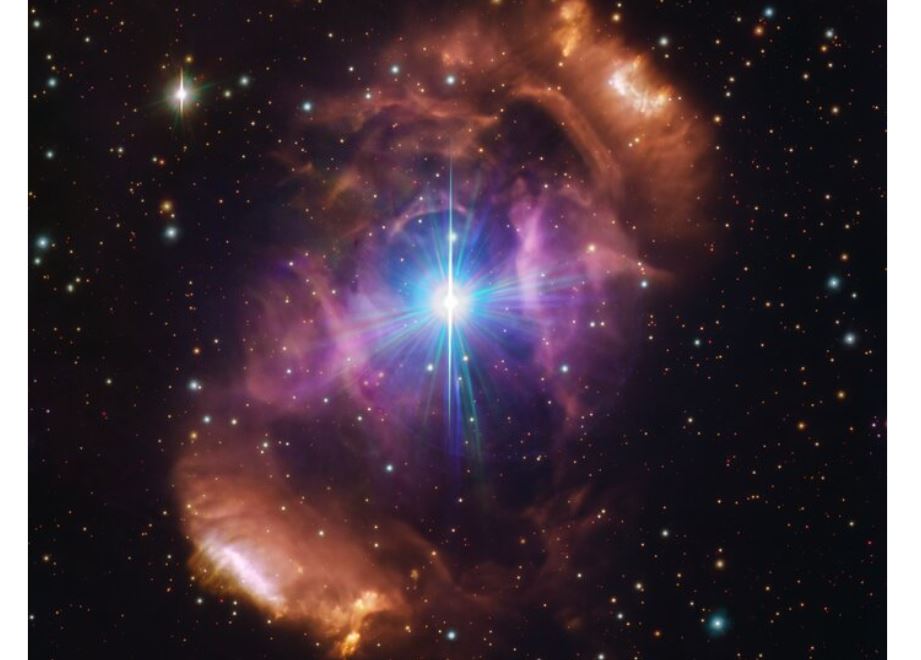
Image of a galaxy showing, on the left, its stellar component, and on the right (in negative), the dark matter present in its halo. Credit: Gabriel Pérez Díaz, SMM (IAC) / The EAGLE team

Dark matter comprises around 85% of all the matter in the universe. Although ordinary matter absorbs, reflects and emits light, dark matter cannot be seen directly, which makes its detection difficult. Its existence is inferred from its gravitational effects on visible matter, the material that forms stars, planets, and other objects in the cosmos.

Galaxies are made up of these two types of material The dark matter is distributed in halos, which are huge structures surrounding galaxies, while the ordinary matter is mainly present in the central regions where most of the stars are found.

Traditi...

Read More

Neural Networks made of Light: Research team develops AI System in Optical Fibers

Neural networks made of light: Research team develops AI system in optical fibers
System training and solving the n-bit parity problem. A) Flowchart of the digital processing layers to interpret the system readout. The training is performed offline using bin selection and linear regression. A simple search algorithm iterates through different frequency bin combinations (see Experimental Section). For each combination, linear regression is used to predict the label (or value) of an inference task. The prediction error was estimated through cross-validation of subsets of the training data. The best-performing combination of bins (i.e., lowest loss) defines an inference-ready system configuration. B) Experimentally measured operation fidelity associated with the n-bit parity problem for increasing bit length and system nonlinearity...
Read More

Possible Atmospheric Destruction of a potentially Habitable Exoplanet

Astrophysicists studying a popular exoplanet in its star’s habitable zone have found that electric currents in the planet’s upper atmosphere could create sufficient heating to expand the atmosphere enough that it leaves the planet, likely leaving the planet uninhabitable.

Until now, planetary scientists have thought that a habitable planet needs a strong magnetic field surrounding it to act as a shield, directing ionized particles, X-rays and ultraviolet radiation in the stellar wind around and away from its atmosphere.
That’s what happens on Earth, preventing dangerous radiation from reaching life on the surface, and what does not occur on Mars, which now lacks a global magnetic field, meaning any initial inhabitants of the red planet will probably need to live in underground caves...

Read More

Blocking Key Potein may Halt Progression of Alzheimer’s disease

Researchers at the University of Colorado Anschutz Medical Campus have found that inhibiting a key protein can stop the destruction of synapses and dendritic spines commonly seen in Alzheimer’s disease.

The study, whose first author is Tyler Martinez, a student in the Pharmacology and Molecular Medicine PhD program at the University of Colorado School of Medicine, was published recently in the journal eNeuro.

The researchers, using rodent neurons, found that targeting a protein called Mdm2 with an experimental cancer drug known as nutlin, stopped neurotoxic amyloid-b peptides that accumulate in Alzheimer’s disease (AD) from overly pruning synapses.

“Cognitive impairments associated with AD correlate with dendritic spine and excitatory synapse loss, particularly within the hip...

Read More