Harnessing the Power of a Parasite that can Stop Pain

3D illustration of one phase of the life cycle of the parasite that causes cutaneous leishmaniasis
Illustration: Shutterstock.com

For the first time, scientists have begun to figure out why the disfiguring skin lesions caused by cutaneous leishmaniasis don’t hurt.

Researchers analyzed leishmaniasis lesions on mouse skin to detect metabolic signaling pathways that differed from uninfected mice. Results suggested the parasites that cause the disease change pain perception—presumably as a way to delay treatment and promote their own survival.

“No one knows why these lesions are painless—but it has been thought that the parasite somehow manipulates the host physiological system,” said Abhay Satoskar, senior author of the study and professor of pathology at The Ohio State University ...

Read More

Anthrobots: Scientists Build Tiny Biological Robots from Human Tracheal Cells

Scientists build tiny biological robots from human cells
An Anthrobot is shown, depth colored, with a corona of cilia that provides locomotion for the bot. Credit: Gizem Gumuskaya, Tufts University

Researchers at Tufts University and Harvard University’s Wyss Institute have created tiny biological robots that they call Anthrobots from human tracheal cells that can move across a surface and have been found to encourage the growth of neurons across a region of damage in a lab dish.

The multicellular robots, ranging in size from the width of a human hair to the point of a sharpened pencil, were made to self-assemble and shown to have a remarkable healing effect on other cells...

Read More

Discovery of Planet Too Big for its Sun Throws Off Solar System Formation Models

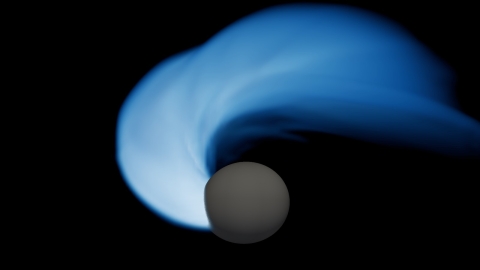
Artistic rendering of the possible view from LHS 3154b towards its low mass host star
Artistic rendering of the possible view from LHS 3154b towards its low mass host star. Given its large mass, LHS 3154b probably has a Neptune-like composition. Credit: Penn State / Penn State. Creative Commons

The discovery of a planet that is far too massive for its sun is calling into question what was previously understood about the formation of planets and their solar systems, according to Penn State researchers.

In a paper published in the journal Science, researchers report the discovery of a planet more than 13 times as massive as Earth orbiting the “ultracool” star LHS3154, which itself is nine times less massive than the sun. The mass ratio of the newly found planet with its host star is more than 100 times higher than that of Earth and the sun.

The finding reveals th...

Read More

Lost Brain Function Restored in Mice after Stroke

Researchers have succeeded in restoring lost brain function in mouse models of stroke (Image: iStock)
Images of brain scans

Researchers have succeeded in restoring lost brain function in mouse models of stroke using small molecules that in the future could potentially be developed into a stroke recovery therapy. “Communication between nerve cells in large parts of the brain changes after a stroke and we show that it can be partially restored with the treatment,” says Tadeusz Wieloch, senior professor of neurobiology at Lund University in Sweden.

“Concomitantly, the rodents regain lost somatosensory functions, something that around 60 per cent of all stroke patients experience today. The most remarkable result is that the treatment began several days after a stroke,” Wieloch continues.

In an ischemic stroke, lack of blood flow to the brain causes damage, which rapidly leads to ner...

Read More