
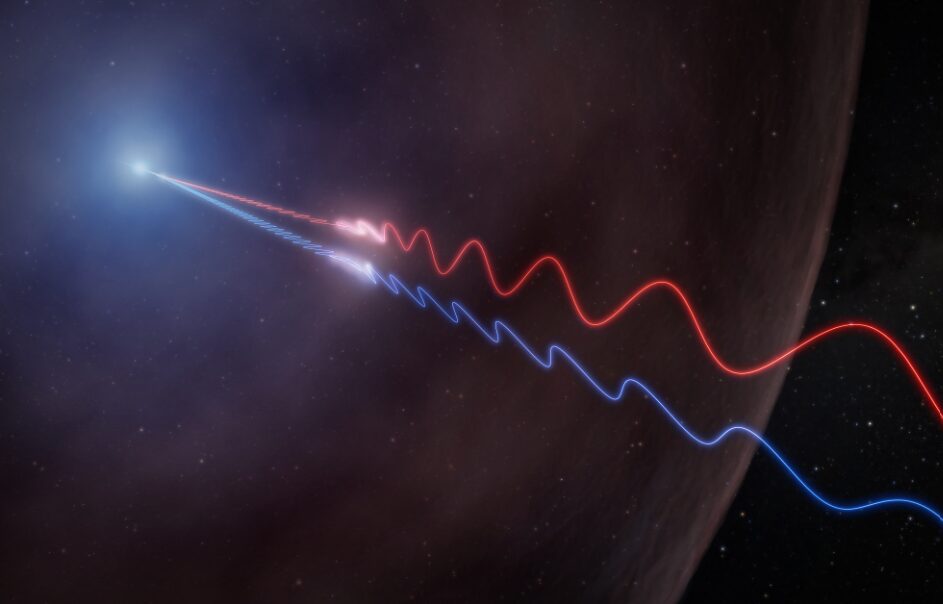
Credit: NSF/AUI/NSF NRAO/M.Weiss
Astronomers have made a series of landmark observations of one of the universe’s most violent events. Using the U.S...
Read More


Until we recognize the essential role of biology, our attempts to truly unify the universe will remain a train to nowhere. ~Robert Lanza Read More

Good health is not something we can buy. However, it can be an extremely valuable savings account. ~Anne Wilson Schaef Read More

The only way forward, if we are going to improve the quality of the environment, is to get everybody involved. ~Richard Rogers Read More

To raise new questions, new possibilities, to regard old problems from a new angle, requires creative imagination and marks real advance in science. ~Albert Einstein Read More

Old Newtonian physics claimed that things have an objective reality separate from our perception of them. Quantum physics, and particularly Heisenberg's Uncertainty Principle, reveal that, as our perception of an object changes, the object itself literally changes. ~Marianne Williamson Read More

Astronomy compels the soul to look upwards and leads us from this world to another. ~ Read More
July 15, 2026,
 Astronomy/Space
Astronomers have made a series of landmark observations of one of the universe’s most violent events. Using the U.S...
Read More
July 14, 2026,
Uncategorized
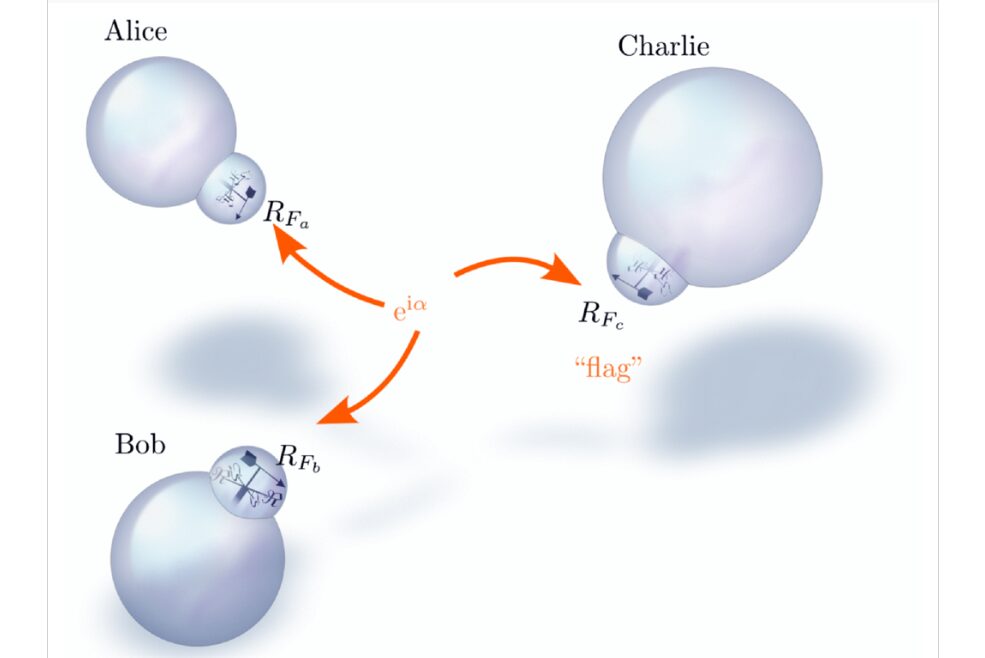
Physicists from Heinrich Heine University Düsseldorf (HHU) have examined a fundamental property of quantum mechanics in collaboration with the German Aerospace Center (DLR). In the scientific journal Physical Review Letters, they show that this theory does not necessarily need to be formulated with imaginary numbers – real numbers can in fact also be used.
Quantum mechanics is the branch of physics that explains how matter and energy behave at the atomic and subatomic scale. Developed in the early 1900s by pioneers including Max Planck, Niels Bohr, Werner Heisenberg, and Erwin Schrödinger, it has become one of the most successful scientific theories ever created.
The theory accurately describes a wide range of microscopic phenomena...
Read More
Shielding astronauts from the deadly radiation they face is a central challenge for any designer of a deep-space crewed mission. Even relatively low levels of exposure over long periods can lead to everything from central nervous system damage to cancer. But current solutions, such as passive water shells or active superconducting magnets, have their own limitations. To get around those, a new paper, available in preprint on arXiv by Valerio Parisi and a team of researchers from Italy and Germany, looks at the feasibility of using a permanent magnet (and its associated permanent magnetic field) to potentially block some of that radiation without the costs of competing technologies.
First, let’s l...
Read More
July 13, 2026,
Health/Medical, Biology/Biotechnology

Some people find it useful to talk through their problems—but language isn’t necessary for logical reasoning, cognitive neuroscientists at MIT’s McGovern Institute for Brain Research say.
In research published in the journal PNAS, researchers led by MIT associate professor of brain and cognitive sciences Evelina Fedorenko have shown that people can perform well on tasks that require logical reasoning even if their language abilities are severely impaired. What’s more, brain imaging shows that language-processing parts of the brain are not called on for logical reasoning.
Philosophers, linguists an...
Read More
Recent Comments