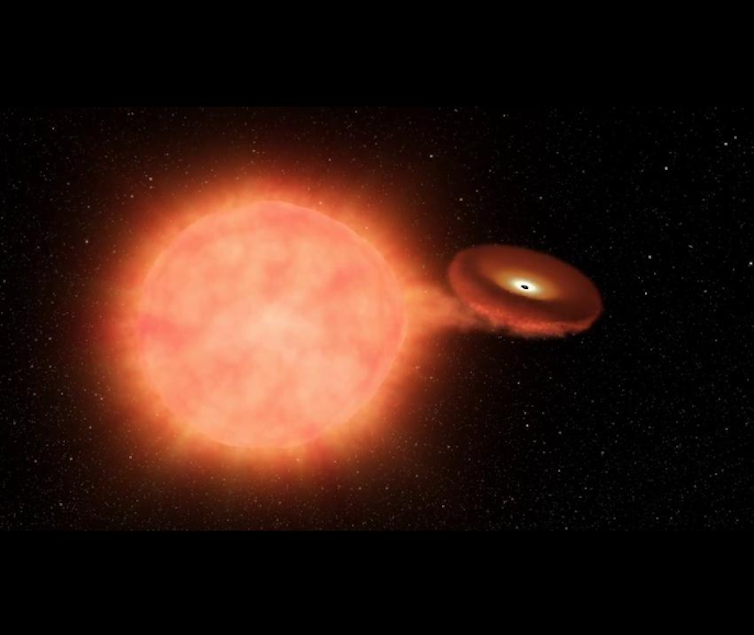
A Giant Black Hole Destroys a Massive Star

Earlier this year, another team of astronomers reported the “Scary Barbie” event where they estimated a star with about 14 times the mass of the sun was destroyed by a black hole. However, this has not yet been confirmed as a tidal disruption, with the estimate of the star’s mass mainly based on the brightness of the flare, not on a detailed analysis of material around the black hole as with ASASSN-14li.

Another exciting aspect of the ASASSN-14li result is what it means for future studies. Astronomers have seen moderately massive stars like ASASSN-14li’s in the star cluster that contains the supermassive black hole in the center of our galaxy...

Read More

Simple Blood Test may Predict Future Heart, Kidney Risk for people with Type 2 Diabetes

blood draw - man
blood draw – man
copyright American Heart Association

An analysis of a clinical trial of more than 2,500 people with Type 2 diabetes and kidney disease found that high levels of four biomarkers are strongly predictive for the development of heart and kidney issues.

A simple blood test may predict the risk of progressive heart and kidney disease in people with Type 2 diabetes and kidney disease, according to new research published today in the American Heart Association’s flagship journal Circulation.

“High levels of certain biomarkers are indicators of heart and kidney complications and may help predict future risk of disease progression,” said lead author James Januzzi, M.D...

Read More

Move over Lithium-ion: Zinc-air Batteries a Cheaper and Safer Alternative

This is a rechargeable zinc-oxide battery in a tri-electrode configuration with cobalt-oxide/carbon nanotube and iron-nickel/layered double hydroxide catalysts for charge and discharge, respectively

A new, superior alternative has emerged in the world of sustainable battery systems. Zinc-air batteries have emerged as a better alternative to lithium in a recent Edith Cowan University (ECU) study into the advancement of sustainable battery systems.

ECU’s Dr Muhammad Rizwan Azhar led the project which discovered lithium-ion batteries, although a popular choice for electric vehicles around the world, face limitations related to cost, finite resources, and safety concerns.

“Rechargeable zinc-air batteries (ZABs) are becoming more appealing because of their low cost, environmental frie...

Read More

Webb reveals Intricate Details in the Remains of a Dying Star

Side-by-side images of the Ring Nebula where the nebula appears as a distorted doughnut. On the right, the nebula’s inner cavity hosts shades of blue and green, while the detailed ring transitions through shades of orange in the inner regions and pink in the outer region. On the left, the nebula’s inner cavity hosts shades of red and orange, while the detailed ring transitions through shades of yellow in the inner regions and blue/purple in the outer region. The ring’s inner region has distinct filament elements.
New images from NASA’s James Webb Space Telescope of the well-known Ring Nebula provide unprecedented spatial resolution and spectral sensitivity. In the NIRCam (Near-Infrared Camera) image on the left, the intricate details of the filament structure of the inner ring are particularly visible in this dataset. On the right, the MIRI (Mid-InfraRed Instrument) image reveals particular details in the concentric features in the outer regions of the nebulae’s ring. Download the full-resolution NIRCam image and the full-resolution MIRI image from the Image gallery. Credit: ESA/Webb, NASA, CSA, M. Barlow (University College London), N. Cox (ACRI-ST), R. Wesson (Cardiff University).

NASA’s James Webb Space Telescope obtained images of the Ring Nebula, one of the best-known examples of a pla...

Read More