New Clues on the Source of the Universe’s Magnetic Fields

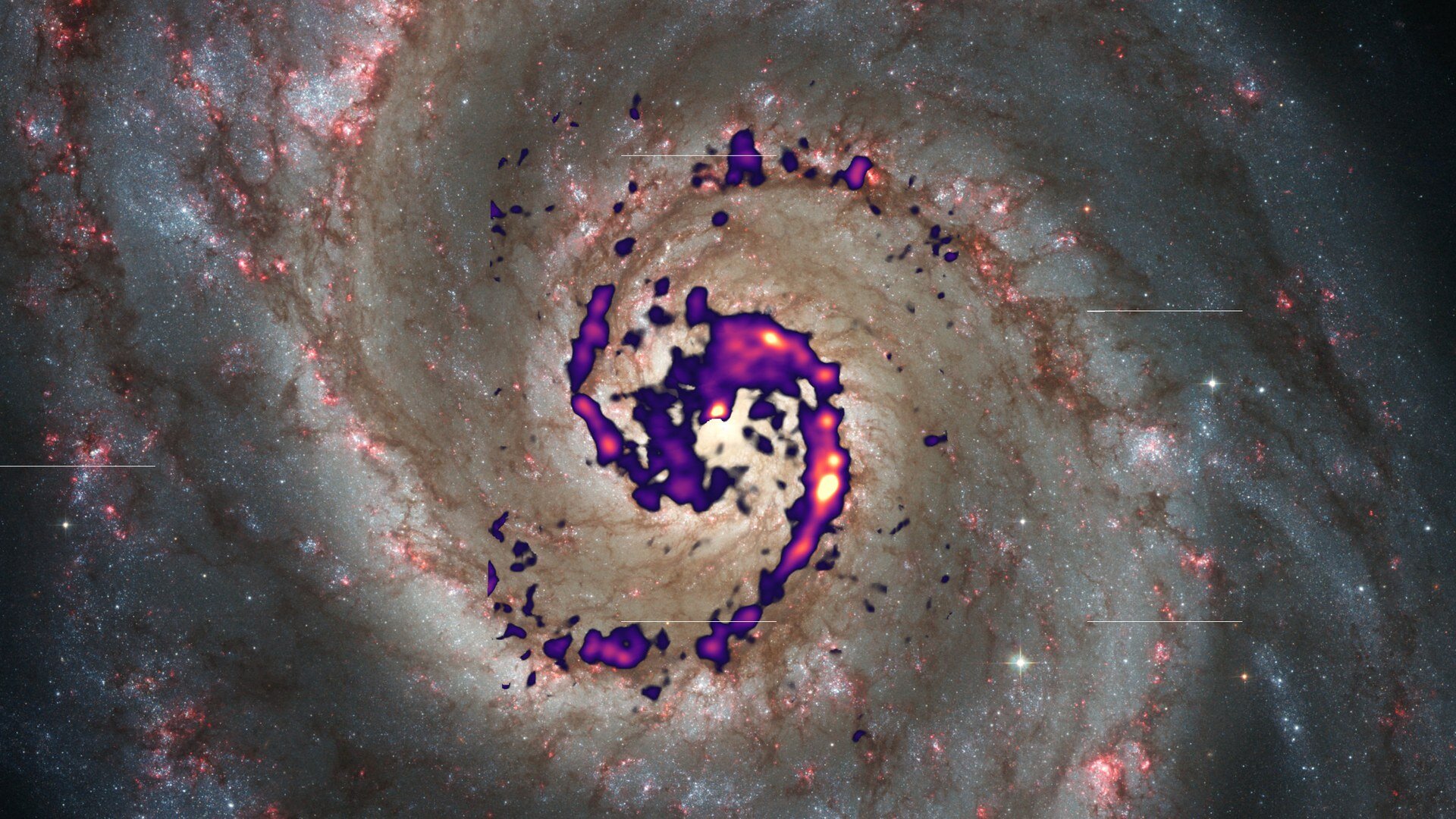
The magnetic field in the Whirlpool Galaxy (M51), captured by NASA's flying Stratospheric Observatory for Infrared Astronomy (SOFIA) observatory superimposed on a Hubble telescope picture of the galaxy. The image shows infrared images of grains of dust in the M51 galaxy. Their magnetic orientation largely follows the spiral shape of the galaxy, but it is also being pulled in the direction of the neighboring galaxy at the right of the frame.

The source of magnetic fields has long been debated: New research offers clues on their origins. It isn’t just your refrigerator that has magnets on it. The earth, the stars, galaxies, and the space between galaxies are all magnetized, too. The more places scientists have looked for magnetic fields across the universe, the more they’ve found them. But the question of why that is the case and where those magnetic fields originate from has remained a mystery and a subject of ongoing scientific inquiry.

A new paper by Columbia researchers offers insight into the source of these fields. The team used models to show that magnetic fields may spontaneously arise in turbulent plasma...

Read More

Scrambler Therapy may offer Lasting Relief for Chronic Pain, review paper suggests

Cancer
Scrambler therapy used for a patient with chemotherapy-induced peripheral neuropathy. The red bursts represent areas where the patient is experiencing pain. Credit: Photo courtesy of Thomas Smith

A new review paper co-authored by two Johns Hopkins pain experts suggests that scrambler therapy, a noninvasive pain treatment, can yield significant relief for approximately 80%-90% of patients with chronic pain, and it may be more effective than another noninvasive therapy: transcutaneous electrical nerve stimulation (TENS). The write-up was published online July 13 in The New England Journal of Medicine.

Scrambler therapy, approved by the U.S...

Read More

Engineers create an Energy-Storing Supercapacitor from Ancient Materials

A streak of blue lightning, representing energy, spreads horizontally across a textured cement surface.
MIT engineers have created a “supercapacitor” made of ancient, abundant materials, that can store large amounts of energy. Made of just cement, water, and carbon black (which resembles powdered charcoal), the device could form the basis for inexpensive systems that store intermittently renewable energy, such as solar or wind energy.
Credits:Courtesy of the researchers

Made of just cement, water, and carbon black (which resembles powdered charcoal), the device could form the basis for inexpensive systems that store intermittently renewable energy, such as solar or wind energy.

Two of humanity’s most ubiquitous historical materials, cement and carbon black (which resembles very fine charcoal), may form the basis for a novel, low-cost energy storage system, according to a new study...

Read More

New Algorithm Ensnares its First ‘Potentially Hazardous’ Asteroid

Image showing the orbit of 2022 SF289 (green) at its closest approach to Earth (orbit in blue). Orbits of Venus and Mars are shown in orange and red, respectively.Joachim Moeyens/University of Washington/OpenSpace

An asteroid discovery algorithm – designed to uncover near-Earth asteroids for the Vera C. Rubin Observatory’s upcoming 10-year survey of the night sky – has identified its first “potentially hazardous” asteroid, a term for space rocks in Earth’s vicinity that scientists like to keep an eye on. The roughly 600-foot-long asteroid, designated 2022 SF289, was discovered during a test drive of the algorithm with the ATLAS survey in Hawaii...

Read More