To raise new questions, new possibilities, to regard old problems from a new angle, requires creative imagination and marks real advance in science.
~Albert Einstein
Read More
Old Newtonian physics claimed that things have an objective reality separate from our perception of them. Quantum physics, and particularly Heisenberg's Uncertainty Principle, reveal that, as our perception of an object changes, the object itself literally changes.
~Marianne Williamson
Read More
Phenomena called ‘Steve’ and ‘picket fence’ are masquerading as auroras, graduate student argues
The purple and white emissions at the top are referred to as “Steve,” while the green emissions are called “picket fence.” The rare phenomena, which are distinct from the typical aurora, often occur together and may be caused by similar conditions at the edge of space. The photo was taken looking south over Berg Lake toward Mt. Robson in the Canadian Rockies, British Columbia, Canada. Courtesy of Robert Downie, robertdowniephotography.com
While auroras occur at high latitude, the associated phenomena Steve and the picket fence occur farther south and at lower altitude. Their emissions also differ from aurora...
A University of Michigan-led study based on a review of genetic and health information from more than 276,000 people finds strong support for a decades-old evolutionary theory that sought to explain aging and senescence.
In 1957, evolutionary biologist George Williams proposed that genetic mutations that contribute to aging could be favored by natural selection if they are advantageous early in life in promoting earlier reproduction or the production of more offspring. Williams was an assistant professor at Michigan State University at the time.
Williams’ idea, now known as the antagonistic pleiotropy theory of aging, remains the prevailing evolutionary explanation of senescence, the process of becoming old or aging...
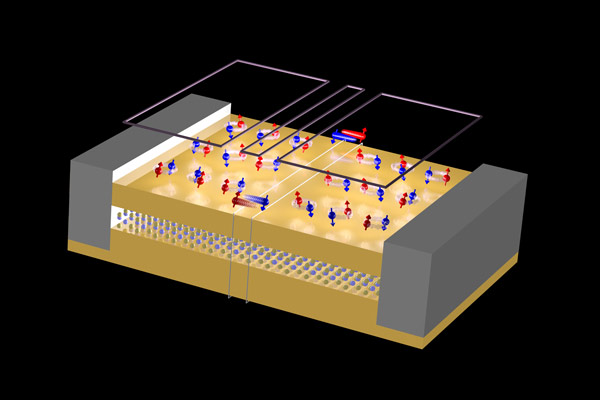
Physicists at RIKEN have developed an electronic device that hosts unusual states of matter, which could one day be useful for quantum computation.
When a material exists as an ultrathin layer—a mere one or a few atoms thick—it has totally different properties from thicker samples of the same material. That’s because confining electrons to a 2D plane gives rise to exotic states...
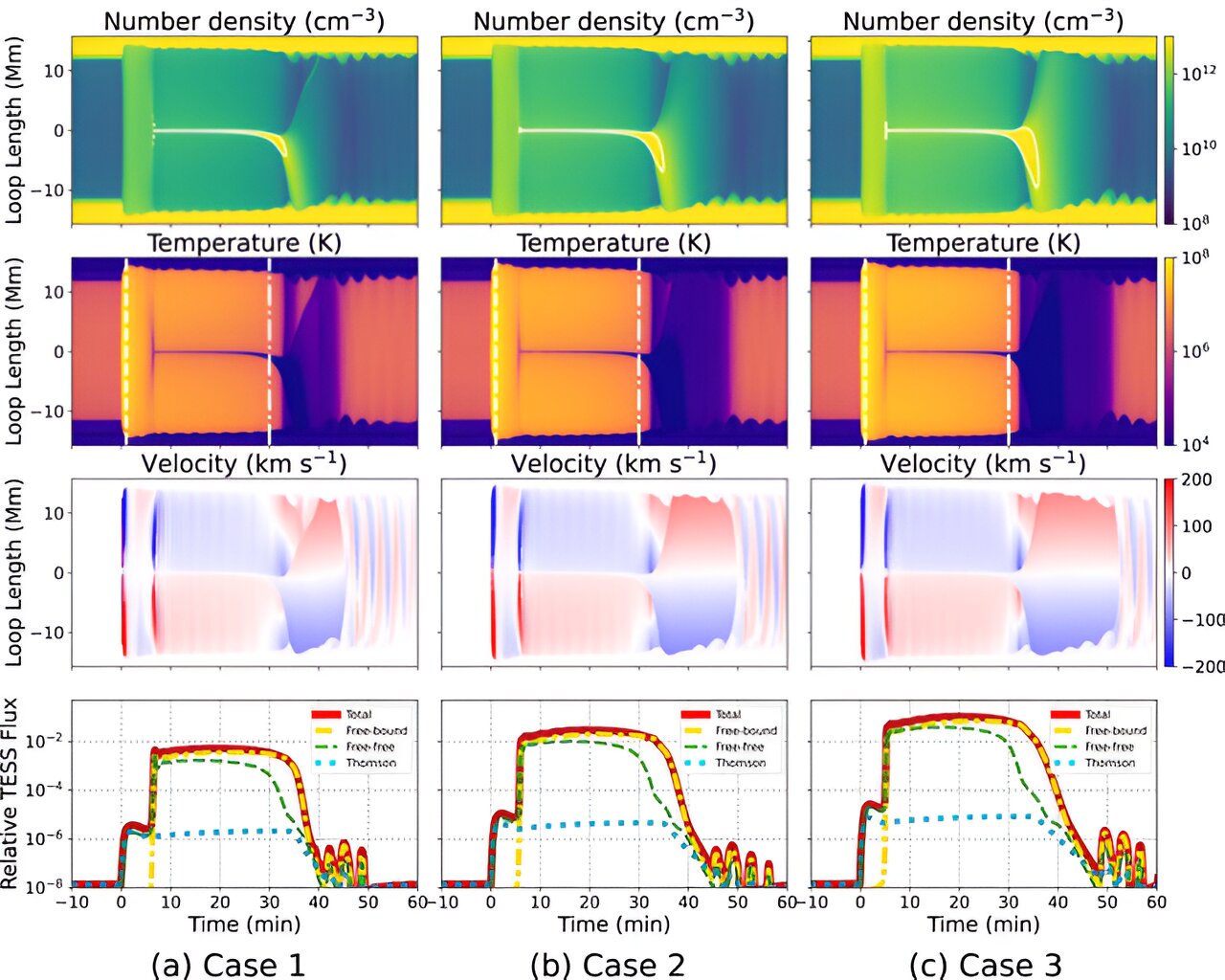
Modeled flare atmosphere and synthesized TESS light curves. Credit: The Astrophysical Journal (2023). DOI: 10.3847/1538-4357/ad077d
Our sun actively produces solar flares that can impact Earth, with the strongest flares having the capacity to cause blackouts and disrupt communications—potentially on a global scale. While solar flares can be powerful, they are insignificant compared to the thousands of “super flares” observed by NASA’s Kepler and TESS missions. “Super flares” are produced by stars that are 100–10,000 times brighter than those on the sun.
The physics are thought to be the same between solar flares and super flares: a sudden release of magnetic energy...











Recent Comments