THC use during Pregnancy linked to Changes in Fetal Development

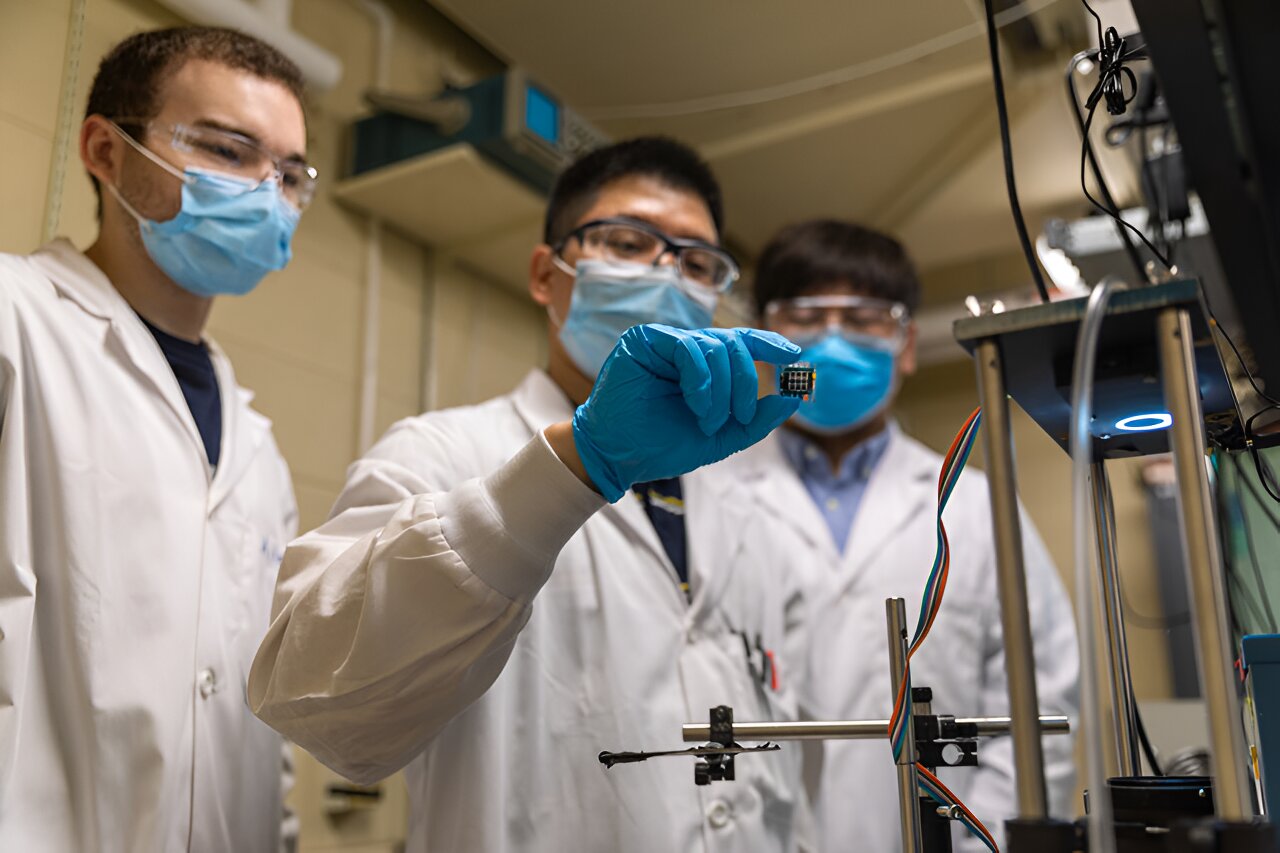
A pregnant person sits in a doctor's office while the doctor asks questions from a clipboard. OHSU researchers in a preclinical study confirm consuming THC while pregnant could potentially affect the development of the fetus and lead to life-long health impacts for offspring. (Getty Images)
OHSU researchers in a preclinical study confirm consuming THC while pregnant could potentially affect the development of the fetus and lead to life-long health impacts for offspring. (Getty Images)

Oregon Health & Science University researchers showed that consuming THC while pregnant could potentially affect development of the fetus and lead to life-long health impacts for offspring.

The preclinical study was published today in the journal Clinical Epigenetics.

Delta-9-tetrahydrocannabinol, or THC, is the main psychoactive ingredient in cannabis, a substance growing in popularity and availability in the United States...

Read More

Testing Real Driverless Cars in a Virtual Environment

Testing real driverless cars in a virtual environment
Public road development of AV driving functions. Credit: Sensors (2023). DOI: 10.3390/s23115088

In an empty parking lot, a car ‘thinks’ it is on a real road.

Researchers at The Ohio State University have developed new software to aid in the development, evaluation and demonstration of safer autonomous, or driverless, vehicles.

Called the Vehicle-in-Virtual-Environment (VVE) method, it allows the testing of driverless cars in a perfectly safe environment, said Bilin Aksun-Guvenc, co-author of the study and a professor of mechanical and aerospace engineering at Ohio State.

Imagine a driverless car is placed in the middle of an empty parking lot...

Read More

Why the day is 24 hours long: Astrophysicists reveal why Earth’s Day was a Constant 19.5 hours for over a Billion Years

The earth with a thermometer beside it - temps rising!
The rise in temperature of our atmosphere due to global warming has the potential to increase the atmospheric solar tides and slow the Earth’s rotation. Image: Â© iStock | narith_2527.

Result sheds new light on how climate change will affect the length of the day and validity of climate modelling tools. A team of astrophysicists at the University of Toronto (U of T) has revealed how the slow and steady lengthening of Earth’s day caused by the tidal pull of the moon was halted for over a billion years.

They show that from approximately two billion years ago until 600 million years ago, an atmospheric tide driven by the sun countered the effect of the moon, keeping Earth’s rotational rate steady and the length of day at a constant 19.5 hours.

Without this billion-year pause in th...

Read More

Quasar ‘Clocks’ show the Universe was Five Times Slower Soon after the Big Bang

Scientists have for the first time observed the early universe running in extreme slow motion, unlocking one of the mysteries of Einstein’s expanding universe. The research is published in Nature Astronomy.

Einstein’s general theory of relativity means that we should observe the distant—and hence ancient—universe running much slower than the present day. However, peering back that far in time has proven elusive. Scientists have now cracked that mystery by using quasars as “clocks.”

“Looking back to a time when the universe was just over a billion years old, we see time appearing to flow five times slower,” said lead author of the study, Professor Geraint Lewis from the School of Physics and Sydney Institute for Astronomy at the University of Sydney.

“If you were there, in...

Read More