Superlensing Without a Super Lens: Physicists Boost Microscopes beyond limits

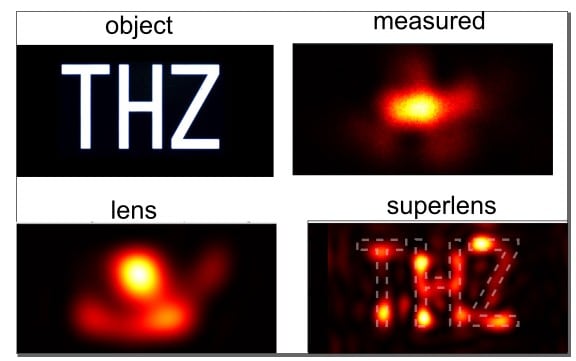
Scientists used a new superlens technique to view an object just 0.15 millimetres wide using a virtual post-observation technique. The object ‘THZ’ (representing the ‘terahertz’ frequency of light used) is displayed with initial optical measurement (top right); after normal lensing (bottom left); and after superlensing (bottom right).

Ever since Antonie van Leeuwenhoek discovered the world of bacteria through a microscope in the late seventeenth century, humans have tried to look deeper into the world of the infinitesimally small.

There are, however, physical limits to how closely we can examine an object using traditional optical methods. This is known as the diffraction limit and is determined by the fact that light manifests as a wave...

Read More
Protostars can Siphon Material from Far Away, says study

Protostars can siphon material from far away
This artist’s conception shows a newly formed protostar surrounded by a swirling protoplanetary disk of dust and gas. Credit: University of Copenhagen/Lars Buchhave

When stars are born, they do it inside a molecular cloud. Astronomers long assumed that the “crèche” supplied all the nutrients that protostars needed to form. However, it turns out they get help from outside the nest.

A new study published in the journal Astronomy & Astrophysics by scientists at the Max Planck Institute for Extraterrestrial Physics delved into the role of streamers and filaments in the star-birth process. Think of them as channels that extend out from the interior of the stellar creche, sometimes out as far as 10,000 astronomical units (about 0.15 light-years)...

Read More

Boosting Weak Immune System: Scientists find an unusual weapon against Virus

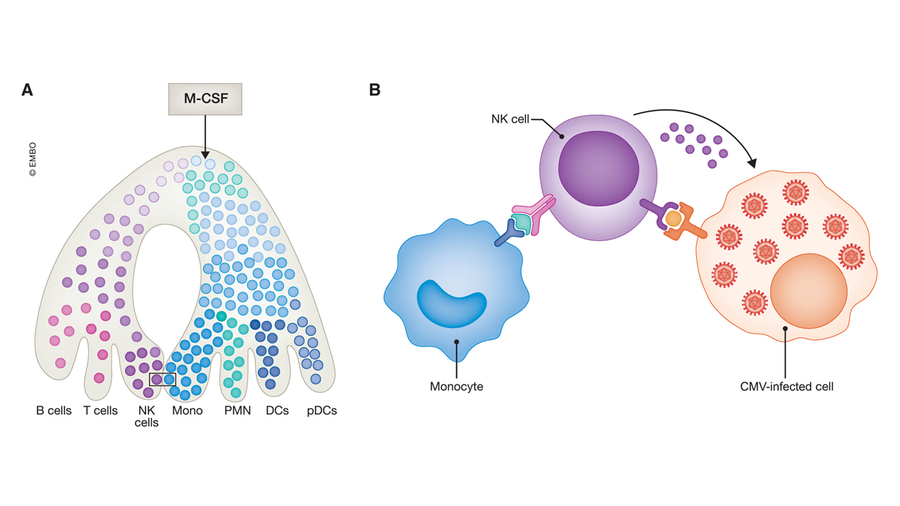
An overview of how the method proposed by the Sieweke group boosts weak immune system. (A) M-CSF cytokine works in the bone marrow to promote generation of monocytes and macrophages, without disturbing the formation of other immune cells; (B) Monocytes and macrophages activate natural killer cells to enable them to target virus-infected cells and kill them through cell–cell contact and the release of toxic agents.

Infections with cytomegalovirus (CMV) are extremely common and often pose no major threat to the vast majority of people. They can however be deadly for people whose immune system is weakened, e.g., after bone marrow transplantation. Current treatments against CMV infections are very limited and can have severe side effects. Researchers led by Prof...

Read More

Harnessing Molecular Power: Electricity Generation on the Nanoscale

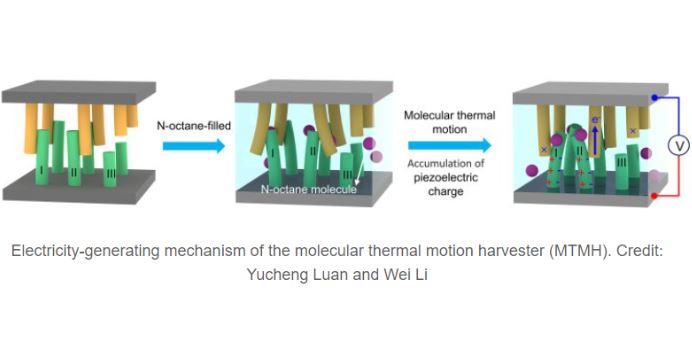
There is power in numbers when generating electricity from the movement of molecules. Researchers tested a molecular energy harvesting device that captures the energy from the natural motion of molecules in a liquid. Their work showed molecular motion can be used to generate a stable electric current. To create the device, they submerged nanoarrays of piezoelectric material in liquid, allowing the movement of the liquid to move the strands like seaweed waving in the ocean, except in this case the movement is on the molecular scale, and the strands are made of zinc oxide. When the zinc oxide material waves, bends, or deforms under motion, it generates electric potential.

Wave energy technology is a proven source of power generation, but there is power inherent in every molecule of l...

Read More